A Response to TIME Magazine’s Mark Thompson

Veterans-Day

By Mike Cronin

Writing for TIME magazine, Mark Thompson asks: Are U.S. Veteran’s Selfish?  

In the article, he argues that since veterans have received substantial pay and benefit increases since 9/11, they should not be so testy about recent cuts to the cost-of-living raises for retirees and proposed cuts to commissary subsidies.  I wrote the following response: (full disclosure: I am a military retiree).

Veterans aren’t selfish for wanting to keep the benefits they were promised and that they earned with their blood and sacrifice, anymore than any civilian corporate employee is selfish if they get upset when their company unilaterally cuts pay and/or benefits. Veterans understand the need for cuts and savings; they simply demand that ways be found to do it honorably. Regardless of how military compensation has increased over the last decade (those increases were meant to close a significant pay gap, by the way), there is no moral justification for reducing promised compensation to those who held up their end of the bargain. If cuts to military pay and benefits must be accomplished, it would be moral to make new promises to new troops (before they sign on the bottom line), but cuts could also come from other sources that are, at the moment, off the table.

We are in the current predicament because Congress has boxed the military in by not allowing more strategically considered fiscal savings, such as a round of stateside and/or overseas base closures, or cancellation of major weapons systems.  It’s simply not politically expedient for an elected official to face their constituents and tell them the base is closing or that they won’t be needed to build ships, tanks, or fighters.

That political expediency is further exposed by Congress’ refusal to reign in the Fed’s “qualitative easing” to the tune of $85 billion per month. If we need to make spending cuts so bad, (and we do) how about we start by picking the ridiculously-low hanging fruit first and turn off the free-money tsunami?

So Mr. Thompson: who is really selfish?  The vets who more than earned what they were promised through their sacrifices, or the politicians who make empty promises and no sacrifices at all?

Read more: Veterans fighting benefit cuts sought by Congress and the Pentagon | TIME.com http://swampland.time.com/2014/01/26/are-u-s-veterans-selfish/#ixzz2rf7JYtI5

Your Income: Earned or Distributed?

tumblr_mht7sopr8g1qg4lyzo1_1280

By Mike Cronin

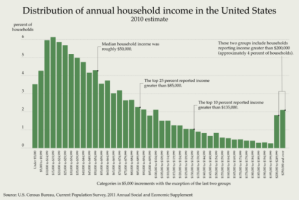
When you received your pay check, was it because you earned it by trading your time and skill for money, or because it was just “distributed” to you?  I suspect you answered that you earned it. Most of us do. That’s why talk about the vast “income inequality” in our country can be very misleading.

When a statistician talks about income distribution, he or she is referring to how income brackets fit in a bell curve, like in the chart above.  When a politician or a pundit talks about income or wealth distribution, we are supposed to just act as if our money has been unfairly distributed and not earned, and  certain adjustments are necessary to make things “fair.”  These adjustments take the form of taxes, if you “received” too much, or hand outs and benefits, if you “received” too little.

The statisticians’ usage of the term distribution is neither bad nor good, it’s just math. The politicians’ and pundits’ usage of the term distribution is insidious, because it sounds so fair, but it drops contexts in at least two ways.  Every dollar that is “given” by the politicians to those who didn’t have “enough” income “distributed” to them, either:

  1. Had to be taken away from those who had produced it, then “redistributed” to the “have nots;”
  2. or, it had to be minted, printed, or digitally conjured up out of thin air and “pumped” or “quantitatively eased” into the economy.

The first is literal and direct theft (though we call it income taxes) and the latter is indirect theft, because it steals value from our existing money. (Full disclosure: I work for the government, so almost my entire income during my working life has come from your taxes – and my own. The part of the government I work for is clearly derived from the enumerated powers in the Constitution, and I favor The Fair Tax vice the confiscatory taxation system we have today. Decide for yourself whether I am a hypocrite. The thought has given me pause from time-to-time.)

So, statistically speaking, we have a vast disparity between the highest income earners and the lowest. That does not mean income distribution is unfair, because it does not mean that the “haves” with huge incomes somehow just got lucky and received an unfairly large distribution of money. Maybe they earned it, maybe they inherited it, maybe they embezzled it. The fact that they have It is not proof that they got it unfairly. Likewise, the fact that “have nots” at the low end of the income bell curve don’t have more doesn’t mean that they have somehow been cheated. Perhaps it means that they can work hard, gain skills, and climb into higher income brackets.

The Deficit, the Debt, and Unfunded Liabilities

images (1)

By Mike Cronin

You’ve heard politicians say we need to increase taxes on the wealthiest Americans. You may have also heard other politicians say our government is spending too much, because we have such a high national debt. Then, invariably, the first group of politicians will respond that they’ve cut the deficit. So how can the debt go up, when the deficit is coming down? What’s the difference?

The deficit is the amount the government has spent over and above what it has taken in during the current fiscal year. For 2013, that amount was over 1/2 trillion dollars. The national debt is the total amount of money, from all years, that the government owes to those from whom it has borrowed (namely US and foreign banks). This number is somewhere around 17 trillion dollars. That’s 17 thousand billion, or 17 million million. Written out, that’s $17,000,000,000,000. Because the deficit is overspending, whenever we have a deficit, any deficit, the debt will go up…even if the deficit is smaller than the previous year. A reduction in deficit spending doesn’t mean the government got it’s financial affairs in order, it just means they slowed down the overspending a little. in fact, the debt can go up even if we have zero deficit in a given year, because the interest on the debt keeps it growing.

If those facts & figures aren’t shocking enough, there is another number we must consider, but you almost never hear about it in the news. That figure represents the unfunded liabilities of the government.  That’s the amount of money it will take to pay for all of the benefits and entitlement payments the government has promised to pay in the future, such as Social Security and Medicare, to people who aren’t old enough, or otherwise eligible, to receive them now. That number is estimated to be anywhere from 55 trillion to 222 trillion dollars, depending on who is doing the estimating and what is included.   That is more than the gross national product of all of the countries in the world, combined.  In other words, our government has overspent, or will overspend, more money now and in the future than the total economic output generated by the entire world!

So, do you think  we have a revenue problem, or a spending problem?

Deficit: What the government overspent in fiscal year 2013 (about $700 billion, according to the US Treasury Dept.)

Debt: What the government has overspent in total (about $17 trillion)

Unfunded Liabilities: What the government has promised to pay in the future over and above what it is projected to take in ($55-222 trillion)

Cost, Price, and Value

Value-Cost-Price (2)

By Mike Cronin

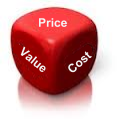
One of the ways some businesses try to do your thinking for you is through misuse of the word “value.” Have you ever seen an advertisement that says something along the lines of “Item X, normally a $200.00 value, now just $149.99?”  Well, the company is trying to tell you what the value of the item is, and that they are selling it at less than that. You’re supposed to think: “Wow, what a bargain! Let me run right out and get one!”  The problem:  Value is subjective, and it’s not determined by the business, it’s determined by you.  If you don’t want that item, it has no value to you at all. If you want it so bad that you would pay twice as much as they are asking, it has great value to you.  Advertising often tries to blur the line between “price” and value.  Price is the amount the business charges for their product. In some cases, price is negotiable, such as when purchasing a car, a home, or a used item at a garage sale.  Sometimes price is not negotiable, such as for most groceries or on-line purchases.  Cost is the total amount of money, in design, labor, time, effort, parts, materials, energy, infrastructure, management, marketing, advertising, sales, transportation, etc. that the business had to spend in order to grow, obtain, or make the thing they are selling. In order for a business to make a profit, the amount of money they take in from sales has to exceed their total costs. In short:

Price – how much the business is charging

Cost – how much the business had to spend

Value – how much it’s worth to you