Ten Observations on Election 2016

hillary-clinton-supporters-cry-over-election-loss

By Mike Cronin

Donald Trump’s victory certainly stirred up a lot of clamor and noise this week.  Let’s see if we can herd some of the cats:

  1. Democracy has failed. The people chose Hillary Clinton by 200,000 votes, but the electoral victory went to Trump. Our “democracy” cannot fail if we don’t have one, which is in fact the case. We were given a federalist republic under the rule of law. We use democratic processes for some decisions to give the people a voice, but we are not supposed to have a system of straight-up majority rule. As to the electoral vote: It remains to be seen whether any electors will “go rogue” and vote against their “pledge” on Dec 19th, but it has happened before (as recently as 2004).  Of course, it’s never been by enough margin to change the outcome of an election.  In this case, at least 38 would have to be “faithless electors” to get Clinton to 270.
  2. Trump hates immigrants. He hates Mexicans. He hates Muslims. He’s racist.  We’ll, he might. Only he knows for sure.  However, he is married to an immigrant and he has people from all walks of life working for him.  He certainly doesn’t think people should be here illegally, which is not the same thing as hating the people who are or the people who want to be.
  3. Trump is a misogynist sexual predator. His caught-on-camera crudities certainly lend themselves to this narrative. There’s little actual evidence and no credible accusers that demonstrate he hates all women or has assaulted any of them, but Trump’s verbal vulgarity in this area is one of the most troubling things about him. Still, while Trump has been caught speaking like a sexual predator might; Hillary Clinton continues to aid and abet one.
  4. Trump is going to destroy all of the progress progressives have made over the last eight years. Possibly, but presidents seldom accomplish their full agendas.  Yes, Trump will have a Republican-majority Congress, but it won’t be a super-majority, and the Republican establishment doesn’t like him.  Trump bills himself as a deal maker.  He’ll have to be to get his agenda anywhere.
  5. Trump is going to elevate nationalism over globalism. Both are euphemisms for collectivism; only the boundaries are different. Neither is as good for individuals as unfettered free market capitalism.  There might possibly be temporary beneficial effects for Americans in the shift, especially if our troops come home and small businesses can thrive again.
  6. Trump is an idiot/outsider/politically inexperienced. He certainly does not articulate himself with Obama’s grace, but he is no dummy. In fact, he’s likely quite adept at persuasion (see items five and six on this list). He is certainly gifted at getting free publicity (or at least notoriety) from the very mass-media that hates him. Also, his lack of political experience, i.e. his NOT being a career politician or D.C. insider, is one of the fundamentals that led him to get elected.
  7. What happened with the polls? They consistently gave Clinton the edge! Bottom line: garbage in/garbage out.  The pollsters drew their samples from the same body of “likely voters” they always used, and in some cases “oversampled” Democrats.  The former was neglectful and led to the Democrats believing in their own invulnerability; the latter was a nefarious attempt to convince would-be Trump voters to stay home on Election Day. Once exposed, the revelation likely caused the exact opposite effect. Either way, the pollsters failed to obtain accuracy because they could not, or would not, sample validly.  
  8. FBI Director Comey’s shenanigans (i.e. his announcements regarding the on-again/off-again investigation into Clinton’s email debacle vis-à-vis Huma Abedin’s laptop) comprised the quintessential October Surprise, and it hurt Clinton. It certainly didn’t help, but it’s much more likely that Clinton’s shenanigans hurt Clinton.
  9. Why were Clinton and Trump our candidates? What secret weapon did they employ that none of their competitors had? 30-plus years of universal name recognition.
  10. What does it mean that Republicans gained more seats in Congress, strengthening their majority? They didn’t get a super majority, so there are a few (rare) actions they would have to earn Democratic support for in order to act: Impeaching the president and overriding his vetoes are two such cases. 2. Republicans will get to shape the Supreme Court for the next generation. 3. Republicans now have an opportunity to reverse much of the Democrats’ work over the last eight years. Whether they will actually do so, or get complacent and/or get caught up with internal divisions remains to be seen.

RIGOROUS RED OR BOGUS BLUE, PT III

87971b3eb353cf89fdefdd9941bb76bb

By Mike Cronin

The focus of the last two posts was on the “blue pill” as it regards our “progressive” education system.  I have written several previous posts dealing with political prescriptions for “blue pill” thinking.  The imagery and tone of those pieces and this one may lead you to assumes I am associating all things “blue pill” with liberal/Democrat/ “blue state” politics, and red pill rigor with Republican/conservative/”red state” politics.

You would only be partially right.  Our education and media elite are certainly dominated by those who would prefer a tame, conditioned electorate, but that desire is not exclusive to the panoply of progressive poohbahs.  There is no shortage of conservatives/traditionalists that would like to impose their own brand of “blue pill” virtuality upon us using the existing, Prussian-model school system.  The pill would be “branded” quite differently, of course: Teaching of creationism/intelligent design as science and mandatory recitation of the pledge of allegiance (a loyalty oath) by children too young to understand the concept of total commitment are two ways that come readily to mind.

“In our secular society, school has become the replacement for church, and like church it requires that its teachings must be taken on faith.” ― John Taylor Gatto

So what can be done?  Ultimately, a “red pill” solution would entail the separation of school and state, in the same way and for the same reasons we have separation of church and state.

Whoa! How can you say such a thing, Cronin?!  If we don’t have public education, we’ll have a bunch of uneducated kids running around that can’t think critically, getting into mischief and gangs and criminal conduct! We won’t be competitive in the global market!

How would that be different than what we have now?

Believe it or not, before the imposition of public schooling, and especially the Department of Education, the literacy rate in this country was actually higher than it is now across many demographic groups. (Admittedly, that is a tough comparison to accept. It requires that one omit slaves from the calculation, for instance, as the first public schools appeared while slavery was still legal; teaching slaves to read was often prohibited.)

I ask you: If a thing can be done privately, what business does the government have doing it?

But if we don’t have public education, won’t the private education system be just as much of a “blue pill?”

Unlikely. The key ingredients missing from education in a system monopolized by government are competition and choice. In a competitive education market, schools would have to meet their customers’ expectations or go out of business.  Good teachers would be highly sought after and well compensated.  Bad teachers could be fired. Government is force. Government performs exceedingly well where force is the required tool to solve a problem.  At best, government achieves a desultory mediocrity at everything else it does. Is force the correct tool to use to educate our children?

We are indoctrinated by a school system designed to mass-produce workers and consumers, “informed” by a mass media machine that continuously keeps us alarmed, and led by politicians whose only concern is getting elected or re-elected.  How could anything be wrong?

Rigorous Red or Bogus Blue? Part II

64555_333787396719890_1465346194_n

By Mike Cronin

Using the analogy of the Matrix movies, last week I posited that two philosophical traditions are vying for primacy over our minds.  One of them, the “blue pill,” offers a fantasy.  Conversely, “red pill” traditions require mental rigor.  They are not so easy to follow, but they flow from and describe the true nature of reality.

The most insidious facet of the “blue pill” is that it works best when it is proffered early in a child’s development…and its greatest efficacy lies in “armoring” the developing mind against the “red pill” before the child even knows there is an alternative. Our school system is the primary dosing mechanism for instilling “blue pill” thinking.

“Education is a system of imposed ignorance.”Noam Chomsky, Manufacturing Consent: The Political Economy of the Mass Media

How can that be? Our kids learn reading, math, and science, don’t they?  With those subjects, they are equipped to learn anything else, aren’t they?

Our schools certainly present those topics. It is in how they are presented that the crime lies. Our education system “standardizes” kids by teaching them facts and theories but neglecting context. It forces the “blue pill” on kids in several basic ways:

  • School as a state function, with attendance becoming compulsory.
  • Regimentation and Pavlovian conditioning (age segregation, dividing the day into lesson periods, sitting in rows, bells, uniforms, etc.)
  • Discouraging holistic comprehension by segmenting knowledge into disjointed subjects (reading, math, science, art, “social studies,” etc.) taught in incomprehensible order.
  • The “professionalization” of teaching. Aspiring teachers, themselves graduates (victims?) of the same system, are given to understand that it is their role to fill minds…instead of to remove obstacles and let young people be their own teachers. This lead to the decline of parent-as-mentor – and of kids who could already read before entering school at six or seven.
  • Employers and higher education institutions began demanding evidence that proved completion of the prescribed program (diplomas).

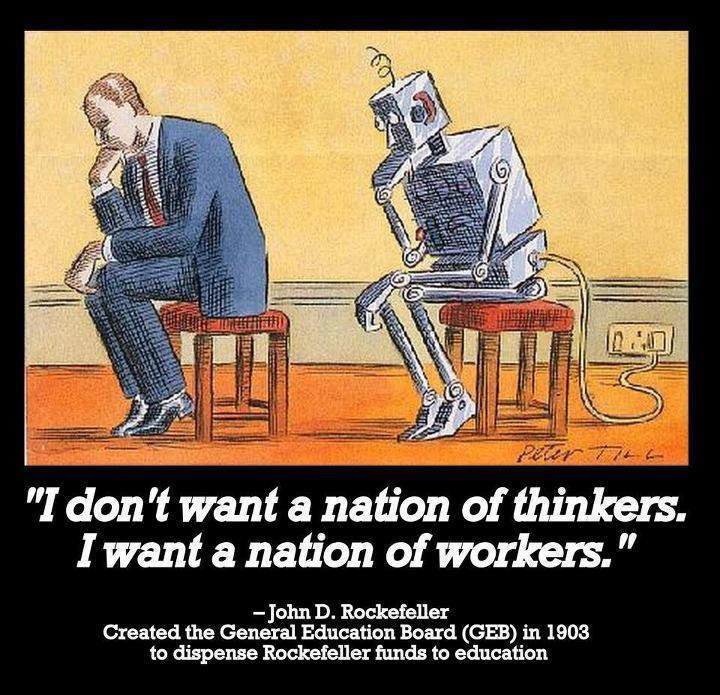
This model was imported from Prussia and/or instituted in the early-to-mid-1800s. The Prussians devised their system independent of any relationship to individual liberty or freedom.  The Prussian system had three tiers.  The vast majority (94%) of the population was to be adequately prepared to function and contribute, but not think for themselves or lead, at volksschulen.  The other 6%, those from elite families, were destined to rule or manage.  They received educations more geared to critical thinking.

In the US, the Prussian model was implemented in part to “Americanize” (i.e. instill WASP values in) the many Catholic immigrants coming in from Italy and Ireland.

According to former award-winning teacher turned public-school critic John Taylor Gatto:

“A small number of very passionate American ideological leaders visited Prussia in the first half of the 19th century; fell in love with the order, obedience, and efficiency of its education system; and campaigned relentlessly thereafter to bring the Prussian vision to these shores. Prussia’s ultimate goal was to unify Germany; the Americans’ was to mold hordes of immigrant Catholics to a national consensus based on a northern European cultural model. To do that, children would have to be removed from their parents and from inappropriate cultural influences.”

So, you know how we are often told that our kids are continually ranking lower on literacy and math than other developed nations, i.e. that our schools are failing?  That we must “invest” more public funding in the schools?

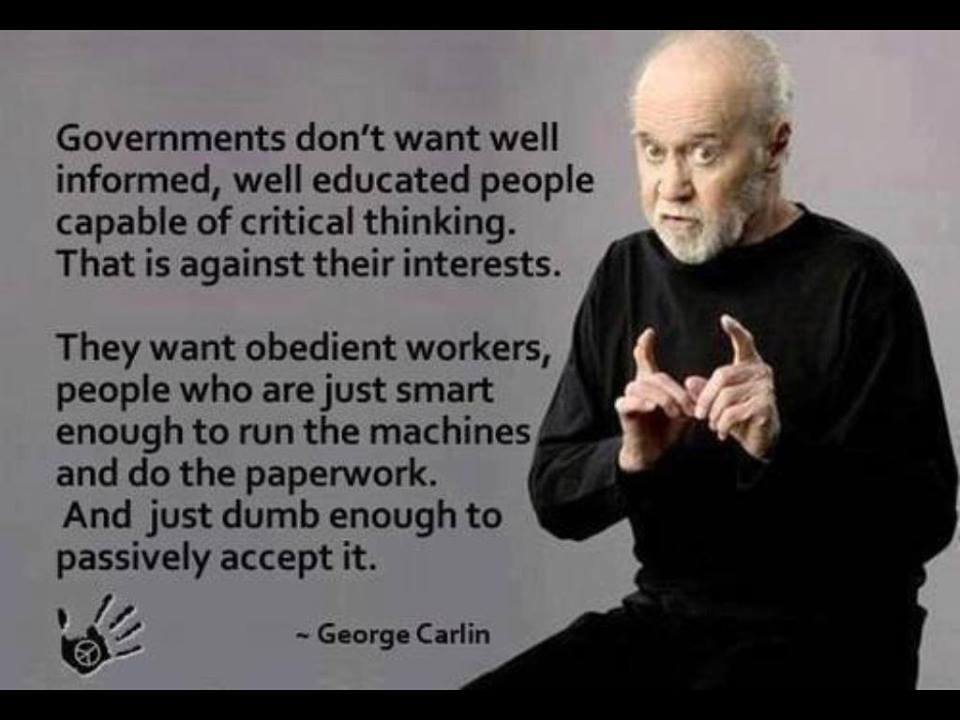
Understand that in the most basic sense our schools are not failing at all; they are doing exactly what they were designed to do: make the vast majority of kids swallow the blue pill and grow them into good consumers who are smart enough to run the machines and think what they are told to think by their betters, but not smart enough to think for themselves and run the businesses or lead the country.

Trolling by Polling

funny_hillary_clinton_vs_donald_trump_election_postcard-ra42557157e2745d582361c25dfe3b9db_vgbaq_8byvr_630

By Mike Cronin

Now that the presidential campaign season is in full swing, we are being treated to the usual inundation of “demographic” polling results (i.e. how are “soccer moms,” Hispanics, gays, white men, etc. going to vote?)  Taken individually, as they are usually reported, the vast majority of these polls tell us nothing useful.  Piolls that tell us how a state will vote are getting closer to valuable.

Consider: This page at Real Clear Politics lists numerous polls with entries similar to this one:

Race/Topic: State X:         Poll : Qunipiac                Results  Trump 44, Clinton 38                            Spread: Trump +6

Trump is up by six points over Clinton in State X.  Sounds dire for Clinton, right?

You still might be getting “trolled.”

Regardless of how you’d like the race to go, we need to remember how presidents get elected: by winning the Electoral College vote.  The popular vote heavily influences the Electoral College, but the nature of that influence is determined by state laws. As we’ve seen as recently as 2000, it is possible to win the popular vote but lose the electoral vote and the election. In terms of polls: It means that generic surveys of this or that demographic, such as the one cited above, are almost useless by themselves for telling us how an election might go, especially in “solid” red or blue states. It makes no difference if a candidate’s poll numbers go up in a state that was already going to vote for them.  It makes a great deal of difference if a candidate’s numbers change in a battleground state with a lot of electoral votes, such as Florida or Ohio – such a shift could move electoral votes from one column to the other, perhaps enough to get to 270.

Thus, even taken in aggregate, “demographic” polls aren’t much of a barometer.  A much more instructive product would tell us how every state is currently trending, with caveats for the states (Nebraska and Maine) that are not “winner take all.”  Such a tool would give us a much better predictive assessment of the electoral college votes likely to go to each candidate.

Such a beast exists: http://www.270towin.com/. They have broken down the race several ways.  If we look at their map that “kluges” current polling data with expert forecasters’ opinions, Mrs. Clinton already has 272 votes in her camp, two more than are needed to win.  But  if we look at their chart that displays the accumulation of polling data only and omits “expert opinion,” then Clinton has about 200 electoral college votes in her camp (out of 270 needed to win), while Mr. Trump has 163.  Either situation sounds much more troublesome for him than “Trump up by six” sounds for Clinton, doesn’t it?

If “demographic” polls vice “electoral vote” polls do little to predict the outcome of the Electoral College race, why publish them? At least two possibilities come to mind:

  1. There’s nothing like stirring the pot in order to keep you tuned in and watching advertisements.
  2. To shape voters’ behavior in some way favorable to whomever commissioned the poll. Example one: Clinton’s current lead only translates to victory on Election Day if enough voters actually go to polling places and pull levers.  If you want Clinton to win, maybe you paint her as losing ground in the polls in order to generate a hint of doubt. Maybe that will motivate folks to go vote that might have stayed home if they felt comfortable she was going to win. Example two: If you want Trump to win, you might commission such a poll in order to generate enthusiasm by painting him as an underdog coming from behind and pulling ahead – a narrative that always does well in America.

Manifestly, Donald Trump still has an uphill battle.  In his best case scenario, he has to take 107 more votes and keep Clinton from gaining, while in his worst case he needs to take at least three of Clinton’s existing votes away!

Despite being much more instructive than run-of-the-mill poll reporting, even such tools as the “270towin” charts are not infallible, nor is the sentiment recorded today going to be the same on election day.  Clinton’s recent bout with “pneumonia,” clumsy messaging regarding her overall health, and “deplorable” commentary on Trump supporters certainly helped Trump’s polling tick up a bit, but did it affect the electoral vote trend?  Time will tell – and we still have to get through the “October Surprise.”

While such and event or revelation may yet upend the race, there is sure to be a battle over the next few weeks for the remaining available electoral votes. Poll results that don’t tell you how that aspect of the election is going are probably not worth your consideration.

Comfortable Lies and Painful Truths

13315357_10157039180120515_1796738583331847165_n

By Mike Cronin

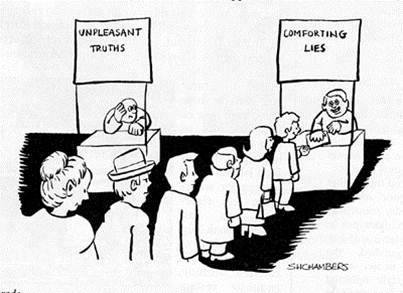
Comfortable lie: The one-percenters have too much money. They should have to pay their fair share of taxes so the rest of us can have more government benefits.

Painful truth(s): 1.The 99-percenters in the developed world (especially in the US) are the one-percenters compared to the rest of the world. If you have food, (even if it wasn’t prepared by a private chef) a car (even if it’s a used beater), a roof (even if it’s a crappy apartment or trailer), multiple changes of clothes (even if you got them second hand), air conditioning, a microwave, and a flat screen TV (or could have those things if you didn’t blow your money on tattoos, booze, drugs, or lotto tickets) then YOU ARE NOT POOR, even if you are living “below the poverty line.” 2. Regardless of how much money a rich person has, it is their money.  If you elect politicians to take money from the rich via taxation, you are no different than a gangster who hires thugs to rob people at gunpoint (unless it can be proved that a given rich person obtained their wealth via theft, exploitation, or other criminal means – and even in such circumstances, the only people who deserve their “fair share” of that wealth are the direct victims, not the rest of us).

Comfortable lie: Your employer owes you a “living wage” and medical benefits.  People who don’t get those things are being exploited.

Painful truth(s): 1. Your employer owes you what you agreed to work for when you signed on and not a dime more.  2. The idea that your employer OWES you medical coverage is fallacious – unless such coverage was part of the compensation you agreed to before you started working there.  The practice of offering medical insurance became popular as a way to increase compensation to deserving employees during World War II without violating the government-imposed wage freezes of the time.  3. You OWE IT TO YOURSELF to increase your knowledge, skills, and abilities in order to increase your worth to your current employer (in order to merit raises and promotions) or to progress up the career ladder at subsequent employment – if you want to increase your income, increase your value.   4. You OWE IT TO YOURSELF not to start, or increase the size of, your family while you are working low-wage/low-benefit jobs. 5. If the pay in your chosen field is generally lower than you might like, it’s probably because there is no shortage of people waiting in line that can take your place. If people with similar skills sets to your own aren’t scarce, there is no need for employers to offer higher compensation. Again – if you want to increase your income, increase your value.

Comfortable lie: We have a right to life, liberty, and happiness. The government must take care of all of our needs from birth to death.

Painful truth: You have the right to life, liberty, and the pursuit of happiness. The government is supposed to protect those rights by not allowing others to interfere with you, so long as you don’t interfere with others.  The government cannot “take care of” everyone without violating those very same rights.  Consider: if the government MUST provide your health care, then it MUST force doctors and other medical professionals to deliver that care. In so doing it has violated the medico’s right to life and liberty and pursuit of happiness (because the government has directed, under threat of penalties, how some portion of the medic’s life is to be spent).

Comfortable lie: We must nurture every kid’s sense of self-esteem by awarding participation trophies, de-emphasizing grades, and eliminating every objectionable word or insensitive influence, etc…

Uncomfortable truths: “If you look like food, you will be eaten.” (Clint Smith) 1. All life is competitive. Predators have to catch prey; prey has to outrun predator. Even plants compete for sunlight.  If you try to protect your kids from competition instead of teaching them how to function in a competitive environment, you are doing them a disservice. (Oh, and by the way, sports are an excellent place to do that…but they are not the only arena!) 2. A kid who has never felt the sting of losing or the “thrill of victory” isn’t going to have healthy self-esteem; he or she is going to have a dysfunctional sense of being entitled to things he or she didn’t earn.

Blanket Guilt or Precision-Guided Accountability?

quote-i-don-t-believe-in-collective-guilt-the-children-of-killers-are-not-killers-but-children-elie-wiesel-107-25-38

By Mike Cronin

Q. What do all of the following have in common?

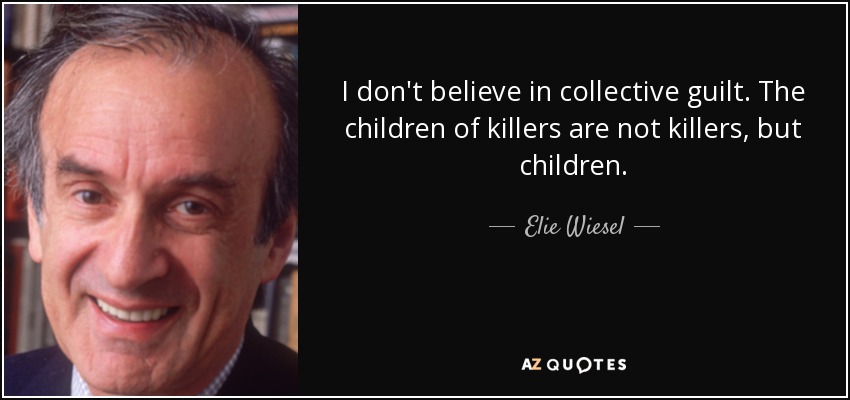
A. You might be tempted to answer racism or bigotry, but that doesn’t cover the last item. The correct answer is that in all of the above examples, an entire group is being held accountable for the supposed sin of an individual or individuals. It is a hallmark of collectivism.

Consider: The sniper who killed the Dallas police officers on Thursday was seeking revenge for the deaths of some black men who had been shot by some white police officers in other states.  In other words, in his mind, since some white police officers in other locations had killed black men, all white officers were racists. The sniper committed the very same crime he believed the white officers had committed:  he held a group responsible for the actions of a few, or of one.  He tried, convicted, sentenced, and shot the Dallas police officers for crimes they didn’t commit, or for the non-crime of being white.

Mr. Trump’s proposal to ban Muslims is less combative, but it still stems from a collectivist mentality: If some Muslims are coming here to do us harm, then we can reduce the potential for such acts by banning ALL Muslims from entering the country. There is certain soundness to the logic here: If no Muslims can enter, it must follow that the jihadist sub-set of Muslims can’t enter.  Nonetheless, setting aside the difficulties in enforcing such a policy, the idea goes against the principles of individual liberty: it applies a sanction to an entire group for potential crimes yet to be committed by some members of that group.

Consider:  If you take the Bible literally, then you believe God created Adam, the first human.  Adam was tempted by Eve (who was herself tempted by the serpent) to eat the forbidden fruit from the tree of knowledge.  Human souls have been tarnished by this “original sin” ever since. Put another way: Humanity is being held to account for a supposed sin we could do nothing about, because it happened thousands of years before any of our births. In essence, we have been born convicted of a crime we didn’t commit and commanded to atone for it or suffer eternal damnation.

The problem is that collectivism belongs to our infancy. Our country was founded on the principles of individual liberty and personal responsibility, but they conflict with the collectivist principles at the root of most religious doctrines, so there has been a constant duality in American culture.  For example: During World War Two, The US Government rounded up US citizens of Japanese ethnicity and “interned” them in concentration camps for the sin of merely having common ancestry with an enemy; yet after the war, our government largely did not hold the Japanese people accountable for the brutality of their vanquished rulers.  Instead, General MacArthur’s occupation forces went after the actual individuals who led the Empire.

It is all too human to project our fear, or anger, or hatred, or resentment over the sins or crimes committed by an individual onto a group, yet there is no justification for doing so. Humans have been doing this since we were stone-age primitives trying to protect our “turf” from rival clans. It takes some enlightenment to dial down our naked aggression and apply accountability with precision.  It is a thing we must learn if we are to advance as a species.

Is it a Conspiracy? Who Gains?

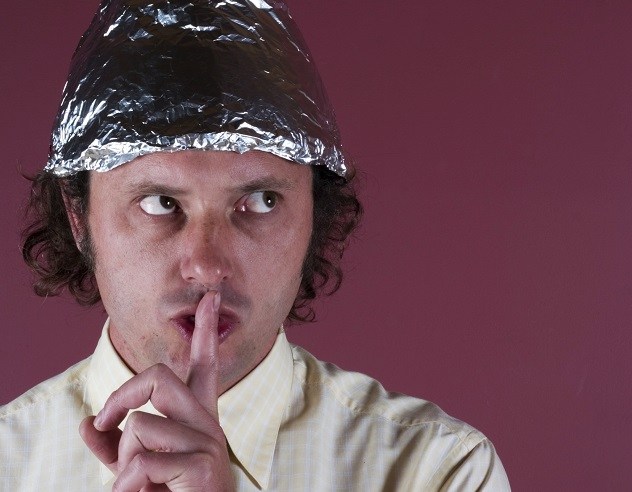
5d-tinfoil-hat-

By Mike Cronin

As we saw last week, Occam’s razor is one tool for helping us avoid falling into the trap of believing in every conspiracy theory that comes along.  Another way to evaluate conspiracy theories for credibility is by asking the simple question: Who stands to gain?  In 1998, when Hillary Clinton was First Lady, she alleged that there was a “vast right-wing conspiracy” to besmirch her husband over the Monica Lewisnky scandal.  The political right certainly made every attempt to tarnish her husband for his indiscretion, but that was not a conspiracy, it was simply opposition politics. The right stood to gain by impeaching the president, but it didn’t take any secret cabal to put together a smear campaign; each individual pundit and politician was able to drum up outrage on his own! On the other hand, Mrs. Clinton stood to gain if she could rally support by painting herself as the embattled victim fighting for truth and dignity, so she let fly with the allegation, and it became one of the most often-cited Hillary quotes.  When the president from one party provides his opposition with the ingredients of a scandal, OF COURSE the opposition will take advantage of the opportunity!  That’s not a conspiracy, it’s an axiom!

Like the “vast conspiracy” against the Clintons, sometimes the activity of a conspiracy theory is credible, but the motives and/or competence ascribed to the perpetrators are dubious: The political right is fond of alleging that the left controls the education system and is intentionally dumbing down our kids through Common Core, campus speech codes, revisionist history curricula, etc.  As with the right’s non-conspiratorial opposition to the Clintons, the state of our education system need not be attributed to a conspiracy of the left. Instead, the state of our education system is the accumulated results of long-term government control.  OF COURSE a government-controlled education system is going to promote and advance a pro-government agenda! That’s not a conspiracy, it’s an axiom!

Let’s look at another example:

Some allege that the wars in Iraq (Desert Storm in 1991, Iraqi Freedom beginning in 2003) were all about oil. It is easy to fan that flame, as Dick Chenney (President Bush Sr’s Secretary of Defense, and Bush Jr’s Vice President) was the CEO of Haliburton (a huge company that provides all manner of services to the oil industry) in between the Bushes presidencies. In the sense that the Bush administrations conspired to go to war in order to gain personal control of Iraqi oil, the answer is doubtful, as Iraqi oil remains under Iraqi control. However, there is a more credible context under which “oil” can be held as the reason for the wars: Saddam Hussein took over Kuwait and threatened to invade Saudi Arabia (his forces actually did cross the border at Najaf). That meant he held a significant portion of the world’s oil reserves (and therefore the lifeblood of international commerce) at risk. OF COURSE the Iraq Wars were about oil! That’s not a conspiracy, it’s an axiom…but not the same one some conspiracy theorists would have us believe.

Often, though, the conspiracy theories are just ludicrous. From the 1990s onward, the term “black helicopters” has picked up the connotation among believers that nefarious forces under the auspices of the United Nations patrol the US and engage in clandestine activities designed to bring about a “New World Order.”  IF such forces exist, and IF they used helicopters for transportation, it is highly unlikely they would adopt a “signature” that would defeat their efforts to remain hidden.

“Chemtrails” is another ridiculous theory. Supposedly, “they” are using jet airliners to spray mysterious chemical agents across the nation for unknown purposes.  The evidence: Contrails. Occam’s razor leaves us no guesswork here: The simplest explanation for contrails is that they are CONTRAILS, not weaponized chemical clouds. Who stands to gain?  The charlatans selling “reports” on chemtrails.

Probably one of the looniest has to be the flat earthers.  Yes, there are still people out there who believe the world is flat.  In order to swallow that pill, you have to ignore or evade absolutely proven scientific facts. For example, you have to believe that every photo and bit of video from orbit showing the curvature of the earth has been faked. That would require that all space programs across the globe have conspired to tell the same lie to billions of people since the USSR launched Sputnik in 1957. The real conspiracy here is the one being perpetrated by the theorists themselves in furthering this drivel.

“What is more likely, a complicated scenario that requires tortured logic to arrive at, or the simple explanation?” “Who stands to benefit, the alleged conspirators, or the person alleging the conspiracy?” When you examine a conspiracy theory and ask a few simple questions, OF COURSE you’ll get a much better sense of the theorists’ credibility!

It’s a Conspiracy!

Paranoid Android

By Mike Cronin

Last week I wrote about critical thinking.  This week I thought we might look at an area that is ripe for its practical application: Conspiracy theories.

Some people believe the 9/11 attacks were perpetrated by our own government in order to provide the Bush administration a pretext to go to war. Others believe the Apollo moon landings were faked.  Conspiracy theories abound: Aliens at Area 51. JFK’s murder. Chemtrails. Black helicopters. The list keeps growing.

How do we get at the truth? Sometimes we can’t. While the truth may be discoverable, the means of discovery are not always available at the time the conspiracy theory is popular, nor is discovery always worth the price to find out even if the means are available.

On the other hand, we have thinking tools to help us decide whether a given conspiracy theory is plausible. These allow us to dismiss the implausible theories.  One of these tools is called Occam’s razor.  In a nutshell, Occam’s razor says that there is seldom any need to consider complicated answers when simple ones will do.

Let’s take the case of UFOs at Area 51.  The theory generally postulates that aliens crashed on earth near Roswell, New Mexico in 1947 and the US government is holding their bodies and recovered spacecraft at Area 51.  In order to believe that, you have to accept:

  1. Out of all the possible places the aliens could visit in our galaxy, the aliens came here.
  2. The aliens have faster-than-light travel (which our science believes to be impossible) or they can hibernate for hundreds or thousands of years. Either way their technology is fantastically beyond ours.
  3. Their fantastic technological advantage both failed them utterly (because they crashed) and succeeded spectacularly (because their bodies and spaceship survived the crash roughly intact.)
  4. Out of all of the possible places they could have crashed, they wound up hitting rural New Mexico.
  5. Our government bureaucrats have been savvy enough to keep the real truth secret all of this time.

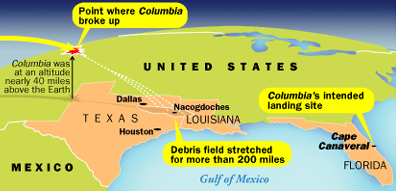
It might be possible…but the “evidence” to support the theory to date amounts to not much more than fuzzy pictures and unverifiable “eye-witness” testimony, while the holes in the theory are powerful. For example: Remember the space shuttle Columbia disaster?  If the aliens’ spacecraft made it through reentry intact, there would have been a huge crater at the impact location like the one near Winslow, Arizona:

16772

If it broke up during reentry, there would have been debris scattered for hundreds or thousands of miles along the descent path:

search_map-med

Let’s apply Occam’s razor: It is far more likely that there was never an alien spacecraft crash in 1947 or any other year. Most likely, whatever the government recovered in New Mexico in 1947 was man-made and that whatever goes on at Area 51 now is wholly human activity devoid of alien influence. Why believe that?  Because there is no evidence beyond the circumstantial that intelligent extra-terrestrials have visited earth.

Why does there always seem to be a slate of such conspiracy theories “active” at any given time?   Because conspiracy theories are fun and profitable!  There is no shortage of people who will “investigate” such mysteries and sell their findings in the form of books and special reports. There are others who make and market souvenirs. If the theory gains enough of a following, there will be entire TV shows dedicated to “solving” (i.e. perpetuating) the myth or even movies that popularize various explanations. (For example: there was a movie called Capricorn One that gave credence to the idea that the government could fake a maned Mars landing – which no doubt fueled the Apollo conspiracy). It’s all meant to keep the gravy train on track.

The conspiracy theory-industrial complex is mostly harmless when understood for what it is.  For example: Like most people, I can enjoy a sci-fi mega-flick like Independence Day or its forthcoming sequel Resurgence (which romanticize the idea of aliens at Area 51). However, for me to enjoy such movies, I have to suspend my disbelief (i.e. “ignore” my faculty for critical thinking).

On the other hand, there is a dark side to the conspiracy market. It manifests in at least two ways:

  1. There are an abundance of Americans whose education neglected to cover critical thinking. They cannot “suspend their disbelief” because they don’t have any!
  2. A viable market for conspiracy theories is also fertile ground for politicians to play upon people’s fears: “The whole aim of practical politics is to keep the populace alarmed (and hence clamorous to be led to safety) by an endless series of hobgoblins, most of them imaginary.” (H.L. Mencken)

10 Thoughts for 2016

By Mike Cronin

Instead of resolutions, I suggest these 10 thoughts for the New Year:

Regardless of your party preference or which side of the political spectrum you align with, remember that even the politicians you like are more concerned about getting elected (or re-elected) than they are about representing you or your interests. (props to Thomas Sowell)

Similarly, the mass media news outlets exist make profit.  They do so primarily by selling advertising air time. Keeping you hooked is the goal of their programming tactics: dramatic music, constant movement, urgent tones, “alerts,” scrolling updates, etc. None are necessary to impart information; they are hooks. Keeping you informed is less important than keeping you watching.

Supreme Court Justice Oliver Wendell Holmes popularized the idea that the Constitution is a “living document.” This notion suggests the founders meant for us to interpret their words in the context of our time, not their own.  In fact, the founders did recognize that times change and the Constitution must be adaptable to those changes.  They meant for us to be able to make those changes by the formal process of amending the Constitution.  Getting an amendment passed and ratified is very difficult – on purpose. But it is possible – that’s why there are currently 27 amendments.  It’s a good bet that any party, pressure group, or court that attempts to re-interpret the meaning of the founders words knows it could never see its agenda come to fruition though the amendment process. The Constitution is not a living document, but it is an amendable one!

Confiscatory taxation: When your neighbors and co-workers use the coercive power of government to steal money from you to pay for laws and programs you don’t want.

When you hear about waste in government spending, you are told about “pork” (e.g. ridiculous projects to study cow flatulence, install “modern art” to “beautify” some government facility, build arenas and bridges, or make payments to farmers not to grow food, etc.). Pork barrel spending is certainly wasteful, but I submit that when a politician says we need to cut waste, then offers pork projects as examples, he is attempting to distract us from the most egregious form of government waste: spending money we don’t have on entire government departments, agencies, bureaus, etc. that do not protect anyone’s rights (the only proper function of government) and thus have no legitimate reason to exist.

You cannot reason with a person who does not value logic. (Props to Sam Harris)

Now that women are allowed in every specialty in the armed forces, there have been calls to require women to register for the draft – in the name of equal rights and equal opportunity.  How about we discuss ending all draft registration and disbanding the Selective Service System instead?  The draft is a form of indentured servitude if not outright slavery. If equal rights are the motivation driving changes in military gender composition, then men should have the same right women currently enjoy: to not register for the draft and to not serve against their will!

One definition of a “license:” When the government takes away a bit of your freedom, then allows you to buy permission to do the thing you were once at liberty to do.

Presidential candidates will make all kinds of assertions and promises about what they will do for the economy or crime control or the environment – but, short of invasion or natural disaster, all he or she can legally do in those areas is make proposals, sign bills into law, and direct the executive branch. The president’s real power lies in foreign relations, not domestic ones.  This is why the Secretaries of State and Defense are more prominent than the Secretary of the Interior, for example.

Some people judge Congress by the number of laws it passes. This is absurd.  The more laws there are, the harder it becomes to be law-abiding, and the easier it becomes to inadvertently break the law.  Supposedly, ignorance of the law is not an excuse to break it – but no one can know all of the laws, because there are too many!