The Minefield of Abortion

Prolife-Prochoice1

By Mike Cronin

My 12 year old daughter told me Donald Trump hates women.  I asked her why she thought so, and she replied that he was against abortion.  Indeed, Mr. Trump expressed several positions on abortion during a recent GOP debate.

Abortion has probably energized more of American politics than any other single issue since the argument over slavery led to the Civil War over states’ rights.  I’m not going to resolve it here, or even take sides, but perhaps we can do a little to clarify the issue to enable some rational decision making.

If you believe that a soul is created at the moment of conception, i.e. if you accept the premise that a growing embryo is a human being, then abortion is killing.  There are grey areas in life, and there are absolutes.  One of the absolutes is that if a fetus is human, then willfully aborting said fetus is murder. One of the most eloquent arguments for taking this position takes the form of a question:  If an embryo is NOT a human being, then what else is it?

On the other hand, in order to accept, or tolerate, or condone abortion, you have to either accept the premise that a zygote/embryo/fetus is not a human being, or you somehow have to rationalize that killing an unborn human is, at least in some cases, permissible. One of the most eloquent answers to the question posed in the previous paragraph takes the following form:  A fetus is a POTENTIAL human being.  It does not acquire the status and rights of a “human being” until it is a separate individual, i.e. until it has been born (or delivered).

Those are the basic parameters of the abortion debate – but the panoply of interests that engage in the debate muddy the waters so much that it is almost hopeless to try and evaluate them all. Consider these few:

The “pro-life” movement has never proven that a soul exists, much less that it is created or first manifest at the point of conception.

On the other hand, neither the “pro –choice” faction, nor medical science, has ever proven that there is no such thing as a soul.

Or how about these positions:

Since a woman has to carry a fetus in her body, it is her right to decide what to do with it.  Until birth/delivery, the fetus is no more a human being with rights than is an appendix, and it may be disposed of in the same manner.

Yet a woman cannot become a mother without at least the provision of some genetic material from a man (excepting the novel cases now anticipated by scientists) – doesn’t that give the father some say in the disposition of the growing embryo?

And two more:

It is monstrous to force a woman who has been impregnated by a rapist to carry the fetus to term and deliver the baby.  That not only subjects her to the physical torture of unwanted pregnancy and child birth, it also enslaves her to the torturous memory of her violation.

But if the embryo is human, then aborting it would be murder.  Murdering the child for the sins of his or her father would be even more monstrous than enslaving the woman to her pregnancy and her purgatory.

Perhaps my daughter was right and those who are against abortion hate women. No doubt there are some people for whom that is accurate, but there is more complexity here.

Some issues are far simpler than politicians, clerics, and the media would have us believe, and some are far more complex.  Abortion certainly falls into the later.   My advice to my daughters will fall along these lines: Abortion is generally legal. That doesn’t mean it is benign.  Even if you believe that aborting a fetus is not murder, the various procedures can still be more brutal and gruesome than mere surgical organ removal.  Even if you believe that it is a woman’s absolute right to decide what to do with her body, and that a growing fetus is part of her and not a separate human being, the best time to exercise that right is before conceiving a baby.

That may be less than fully satisfying dad advice, but it is all I’ve got at the moment. Like my daughters, you will have to navigate the minefield, make up your own mind, and live with the consequences.

A Hard Truth About Pay

By Mike Cronin

Some fields of human endeavor are inherently hard to learn. Medicine, for example. Becoming a doctor requires a person to study for eight or more years beyond the baccalaureate level and become an expert on the composition, functioning, and behavior of the human body. The sum of human knowledge on the subject increases greatly each year due to the efforts of scientists.  People who have acquired skill as a physician are relatively scarce, but because we all want to have our diseases cured and our injuries repaired, they are in high demand and they command high salaries.

On the other hand…some fields are made hard to enter by the members comprising them.  Consider: The Constitution of the United States is the ultimate law of the land.  It was written by well-educated men – in elegant prose that any reasonably literate reader can understand, even after two centuries of language drift.  It is about 17 pages long, and one need not become a lawyer to understand and apply it. Yet somehow that document can describe the limits and give operating instructions for three branches of government.   Now consider that the field of law grows every year. The vast majority of that growth is due to politicians making new laws, not by legal “scientists” discovering new truths.  And most of these new laws are written in “legalese,” which is often designed to be vague or confusing to the lay person.  Understanding modern law requires years of schooling not because it is inherently difficult, but because it is purposely made and kept so by legal practitioners. In other words, most of the difficulty in understanding law and becoming a lawyer is self-imposed by the field of law, not by the need to learn nature’s secrets.  Even so, the end result is a person who, like a doctor, has acquired a relatively rare ability set, so he or she can also command a high salary.

Some star athletes at the pinnacle of professional sports (specifically the NFL, MLB, and NBA in the US, and Soccer/”Futbol” throughout the world) get paid even more than doctors and lawyers – sometimes fantastically more.  Yet any able-bodied person can go out and play football, basketball, baseball, and soccer.  The difference is that the professional “star” athlete has a skill even more rare than medicine or law – the ability to entertain us and win championships.  Most professionals have to spend years at college to acquire the knowledge and skill to practice their trade; the star athlete had to be born with a greater degree of natural athleticism than the rest of us, and he had to learn his sport and hone his skills from elementary school through college. His career will likely be over by the time he gets to 40; the professionals in more intellectual and academic settings will just be hitting his or her stride by that point.

As difficult, or even deadly, as it is to be a teacher, or a first-responder, or a military member, or a tradesman, it is far easier to acquire the skills and knowledge to enter such professions  than it is to become a doctor, lawyer, or pro sports star.  And because they are easier fields to enter, there are lots more people qualified to enter them, and lots more people in them.  The skills, knowledge, and abilities just aren’t as rare, so the salary just isn’t as high.

We might like to think our priorities are all wrong because we pay people who put their lives at risk to protect us far less than pro athletes or entertainment stars. After all, isn’t protecting our lives more important than entertainment? Don’t teachers deserve more because they are preparing our children to be productive members of society? I think most of us would agree that our military and first-responders and teachers certainly deserve more. As a veteran, I certainly would have liked to earn more than I did, and I might have even deserved more than I got…but I didn’t get paid based on what I felt I deserved. But there is a hard, inescapable truth: No one really gets paid on the basis of what they “deserve” or on how difficult their job is. The real basis for pay is how rare and how in demand your knowledge skills, and abilities are. Those with the rarest, most in demand attributes will always be offered bigger salaries than the rest of us with more mundane skill sets.

Socialism Seems Free, but You WILL Pay for it!

By Mike Cronin

No doubt you’ve heard the word socialism being bandied about a lot lately. Democratic presidential candidate Bernie Sanders is an avowed socialist. A recent poll shows that 36% of millenials favor socialism.  And whys shouldn’t they? Free education!  Free healthcare!  Subsidized housing, food, & utilities! Socialism sounds really good. But it isn’t.

It might help if we have a common understanding of what socialism really is.

Simply, socialism is a political/economic theory where all property is owned “by the people.” What could be better than a place where all property is shared and nothing is owned?  That’s the theory.  In practice, It results in the state asserting primacy in all aspects of life and individuals having few, if any, rights. It is a form of collectivism – which means the group, or collective, is prioritized over the individual. Bee hives, ant colonies, and human “communes” are collectives. Under any form of collectivism, the majority can do away with the rights (and often lives) of the minority (of which the individual is the most basic element).

Collectivism/socialism comes in various forms, such as communism, which the Union of Soviet SOCIALIST Republics (USSR) subscribed to, and “Nationalsozialismus” (the German term for National SOCIALISM, from which the term “Nazi” is derived).  Some might argue that the Nazis were in fact fascist, not socialist.  Fascism was also the system of socialism that Mussolini oversaw in Italy. (The term fascism derives from the Latin term “fasces,” a bundle of sticks with an axe protruding from it. Fasces was the Roman symbol of power.)

Some political scientists argue that communism is on the political left, while fascism is on the right, as depicted in this graphic:

I argue that the only practical difference between communist variety of socialism practiced in Soviet Russia and the fascist-flavored socialism animating Nazi Germany and Italy was that the fascists gave lip service to the idea of private property rights – as long as the property was used at the direction of the state.   There were no private property rights at all in the Soviet Union.

Whether people have no property rights at all, or have the “right” to own property in service to the state, is a distinction without a difference. Both systems had charismatic, murderous dictators in charge. Both systems had secret police, concentration camps, and mass murders. Both systems failed to create wealth; they could only steal it or destroy it. There was no freedom in either system.

Thus, a more accurate depiction of communism and fascism on the right-left political model would be to put them both on the left under socialism, with freedom and capitalism on the right.  The diagram below is closer to the truth:

Consider that every country that has adopted any form of socialism has been degraded or destroyed in direct proportion to the degree of socialism it enacted. Nazi Germany. The Soviet Union. North Korea. Cuba. Venezuela.

China and Vietnam were once in the same boat, but both have attained some limited reversal from the crushing oppression the others experienced through adoption of limited free-market economic reforms. But make no mistake, the Chinese and Vietnamese people are not free.

Consider Karl Marx’s famous aphorism: “From each, according to his ability; to each according to his needs.” It sound so wonderful, but it glosses over the essential question: Who decides what your gifts and needs are? (Newsflash – it sure isn’t going to be you!) “From each, according to his ability” means that the state will extract every bit of use out of you that it can, and your desires are irrelevant.  “To each, according to his needs” means that the state, not you, will determine what you need, and you will be lucky to get it.

So how bad is socialism?  At it’s best, socialism creates resentment and dependency; at its worst the people living under socialist governments are slaves – the ones who survived mass murder.


Independence Day?

Tattered-American-Flag-Distress

By Mike Cronin

Six months ago, Military Times reported that morale in the military is waning.  The article sums up the reasons thusly: “Today’s service members say they feel underpaid, under-equipped and under-appreciated.” Of course, feeling underpaid and overworked would sap anyone’s morale, but that last bit, feeling underappreciated, is key.

Today is supposed to be about celebrating our independence and our freedoms.  While we certainly capitalized on the gift of independence from Britain our founders bestowed on us, we are regressing on the freedom front.

Everywhere you turn, there is a law or rule or tax that does nothing to protect our rights.  Protecting individual rights is the only proper purpose of a government meant to function under the consent of the governed. Instead, we are shackled with millions of pages of petty proscriptions and ruinous regulations. Instead we are creating a dependent class.

Service men and women joined to protect those freedoms, not to watch them erode.

On top of that, our military has been commanded to fight wars with a proverbial hand tied behind its back (Vietnam, Iraq II, Afghanistan) against enemies we don’t care to name (War on Terror, War on Drugs); “led” by politicians who haven’t served and don’t respect the Constitution and the rule of law.

Worse, our military has been commanded by our elected politicians to fight wars at the cost lives, and cut spending at the same time, while being prohibited from employing the most direct methods of saving those funds (e.g.. base closures). Closing bases costs jobs, and thus votes, to those self-same politicians. Thus, the life of the service member fighting abroad means less than the job of the base employee working at home.  How’s that for a morale killer?

The bureaucrats in the Pentagon are left with the alternative of achieving spending cuts by cutting pay, benefits, and/or people, and “consolidating” services…while we are still at war!

By all means, celebrate Independence Day today.  We remain an independent and sovereign nation. But think twice when you are told we celebrate our freedom today, because that freedom is eroding, and our service members know it.


UFOs: Fact AND Fantasy

10290701_10153038770176605_4125244323639896682_n

By Mike Cronin

Do I “believe” in UFOs?  I absolutely believe people have seen objects or phenomena in the sky that they couldn’t identify, so yes, I believe that unidentified flying objects exist in the most literal sense. I enjoy science fiction and space opera fantasy, and I believe earth can’t be the only planet in the universe with sentient life.  Do I believe any of the UFOs people have seen here on earth are alien spacecraft?  No. As Carl Sagan once remarked: “extraordinary claims require extraordinary evidence.”

My belief that other sentient creatures must exist is not evidence of anything. For spacecraft to come here from another solar system would mean either the alien operators found a way around the speed of light, or they spent centuries, or even millenia, to travel here. Either would fit the very definition of extraordinary.

So far, the body of evidence indicating UFOs are extraterrestrial spacecraft is not only not extraordinary, it is completely underwhelming. Fuzzy pictures, suspect “eye witness” accounts, and dramatized “documentaries” do comprise strong evidence – of our own credulity.

Stuff I Want My Kids to Know #1: There ain’t no Such Thing as a Free Lunch

FreeLunch

By Mike Cronin

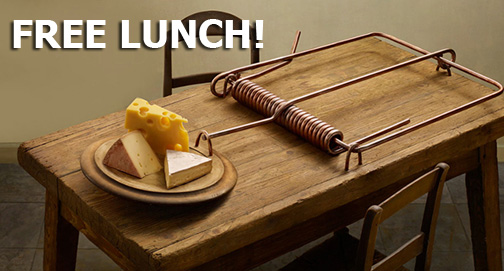
Have you ever heard the phrase “there ain’t no such thing as a free lunch,” often abbreviated TANSTAAFL?  Well, it doesn’t just refer to meals.  It means that whenever something is advertised as “free,” there’s always a catch or a string attached. “Buy one, get one free” doesn’t really mean you get one free, it means you get two for the price of one, or two for half-price each. It might be a good deal, but you are not getting anything free.

It’s the same deal when you are offered a “free” gift or a “free” upgrade when you purchase goods or services.  You are paying for the thing that’s free in the price of the thing that isn’t.

Sometimes you really do get a good or a service for no money, but it still isn’t really free. “Free” software often comes with adware or malware that will cost you time, money, or in some other way cause you stress. Even if it didn’t cost you money, you are still paying for it in other ways.

Many times, the catch or the string is buried in the “fine print.”  All of the big, bold, splashy fonts and bright colors on an ad are just a lure. The legal facts are in the tiny text buried in the middle of the insert or at the bottom of the ad. The fine print section is like the ingredients portion of a food label – it tells you what’s really in there.

The bottom line is that you can’t get something for nothing except in very rare circumstances. One way or another you have paid, or will pay, for what you receive.  That is not necessarily a bad thing.  For example, when you receive a birthday or Christmas present, in a sense, you have already “paid” for it by being a friend worthy of receiving a gift. The trick is to remember TANSTAAFL whenever you are excited about a seemingly good deal.  If it seems to good to be true, it probably is, because you will pay for it one way or another!