Weasel Words: Altruism, Greed, and Selfishness

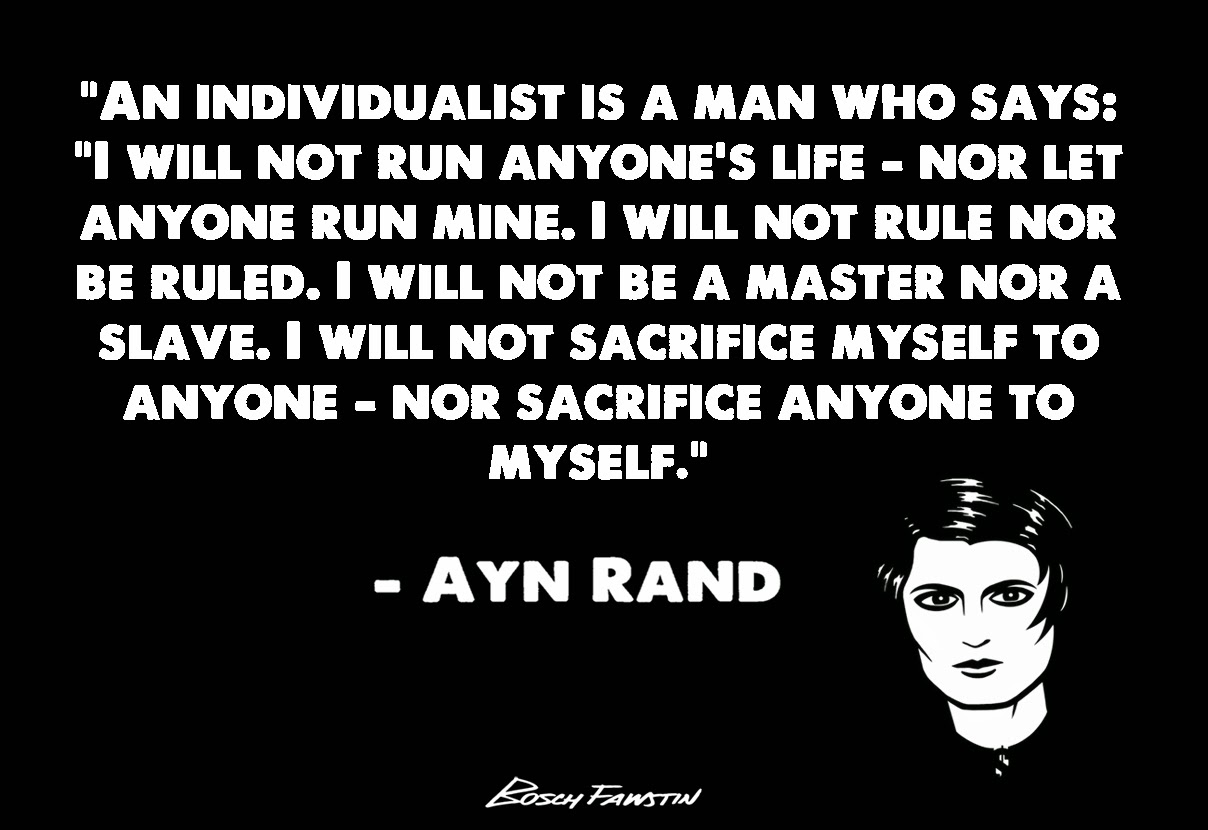
rand sacrifice

By Mike Cronin

I went to a Catholic high school that subscribed to the motto “A Man for Others.”  A high school whose mission is to produce young gentlemen who put other people ahead of themselves sounds pretty good right? Similarly, the motto of the US Air Force’s Pararescue corps, whose specialty is rescuing downed pilots from behind enemy lines, is “So that Others May Live.”  Pararescue men, or “PJ’s,” often serve in Special Operations alongside Green Berets and Navy SEALs.  They are some of the most highly trained, dedicated, and respected troops in the US military.

Both mottos speak to putting other people before oneself. This is slippery territory. According to http://dictionary.reference.com, altruism is “the principle or practice of unselfish concern for or devotion to the welfare of others.” We are meant to hold altruism as one of our highest virtues, and to consider selfishness a negative trait.  The same site defines “selfish” as “devoted to or caring only for oneself; concerned primarily with one’s own interests, benefits, welfare, etc., regardless of others.”

Enter the weasels.

Without selfishness, there would be little or no human advancement. We advance as a species because selfish people discover, invent, or produce the things that have helped us travel to the moon, communicate around the globe instantaneously, or live active, comfortable lives into our seventies and eighties. In exchange, they desire just compensation. Selfish people demand fair trade and produce wealth and abundance. With their wealth, selfish people often do productive things, such as expand their business and hire employees. With their abundance, selfish people often do generous things, such as donating time or money to charities.

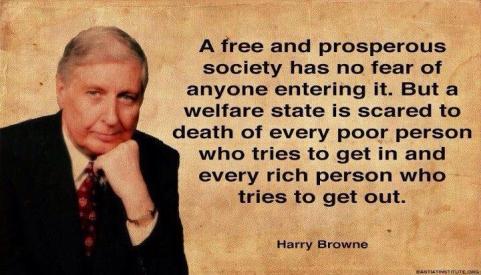
The weasels have corrupted our language to the point that selfishness and greed are used interchangeably, but they do not mean the same thing. Greed is a ravenous desire for the unearned. Wherever you hear the loudest calls for altruism, i.e. for self-sacrifice, you will find weasels and tyrants great and small, from ghetto muggers to Hitlers, who mean to collect your offering. Taken to its logical extreme, altruism demands one sacrifice himself to those who merit only contempt. Truly greedy people demand and take from others yet produce nothing but decay and misery.

I admire PJs and other warriors for their dedication, courage, and skill.  Many have indeed given their lives so that others could live.  Was that altruistic of them?  Consider this: there is a great deal of camaraderie that comes with serving voluntarily in the US military, and a great deal of prestige in serving among the most elite warriors America has.  When a PJ gives his life for others, it is often a trade for equal or greater value: a highly trained and capable warrior exchanging his life so that another warrior, or many other warriors like him can live to fight or be brought back to safety to continue the campaign. The PJ is exchanging one life for many; in essence, he is creating or maintaining a form of wealth.  While the PJ serves, he understands all too well the risks he takes, but he also trades his services and risk-taking for many forms of tangible and intangible compensation. If he dies in the line of duty, he is a producer of the first order, a genuine hero.  Those who send such men to war without extreme justification, while managing to remain safe and comfortable themselves, earn no such merit.

So ask yourself who is truly greedy: The inventor or entrepreneur or CEO who wants to keep what he has earned, or those who call him greedy for daring to feel he deserves the fruits of his own labor while they take it from him using the coercive power of government?

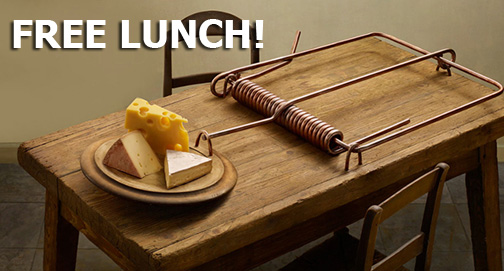
Stuff I Want My Kids to Know #1: There ain’t no Such Thing as a Free Lunch

FreeLunch

By Mike Cronin

Have you ever heard the phrase “there ain’t no such thing as a free lunch,” often abbreviated TANSTAAFL?  Well, it doesn’t just refer to meals.  It means that whenever something is advertised as “free,” there’s always a catch or a string attached. “Buy one, get one free” doesn’t really mean you get one free, it means you get two for the price of one, or two for half-price each. It might be a good deal, but you are not getting anything free.

It’s the same deal when you are offered a “free” gift or a “free” upgrade when you purchase goods or services.  You are paying for the thing that’s free in the price of the thing that isn’t.

Sometimes you really do get a good or a service for no money, but it still isn’t really free. “Free” software often comes with adware or malware that will cost you time, money, or in some other way cause you stress. Even if it didn’t cost you money, you are still paying for it in other ways.

Many times, the catch or the string is buried in the “fine print.”  All of the big, bold, splashy fonts and bright colors on an ad are just a lure. The legal facts are in the tiny text buried in the middle of the insert or at the bottom of the ad. The fine print section is like the ingredients portion of a food label – it tells you what’s really in there.

The bottom line is that you can’t get something for nothing except in very rare circumstances. One way or another you have paid, or will pay, for what you receive.  That is not necessarily a bad thing.  For example, when you receive a birthday or Christmas present, in a sense, you have already “paid” for it by being a friend worthy of receiving a gift. The trick is to remember TANSTAAFL whenever you are excited about a seemingly good deal.  If it seems to good to be true, it probably is, because you will pay for it one way or another!

Are We Truly Guilty of Damaging the Climate?

By Mike Cronin

The allegation:

The human race is causing the earth’s climate to change in a destructive way, mainly by putting too much carbon dioxide into the atmosphere, causing acceleration of the greenhouse effect (warming the planet up faster than if it had been “left alone”).

The evidence you may have heard:

The global average temperature has risen over the last century. The amount of carbon dioxide in the atmosphere released by human activity has risen dramatically as a result of technological advancement from fire to steam to fossil-fuel burning for energy. The science is settled.

The polar ice caps are melting. Glaciers are receding.

97% of climate scientists are in consensus that global climate change is occurring and that it is being caused by man.

Let’s break it down.

  1. “The average global temperature (AGT) has not increased since 1995 and has declined since 2002, despite an increase in atmospheric CO2 of 8% since 1995.” The earth’s climate is changing – it always has.  The increased carbon dioxide released by human activity since the industrial revolution MAY indeed be a factor.  Some evidence is suggestive, but not incontrovertible. The science is NOT settled.
    1. Carbon dioxide is not a major greenhouse gas. Water vapor is the most important one.
  2. Regardless, climate change is inevitable – over time. That doesn’t make it a crisis.  We can adapt. It is what we excel at as a species.
  3. Both the Greenland and Antarctic ice sheets are growing in thickness and cooling at their summit. Sea ice around Antarctica attained a record area in 2007.
  4. Consensus has no bearing on physical reality.
    1. The fact that 97% of climate scientists agree is irrelevant; the 3% of climate scientists who don’t concur with their colleagues might be correct.
    2. The “fact” that 97% of climate scientists agree is itself not settled science!

The science of global climate change has been hijacked by ideologues who want to further their own agendas using scientific nomenclature to scare us laymen. Note how all of the “solutions” to global climate change always seem to require some sacrifice from the developed world. Note how the term “climate change denier” has become all but synonymous with the word “heretic.”

  1. Consider that in the 1970s, the scare was over global cooling. Then it was global warming. Now it’s “climate change.”
  2. Consider that the organization most responsible for climate change alarmism is the UN’s Intergovernmental Panel on Climate Change (IPCC). Is it a political body, or a scientific one?  Note that “solutions” to global climate change promoted by the IPCC, such as the so-called Kyoto Protocols, require developed nations to curtail carbon-dioxide producing activity, but allow developing nations to continue to produce CO2, as if the climate is sensitive to where CO2 comes from and who benefitted from its emission – a rich country or a poor one.

So, what can we do?

  1. Don’t be alarmed, be skeptical.
  2. Don’t go out of your way to add CO2 to the atmosphere, but don’t take a guilt trip if you drive an SUV or don’t recycle. Live your life as you will, on your own terms.
  3. Be wary of politicians, educators, and celebrities that proselytize the religion of climate change. They can’t save you from it even if they are right, but humanity can adapt.

Becoming Antifragile: Beyond “Sissy” Resilience | The Art of Manliness

header

A bit of useful truth: it is nice to enjoy the abundance we are surrounded by, but it has led to a culture of entitlement. Reliance on entitlement comes at a cost: fragility.

Becoming Antifragile: Beyond “Sissy” Resilience | The Art of Manliness.

The Minimum Wage Makes Minimum Sense

Cartoon from: http://tunnelwall.blogspot.com/2014/03/political-populism-not-economics-behind.html


By Mike Cronin

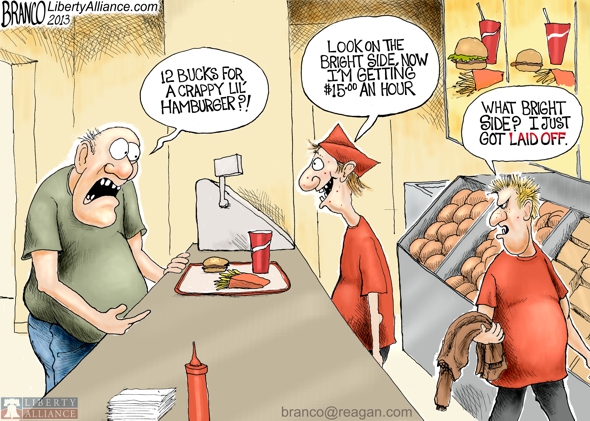
Minimum wage laws, which are meant to reduce poverty, actually cause dysfunction and increase poverty and criminality. The political architects of such laws know this, or remain purposely blind to it, so that they can make promises, get votes, and gain or remain in office.

So how does a mandated minimum wage increase poverty?  While the person who has a minimum-wage job may or may not be defined as poor, it is the person who can’t get a job that suffers the worst effects of minimum wage laws. Since there is no corresponding minimum revenue laws, minimum wage laws dis-incentivize job creation.  Business owners, especially small business owners, have to make a certain amount of money in order to break even, that is, just to pay for their business loans, employees, suppliers, landlords, taxes, and whatnot. Yet there is no law forcing anyone to buy the offerings of a given business.  If a business doesn’t earn enough revenue, they can’t afford to pay even the minimum wage to their employees, so they either have to hire less people than they otherwise might have, they have let people go, or they have to go out of business. In any of those cases, jobs were either lost or not created, which makes it harder for unskilled people to find work, which leads to increased unemployment and poverty.

For example:  If you are old enough, you might remember the days when movie theaters had ushers.  It’s an extremely low-skill job; you could teach it to a high-school kid in an hour or two – and pay him or her correspondingly low wages. There was a match between worker skill level, worker responsibility level, and worker pay.  These days, no one is going to pay a kid $8.00 or $10.00 an hour just to usher, so the usher’s duties got blended into other jobs (assistant manager?) and the job all but disappeared.

Similar entry-level jobs are hard to find anywhere, which makes it harder for high school kids to find work and establish an employment track record.  Instead, such kids either remain with their parents longer, causing the parents to have to support a child longer than they had planned, reducing the parents’ own wealth; or the kid lives on the streets, greatly increasing the likelihood he or she will resort to criminal conduct to survive.

There is a another way some employers skirt the minimum wage laws and pay cheap rates for low-skill labor: They pay illegal immigrants illegally low wages in cash under the table.  This incentivizes illegal immigration, which, in effect, imports more poverty. The illegal immigration “infrastructure” is an underworld, and it attracts other crime: tax evasion, prostitution and other forms of human trafficking, narcotics, gunrunning, gambling (esp. on illegal dog and cock fights), ID forgery, and so on.

To be sure, the minimum wage laws aren’t solely responsible for poverty, illegal immigration, and vice.  Rather, they are a large and obvious contributor to those maladies, even as they fail to produce the promised positive effect.  But they sure sound good.

The Real Reason Ferguson Burns | Michael J. Hurd, Ph.D. | Living Resources Center

Dr. Michael Hurd on the riots in Ferguson: The Real Reason Ferguson Burns | Michael J. Hurd, Ph.D. | Living Resources Center.

Untangling the Illegal Immigration Knot

1972274_636147066434013_742855534_n


By Mike Cronin

Let’s wrap our head around the multi-faceted illegal immigration problem.

  1. If you are an elected Democrat, the problem is that there are millions potential voters out there who cannot legally vote for you or your pals. How to solve that problem? Adopt narratives that simultaneously paint the illegal immigrants as victims who need rescuing and those who see things differently as racists. Then legalize the immigrants (or some portion of them) somehow, and/or prevent the passing of laws that require voters to produce a photo ID proving their eligibility.
  2. If you are an elected Republican, there are millions of potential Democratic voters out there who might vote illegally or who might become legal voters at the stroke of a pen. How to solve that problem? Adopt narratives that illegal immigrants are by definition criminals just for being here, and who steal jobs from American citizens, who vote illegally, and who cost us a lot of money in “stolen” benefits and entitlements.
  3. If you run a manual- labor intensive business that can’t afford to pay the minimum wage, paying an illegal immigrant in cash under the table is an attractive option.
  4. If you are a desperate person from Mexico or an impoverished country to our south, getting to America for the opportunities and freebies is an attractive option.
  5. If you are a cunning and morally flexible person, exploiting the stream of immigrants headed north is an attractive option.

So how do we solve a multi-faceted problem?  With a multi-pronged strategy that is also consistent with smaller government :

  1. Economics is the driving factor. As long as immigrants perceive things as better here than wherever they are from, they will come here.  Immigration has always been one of America’s strengths. We can’t stop it and we shouldn’t but we need to do a much better job of managing it. Currently, unless one can claim one of the “Three R’s” (Relative, Rich, or Remarkable), it is next to impossible to attain a green card or citizenship. It should be easy for anyone to come here and start a new life…except for those who would do us harm (i.e. real criminals, terrorists, non-producers, etc.), so we need to secure the border. Immigration policy should be positive (you can immigrate here unless…) not negative (you can’t immigrate here unless…).
  2. We need to wind down the rhetorical panic. “Illegal immigrant” is no more a racist term than “speeder” or “shoplifter.” “Illegal immigrant” isn’t a race, it’s a status. “Mexican” isn’t a race, it’s a nationality.  “Latino” isn’t a race, it’s an ethnic identification. Yes, illegal immigrants broke a law. That doesn’t make them hardened criminals.   Also, “Illegal immigrants” can’t “steal” jobs from Americans, because jobs don’t belong to employees, they belong to employers.
  3. Lastly, as with most big-government problems, illegal immigration is an overlapping symptom, (along with unemployment), caused by another problem: Minimum wage laws. More on that can of worms in a future post.


How do You Like Your Economy?

By Mike Cronin

I’ve written previously about how our country is supposed to be a republic and not a democracy or an empire.  Similarly, our economy is supposed to be based on a free market and not centrally controlled. As with our political system, our economy has become mixed. It retains some free-market features, and it suffers under an ever-increasing burden of controls, regulations, and other government and central bank interference.

Why are controls bad? Because those who do the controlling cannot possibly know every way their actions will affect the market. Ignoring this simple fact brought the Soviet Union to ruin; acknowledging it has brought China a measure of prosperity. To understand how intricately complex the market is, consider the case of a simple pencil. It only has a few parts and some paint, yet it takes thousands, if not millions, of people using lots of other products and services in many other industries in order to make pencils and get them to stores.  Interference in any of those areas could affect pencil production, and interference in pencil production could set off a chain reaction into any of those areas. A mixed economy doesn’t just affect our wallets, it affects our morality. Ayn Rand explains it best:

“A mixed economy is rule by pressure groups. It is an amoral, institutionalized civil war of special interests and lobbies, all fighting to seize a momentary control of the legislative machinery, to extort some special privilege at one another’s expense by an act of government—i.e., by force. In the absence of individual rights, in the absence of any moral or legal principles, a mixed economy’s only hope to preserve its precarious semblance of order, to restrain the savage, desperately rapacious groups it itself has created, and to prevent the legalized plunder from running over into plain, unlegalized looting of all by all—is compromise; compromise on everything and in every realm—material, spiritual, intellectual—so that no group would step over the line by demanding too much and topple the whole rotted structure. If the game is to continue, nothing can be permitted to remain firm, solid, absolute, untouchable; everything (and everyone) has to be fluid, flexible, indeterminate, approximate. By what standard are anyone’s actions to be guided? By the expediency of any immediate moment. The only danger, to a mixed economy, is any not-to-be-compromised value, virtue, or idea. The only threat is any uncompromising person, group, or movement. The only enemy is integrity.” (http://aynrandlexicon.com/lexicon/mixed_economy.html)

Sounds a lot like 2014 America, doesn’t it?

Why Don’t Teachers Earn More?

By Mike Cronin

On average, elementary school teachers make about $53,000 per year as of 2012.  As a group, they are often thought of as deserving higher pay and better benefits. Indeed, in my state of residence, Arizona, elementary teachers earn one of the lowest mid-career salaries for bachelor’s graduates.  So why can’t teachers get more?  After all, they have higher education and they have some of the most powerful unions around, like the NEA. Is it because of oppressive state and local government or vindictive school districts?  Of course, some of that is going on, but there are a few simpler and and more widely applicable explanations:

First: Simple economics. In general, the supply of elementary teachers exceeds the demand by about double, so there is simply no need for districts to pay any more than they are – there is always someone else waiting for a job that would be willing to work for the going rate. I saw a graphic that lamented America’s priorities because teachers make less than cable installers in one area.  It has nothing to do with priorities, it has to do with supply.  Teachers make less because supply exceeds demand – and that’s not just true for teachers, it’s true for lots of industries. Soldiers, Sailors, Airmen and Marines, firefighters, and police officers, our protectors, make less than sports and entertainment stars for the same reason. Ditto for nurses and doctors – doctors make more because demand exceeds supply.  As long as there is an ample supply of teachers willing to work for the going rate, then the going rate will not rise much.

Second, the unions, especially powerful unions like the NEA, don’t do what’s best for teachers; they do what’s best for unions.  When teachers’ interests and the union’s interest coincide, teachers benefit.  When they do not, teachers lose. Since unions typically advocate for non-merit factors, like years on the job, to be primary in setting pay and achieving tenure, really good teachers of a given experience level will get paid the same as mediocre and bad teachers of the same experience level. Thus, the unions’ interests most often align with the mediocre and bad teachers, who get paid more than they might deserve thanks to union intervention.  This sucks for the superstars, since they don’t get paid what they are worth.

If you are a good teacher and you wonder why you can’t get paid more than you do, it’s because your union is better at advocating for your mediocre and poor colleagues than it is at advocating for you, and because there is no shortage of people willing to work for the going rate.

Discrimination: Weasel Word?

dis1

By Mike Cronin

Why is it that advertisements for luxury goods often appeal to those with “discriminating tastes,” yet it is widely regarded as wrong to discriminate against people on the basis of their genetic makeup, physical abilities, or group affiliations? How can it be good to discriminate in one instance, but not the other? I submit it is because the word discrimination has two opposing meanings; one of which is weasel-ease.

Dictionary.com gives four definitions for discrimination.  The first two seem to be almost completely contradictory to each other. The first, i.e. “an act or instance of discriminating, or of making a distinction,” alludes to judgment. It is the meaning that applies in the case of advertisers appealing to the supposed keen discernment of well-heeled consumers.  The second definition, “treatment or consideration of, or making a distinction in favor of or against, a person or thing based on the group, class, or category to which that person or thing belongs rather than on individual merit…” is the kind of discrimination that gets folks into legal and moral trouble.

Here’s the rub: a person who takes such action for or against another solely on account of race, creed, gender, etc., is actually indiscriminately applying their prejudices or stereotypes against their victims. They are in fact failing to discriminate based on individual merit. That’s the exact opposite of the primary definition of discrimination, and it is the essence of collectivism. “Discrimination” has entered the weasel lexicon.