Obamacare: Dysfunction & Chaos!

Kathleen Sebelius

By Mike Cronin

Why has the Affordable Care Act (AKA Obamacare) been a failure so far? Because it was doomed from the start. Just like any other sector of the economy that gets taken over by the government, health care cannot and will not be improved by central planning and control.  But don’t we need Obamacare, so that people who don’t have health insurance can finally get coverage?

According Dr. Michael Hurd, a psychotherapist who writes a comprehensive mental health blog:

Health insurance started out as hospital insurance. People purchased hospital insurance in the marketplace so that they could afford catastrophic care when and if they needed it. Government regulations (e.g. mandating coverage for primary care) and tampering with/restricting the marketplace (e.g., no purchasing insurance across state lines; tax credits for large companies, but not individuals) are what led to health insurance premiums skyrocketing in the first place.

Piecemeal government interventions made the health care industry dysfunctional and insurance premiums un-affordable, so now the solution is…higher premiums for total government control of health care? Insane.

Health care providers will be unsatisfied because they will be paid based on what the government says they should be paid, not what free-market factors allow them to earn. Further, they will, be micromanaged and second-guessed by bureaucrats and bean-counters, and they will have to comply with ever more red tape.  Bright young people, realizing this, will opt out of medical careers, exacerbating the shortage of care providers. To compensate, the government will be forced to either pay bonuses to medical providers…or draft people into the medical profession.

Beneficiaries are discovering that, enrollment debacle aside, they will be charged exorbitant premiums, (especially the youngest, healthiest adults, in order to pay for the more medically needy); sometimes including mandatory coverage that they don’t need (such as pregnancy coverage for males);  that they won’t be able to keep insurance they already have (not because they law says they have to change companies, but because the economics of implementation have caused their employers to drop their old insurance), or the doctors they already have (again, because their insurance has changed). Some of the sickest beneficiaries will also discover that the government can arbitrarily decide that a given care regime is too costly, so it will be denied to them.

Think of it another way:

Imagine if we relied on auto insurance for “primary care” for our vehicles (fluid changes, tire rotations, wiper blades). Think of the paperwork and billing hassles we would endure for each little oil change. The overall cost of auto maintenance would increase to cover the business overhead. Soon, fewer Americans would be able to afford auto insurance, with serious ramifications for liability, setting the stage for a national crisis. It’s a ridiculous idea, isn’t it? Yet this is the way that health care works in America today. (from dpcare.org)


Weasel Words: Social Justice

1016565_623204397728280_338338282_n

By Mike Cronin

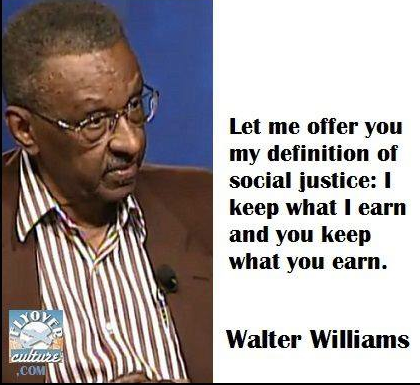
When you hear someone speak of social justice, what comes to mind?  The first time I heard the term, I recall wondering why justice needed a qualifier. Over time, I came to realize that it was simply another corruption of language the weasels have been using to push us towards more collectivism; in this case: it sounds so righteous, but it is really just code for the same old thing collectivists always seek: group “rights” and wealth redistribution.

To their way of thinking, it is unjust for a few to accumulate substantially more wealth than others, or for there to be a large difference in incomes and holdings between the wealthiest and the poorest members of society. The supposed goal of social justice is a community wherein there is at least rough parity in the economic outcomes for everyone. The goal is to be obtained regardless of whether there might be a huge disparity in the productive inputs between everyone, and in ignorance of the economic concept that it is possible to create wealth vice distribute it. More broadly, but in the same vein, the term social justice is also used when collectivists seek “rights” for groups that do not exist for the individual.

Here are some of the problems with the concept:

1.            When opponents argue that the term social justice means equal outcomes without equal inputs, proponents argue that they don’t mean absolutely strict equality…but they fail to identify just what an acceptable range of differences might be, and they blank out discussion of input entirely – as if it were axiomatic that all input effort is equal.

2.            Proponents of social justice have no recourse but to use the coercive power of government to obtain “equality of outcomes.” In other words, to tax the incomes and/or confiscate the wealth of those who have been the most industrious, in order to give it to those who have been less industrious.  This deters productivity and rewards mediocrity – where is the justice in that?

3.            Polish political commentator Janusz Korwin-Mikke (a.k.a. JKM) opines: “Either ‘social justice’ has the same meaning as ‘justice’ – or not. If so – why use the additional word ‘social?’ … if ‘social justice’ means something different from ‘justice’ – then ‘something different from justice’ is by definition ‘injustice.'”

4.            Valid rights are negative in nature. That means they require no positive action on the part of others, merely that one restrain oneself from violating another’s rights.  The group “rights” social justice proponents argue for are really privileges, obtained at the expense of others. Two examples: If one has a “right” to housing (as opposed to the right to attempt to buy or rent shelter through mutual agreement with an owner or landlord), then one has a “right” to the time, materials, and labor of construction workers, tradesmen, planners, landscapers, and other human beings involved in the production and marketing of the house. If one has a “right” to health care (as opposed to the right to seek out health care from a willing provider in exchange for some mutually agreed upon value), then one has the “right” to the time, effort, skill, and materials of doctors, nurses, therapists, pharmaceutical producers, and all of the other people engaged in the provision of one’s care.

How awesome for you if you’re getting some of that social justice the politicians have been promising! How cool is it that now you have such rights! But how long will it be until no one will design new technology, or build a factory, or rent a house, or grow crops, or slog through years of medical school anymore?  Ever wonder why there is a shortage of engineers and doctors, and an overabundance of lawyers in this country? Where will you get your social justice when such people extract their own form of justice from society?

Elevating “Minority Rights” over Individual Rights Yields Chaos

Minority

By Mike Cronin

Free market advocate Richard Maybury often mentions the two “laws” of human civilization: Do all that you have agreed to do; and do not encroach on others or their property. According to him, every place that has based their justice systems on these two fundamental principles (wittingly or not) have been relatively more prosperous and free than the places that have not adopted them. Maybury even coined a term for the places where these two principles hold no sway: Chaostan. It comprises, roughly: The Balkans, most of Eastern Europe, Russia and the rest of Asia (minus Japan), North Africa, and the Middle East.

The current troubles in Ukraine, Syria, and Afghanistan are the most recent manifestations of the chaos endemic in that region.  As long as, and to the degree that, the two laws of civilization hold no influence in that part of the world, it will remain conflicted and embattled. We should take note as our own government takes ever more liberties with its own laws (as if governments do not have to obey the same laws as individuals) and leaves us with less freedom, less order, and increasing chaos.

Two recent examples of chaos encroaching:

  1. The Ninth Circuit Court’s arbitrary ruling in California that in effect promotes Mexican culture and the “rights” of a group (Cinco de Mayo celebrants) over American culture and the rights of individuals (see my post from March 2nd).
  2. The recent cases in Colorado and Arizona that in effect promote minority rights over the rights of individuals – as if they were different. In this set of cases, the state governments have created a “right” for homosexuals to not be refused service by business owners. In other words, in Colorado and Arizona, the government is compelling business owners to conduct business that may be potentially offensive to them (providing goods or services to same-sex weddings) in order to not offend the homosexual constituency. In both cases, authorities have:

-Failed to recognize individual rights. One group does not accrue special privileges over another simply because they have lacked special privileges in the past, or because they are a minority. (If we stop and ask “what is the smallest minority?”  The answer: the individual.)

-Failed to apply the basics of the two laws: in the California case, it is no infringement, or encroachment, on the rights of the Cinco de Mayo celebrants for other student to wear patriotic American clothing, nor should it be considered an infringement for those wearing patriotic Americana to have to tolerate the celebration of Cinco de Mayo. In other words, such displays of cultural enthusiasm ought to be protected as free expression, with the realization by the celebrants that doing so does not grant a right to be protected from competing cultural enthusiasm in a public forum. In the Colorado and Arizona instances, there is no violation of individual rights if the owner of a private business refuses to do business, (i.e., declines to associate) with anyone for any reason, though it may indeed be discriminatory, bigoted, and economically unwise.

No one has the right to not be offended, but our governments are trying very hard to make it a crime to offend…some people some times.

When the government encroaches on others by telling them how they can or cannot express themselves, or compels them to conduct business that offends them, it is making a mockery of the concepts of free expression and free association and displacing the concept of the rule of law with the chaos of rule by influence and pressure.

The Ninth Circuit has no Appeal to Patriots

flag ban

By Mike Cronin

The Ninth Circuit Court of Appeals recently ruled that it is Constitutional for a California high school to ban students from wearing patriotic American-themed clothing, such as t-shirts displaying the stars and stripes, during the the Mexican commemoration day Cinco de Mayo. Their reasoning is that the school has issues with ethnic tensions between its majority Hispanic and minority white student populations, and that the school was acting prudently to ban the patriotic garb so as to reduce friction between the two groups.

The court’s decision has inflamed adults in the name of reducing the tensions of students. On the one hand, it very well may be provocative to “throw the flag” in the face of Cinco de Mayo celebrants, especially if that were the obvious intent of those so clothed. On the other, the purpose of the First Amendment is to protect unpopular, offensive, and disagreeable speech. It is a wonder to patriots that such a ban, seemingly in direct conflict with the freedom of expression, can be upheld, and it’s insulting and supremely ironic that the proscription elevates the cultural expression of a hosted culture at the expense of the host. (Note that the court did not ban Cinco de Mayo or Mexican-themed apparel.)

To be clear: The Ninth Circuit upheld the ban on the basis that the school was acting for the safety of the students. If that is truly their reasoning, then why not ban patriotic apparel for both cultures?  If wearing American-themed apparel at a high school in the United States of America, which receives funding from the American government at the expense of American taxpayers, is offensive to some Mexican students, could it not also be just as likely that celebrating a Mexican commemoration at that same high school might be offensive to the non-Mexican students?

The court made at least two serious errors: In banning patriotic wear, i.e. self –expression, it has taught the teens that their individual rights are to be violated at whim by authority rather than protected by it. In making the ban applicable to only one set of cultural expressions (American-themed), it has taught the students that it’s the majority that rules (at that school, the majority is Hispanic), not the law.

I wonder what country the Ninth Circuit judges come from?

Why is the Trouble in Ukraine Newsworthy here?

Location of  Ukraine  (green)in Europe  (dark grey)  –  [Legend]

(image from Wikipedia)

By Mike Cronin

During the days of the USSR, Ukraine was one of the many Soviet Socialists Republics.  Ukraine is an energy producer, breadbasket (third largest food exporter in the world), and industrial power, similar to the US Midwest. Ukraine has Europe’s 2nd largest military (and for a little over five years, it was a significant nuclear power: Ukraine inherited nearly 2000 nuclear weapons during the dissolution of the USSR; it returned all of them to Russia for dismantling by 1996), and it hosts the Russian Navy’s Black Sea/Mediterranean fleet at Sevastopol.

Russian rulers have always felt the need for buffers between Russia and its potential adversaries. During the Soviet days, that buffer was made up of the various Soviet “republics,” such as Kazakhstan, Belarus, and Ukraine. When the Soviet Union fell, such republics became independent countries. Since Vladimir Putin came to power, Russia has been steadily trying to reassert itself in those countries that were once part of the USSR – including Ukraine.

Current events in Kiev matter because Ukraine is the northern edge (Turkey is the southern edge) of the intersection between the Russian, European and, to some extent, Muslim spheres of influence. In fact, the name Ukraine literally translates to “on the edge.” None of these factions wants to see a prize like the Ukraine fall into another’s orbit. Ukrainians themselves understand this, and want to be independent while playing all sides off each other – a risky, but profitable, strategy.  This is not new. Ukraine has been invaded many times over the course of Eurasian history; and it sits at the historical intersection of the Christian, Islamic and Eastern Orthodox spheres of influence. In the early 20th Century, World War I ended the Ottoman Empire, to which the southern portions of Ukraine belonged. Soon after, the Soviet Union was formed – with Ukraine as a founding member.

Expect periodic drama and conflict regarding Ukraine to continue for decades, if not centuries – it’s the normal pattern of life for valuable territory on the geopolitical fault lines between civilizations.

Is Feeling Better Bad Medicine?


164ASPWE444852

By Mike Cronin

I am of mixed opinion about alternative/eastern medicine. On the one hand, there is an endless parade of charlatans who can weave a compelling web to ensnare the credulous and separate them from their money.  On the other, just because a field like reflexology, herbal remedies, or acupuncture developed outside the realm of western scientific rigor does not mean that everything within those practices is fraudulent.

One source of the conflict between eastern healing and western medical premises may be that (I am given to understand) Chinese languages are more metaphorical than English. Thus, when a reflexology practitioner massages a client’s foot in a certain way, or an acupuncturist inserts needles in certain locations, we are right to be skeptical that a particular internal organ is being affected, but we can still allow that the client may feel some real relief or other wellness benefit.  We might see this as an example of the “placebo effect.”

As long as a practitioner makes no claims that such treatment can cure a disease or reverse a congenital defect or heal an injury, or offers factual, documented, vetted proof that it can, then there is no real harm being done – but it is up to both groups (practitioners and clients) to be wary. Practitioners ought to never offer misleading claims that their treatment can do more than help you feel better, while potential clients ought to be skeptical of any claims more specific than that.

It would be interesting to see luminaries in the eastern and western schools get together and “cross pollinate.”  The western practitioners could subject eastern methods and claims to rigorous “myth busting,” while the eastern gurus could show the westerners some techniques for improving their  “care” quotient.

Hazing vs. Hell

By Mike Cronin

Most of my posts to date have been pretty heavy on how our bloated government is dragging us away from the ideal of liberty our founders envisioned.  Despite these criticisms and misgivings, I continue to work as a civil servant, because I think the USA is still the best place on the planet for individuals to aspire and achieve their dreams. We have a long way to fall before we reach bottom, and we can stop the slide.

By way of contrast, consider the latest reports of the inhumanity routinely visited upon the poor souls in North Korea.

“A North Korean prison camp survivor told of a pregnant woman in a condition of near-starvation who gave birth to a baby — a new life born against all odds in a grim camp. A security agent heard the baby’s cries and beat the mother as a punishment.

She begged him to let her keep the baby, but he kept beating her.

With shaking hands, the mother was forced to pick up her newborn and put the baby face down in water until the cries stopped and a water bubble formed from the newborn’s mouth.” (from http://www.cnn.com/2014/02/16/world/asia/north-korea-un-report/ )

Compared to the catalog of misery in that hell-hole, what happened at Abu Ghraib in the early days of Operation IRAQI FREEDOM was mere hazing, and water boarding terrorists isn’t much more than a mean prank.

As long as we have the freedom of speech, we can argue and protest all of the slips, missteps, debacles, and scandals that erode our freedom and are driving us towards the execrable brutality of living in a North Korean-style atrocity machine.

Weasel Words: Poor and Poverty

By Mike Cronin

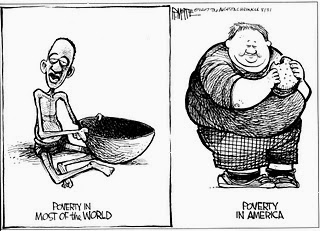
When you are told that you need to help the poor in this country, what image comes to mind?  Are you thinking about the homeless lady pushing around a shopping cart full of her meager possessions? Do you envision whole communities in America that live in shanty towns and dig through landfills to scrounge for their daily sustenance?  Well, that kind of abject, absolute poverty may exist somewhere in America, but it’s exceedingly rare. When politicians, clerics, and pundits demand your sacrifices so they can help the poor, they are speaking “Weaselese.”

Most of the poor in this country may suffer from relative poverty, but not absolute poverty. According to 2010 Census Bureau and other government statistics cited in a Heritage Foundation backgrounder:

  • 80 percent of poor households have air conditioning. In 1970, only 36 percent of the entire U.S. population enjoyed air conditioning.
  • 92 percent of poor households have a microwave.
  • Nearly three-fourths have a car or truck, and 31 percent have two or more cars or trucks.
  • Nearly two-thirds have cable or satellite TV.
  • Two-thirds have at least one DVD player, and 70 percent have a VCR.
  • Half have a personal computer, and one in seven have two or more computers.
  • More than half of poor families with children have a video game system, such as an Xbox or PlayStation.
  • 43 percent have Internet access.
  • One-third have a wide-screen plasma or LCD TV.
  • One-fourth have a digital video recorder system, such as a TiVo.
  • 96 percent of poor parents stated that their children were never hungry at any time during the year because they could not afford food.
  • 83 percent of poor families reported having enough food to eat.
  • 82 percent of poor adults reported never being hungry at any time in the prior year due to lack of money for food.
  • Over the course of a year, 4 percent of poor persons become temporarily homeless.
  • Only 9.5 percent of the poor live in mobile homes or trailers, 49.5 percent live in separate single-family houses or townhouses, and 40 percent live in apartments.
  • 42 percent of poor households actually own their own homes.
  • Only 6 percent of poor households are overcrowded. More than two-thirds have more than two rooms per person.
  • The average poor American has more living space than the typical non-poor person in Sweden, France, or the United Kingdom. In fact, at 1,400 square feet, the dwelling of the average poor American is still substantially larger than the average dwelling in every European nation except Luxembourg.
  • The vast majority of the homes or apartments of the poor are in good repair.

The next time you feel shamed into to voting for a politician that demands a sacrifice from you in order to help “the poor” through his government programs, understand that your hard-earned money, and your neighbors’, isn’t helping “the poor” stave off starvation, it’s enabling them to buy cars, air conditioning, flat screen TVs, TiVos, and Xbox-es.

Weasel Words: Crony Capitalism

weasel

By Mike Cronin

No doubt you’ve heard the term “crony capitalism.” It’s a “weasel word.” Weasel words are terms or phrases that are used to steer your thoughts or beliefs away from the hard truth.

As I’ve discussed elsewhere, both of the dominant political philosophies in American discourse today, liberalism and conservatism (each weasel words in their own right, to discuss in separate posts!) tend towards the collectivist end of the political spectrum vice the individualist side. Neither school wants fully unchecked free market capitalism. The liberal school believes capitalism is exploitative, but it knows that without a productive economy that is at least semi-free, there will be no wealth to “redistribute.” The “establishment” branch of the conservative school professes to hold capitalism in high regard, but has never given up political power by totally de-regulating our economy and giving us a truly free market, despite having had occasional chances to do so. (The “Tea Party” branch of conservatism espouses capitalism and free market economics, but it has yet to achieve enough power in Washington to affect any changes to our mixed-economy system.)

Hence, members of both camps use the term crony capitalism in place of the term “corporatism” as a way to attach a negative connotation to pure capitalism. Corporatism is the result of industries, large corporations, unions, and other pressure groups essentially “buying” the laws and taxes and tariffs they want in order to change the game against their competitors. The competitive principles of bringing the best product to the buyer at the best price are replaced by using the coercive power of government to penalize or prevent the activities of newer, smaller or foreign businesses, or to rake in subsidy and bailout money.

Capitalism, and the free market, is the politico-economic system that develops as a natural result of government that recognizes and protects individual rights and liberty. It rewards achievement and is free from governmental coercion. We have never had a fully free and unfettered market in the US, yet our greatest periods of economic growth and prosperity have occurred during the times when our market was freest and our government was most constrained. China has risen to become the world’s second largest economy over the last 30 years because it shed many aspects of communist central economic planning and adopted some free market reforms. If China ever allowed its 1.4 billion people the same amount of political and economic freedom as we have enjoyed from time-to-time in this country, it would easily eclipse the US as an economic power. In essence, China’s rise is commensurate with the degree it has adopted free-market economic principles, and the decline of the US is commensurate with the degree corporate and other pressure groups, via government coercion, have shackled our economy.

Four Branches of Dysfunction in US Government, Part V

Dysfunction-Jct

By Mike Cronin

To recap the first three major strains of dysfunction in our government: Keeping the institution of slavery while proclaiming all men are created equal introduced the strain of accommodating hypocrisy in our national psyche right from the birth of the nation. Trying to maintain that contradiction led to the Civil War, which ended the chattel slavery of blacks…but the income tax, given its first trial run during the Civil War and made permanent in 1913, made all of us tax slaves to the government and thieves to our fellows.

The fourth major branch of dysfunction is currency debasement. Currency debasement is the act of reducing the value of money by increasing its supply. This can only be done with fiat currency, and usually by central, or national, banks, such as the US Federal Reserve.

So what is fiat currency, and why is currency debasement a dysfunction?

Fiat currency is money that has nothing backing it. US dollars used to be backed by gold. For a long time in this country, you could exchange a given amount of dollars for a given amount of gold, and the prices of goods and service remained relatively the same. A man from 1800 would not have been shocked by the prices in 1900. This is what the original meaning of the term “gold standard.” Our money was as good as gold.  Then, in 1913, the Federal Reserve was established, and it began manipulating the economy. In 1973, President Nixon dissolved the gold standard altogether, our money became mere paper, and the only thing backing it became faith.

toilet-paper-money1-293x150

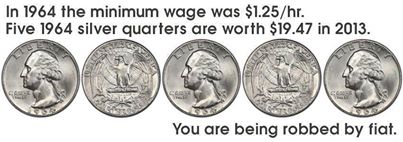
Once a currency becomes fiat, it is relatively easy for the central bank to manipulate the value of the money. Central banks ostensibly manipulate the currency to control inflation by “stimulating” the economy or changing interest rates, but the reality is that injecting additional money into the economy is the source of inflation. There are two aspects to inflation. When the newsies report inflation, they are usually talking about price inflation. When the Fed injects money into the economy (i.e. by stimulus, AKA quantitative easing), it is inflating the money supply. That is monetary inflation. Monetary inflation dilutes the value of the money already in existence, so merchants have to raise prices in order to receive the same value for their products. Monetary inflation is meant to control price inflation by “stimulating” consumption, but it actually causes price inflation because it makes our money worth less than it was before!

This leads to all kinds of trouble. First, just like income taxation, it concentrates power that should belong to the people into a few select hands, namely the operators of the central bank. (In the case of the US, it’s the board of the Federal Reserve). Second, when a powerful group like the Fed lowers the value of your money, it is, just like income taxation, using the force of government to take value from you. Third, if the central bank goes too far with its machinations, it will create hyperinflation. This is when the money loses value so fast that prices may rise weekly, daily, or even hourly.  The money literally becomes more valuable as fuel for the fireplace or as wallpaper than as currency. If it is still accepted, it will take a literal wheelbarrow full of cash to buy a loaf of bread.  Can this happen in the US? Consider:

1551581_10153691567945515_1391063965_n