Four Branches of Dysfunction in US Government, Part IV

tax-slavery_cropped

By Mike Cronin

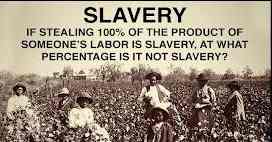
In Part III, I argued that income taxation is theft, and that it turns the rest of us into thieves and slaves. I also argued for a national sales tax, such as the Fair Tax. Why would I make such an argument? Isn’t one form of taxation just like another?  Nope.

Income taxation is rotten for at least two reasons: 1. It is taken from you, before you ever see it, through the coercive power of government. That is theft, plain and simple.  2. Then, as if that’s not bad enough, income taxation penalizes productivity – the more you make, the more you pay; and it’s not even a simple percentage; it’s “progressive.” That means that not only do have to pay more because you made more, you have to pay a progressively larger percentage of your income as your income increases.  It is insane to want and need people to be productive on the one hand, while progressively penalizing them for that very productivity on the other.

To make a simple analogy: if you try to teach and encourage a puppy to go outside to do his business, then smack him every time he does, and smack him harder and more often as he gets more insistent to go out, how long do you think it will be before he quits trying and just goes on the floor? Especially if you then give him a treat when he does?  Everyone may pretend to be happy in such a house, but the price of that feigned happiness is to either have to continuously clean up dog waste, or to live in a progressively more filthy and stinking residence.

A national sales tax, like the Fair Tax, is based on consumption, not income. That means you pay in based only what you buy and use. If you consume more goods and services and government, you pay more; if you consume less goods and services and government, you pay less. You are in control of how much you pay, not the government. There is no force, no penalty for productivity, no byzantine regulations, no loopholes, no escape for illicit profits, and no more IRS.

Four Branches of Dysfunction in US Government, Part III

Taxation-791x1024

By Mike Cronin

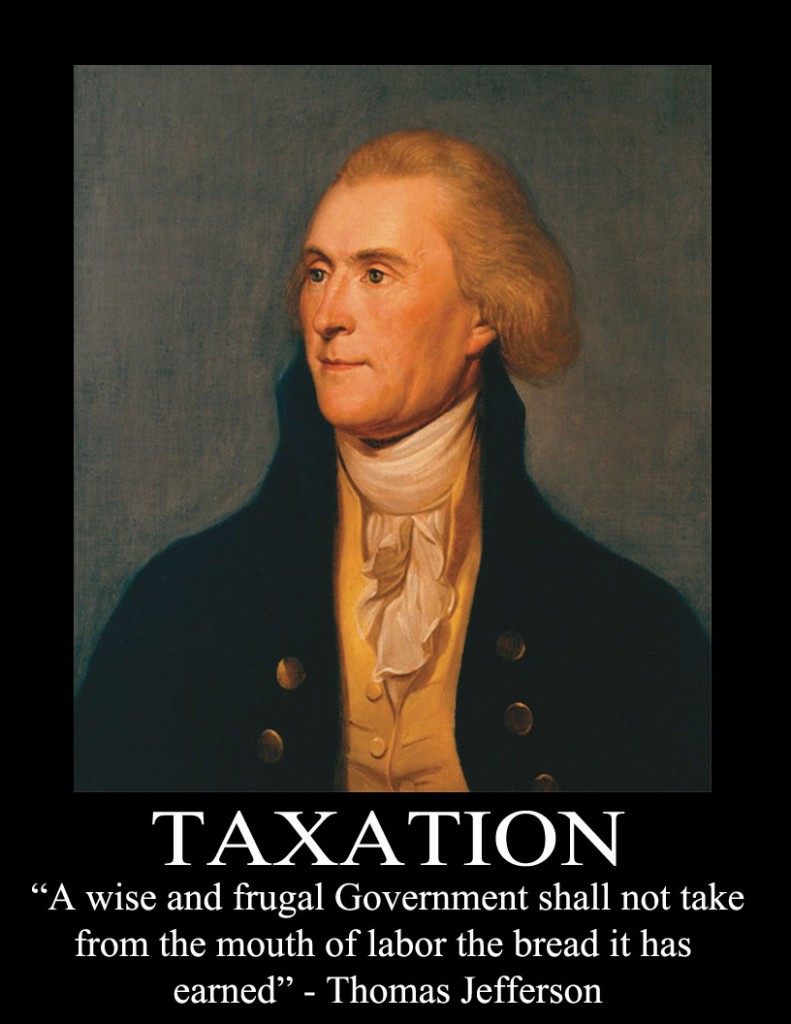
Another dysfunction that has corrupted the fabric of our freedom in countless ways is the confiscatory (i.e. to take) income tax system.  It is a dysfunction because it corrupts all of us.

Income taxation allows lawmakers and appointed bureaucrats to use the coercive power of government to take our property (i.e. the fruits of our labor) from us without our consent. That power then further corrupts our elected leaders by enabling them to “re-distribute” the collected revenue by spending it on government programs that favor their own constituencies. It has corrupted the citizenry by enabling us to obtain “benefits” that exceed the limits imposed on our government by its founding charter. Such “benefits” ultimately come to us from our neighbors’ pockets, which is property we had no right to. Our taxation system has essentially made Americans simultaneously into thieves and slaves.

Prior to the Civil War, there was no income tax. During that war, there was small tax of 3% on high incomes ($600-10,000 per year – a lot of money then!). It was abolished after the war. Congress flirted with income taxes a few more times between the Civil War and the turn of the century. In 1913, the government started taxing our income again, and it hasn’t stopped since.

Our founders went to war with Britain over far fewer provocations, including unfair taxation, than our own government imposes on us today. In fact, their grievances were listed on a single sheet of paper – the Declaration of Independence.  Could we catalog all of the grievances our tax laws generate today on even just one ream of paper? Our taxation bondage may not seem brutal to you, especially compared to what people living under fully tyrannical governments have to endure, but the proper comparison of our burden is not to what others have to endure elsewhere, it is to what it means to be “the land of the free.” If your government takes half of everything you earn, or more, either directly or indirectly, are you free?

Perhaps it sounds to you like I am advocating violent revolution, or that you break the law and dodge your tax obligations.  I am not.  As long we have the freedom of speech, we have the means to peaceably restore a bit of sanity to our system. One possible way is by switching from a confiscatory income tax to a national sales tax, such as that espoused by The Fair Tax proposal.

When it comes to income taxation, you may be happy to “pay your fair share,” or you might deny that withholding income taxes is any kind of slavery, but consider: If your property is taken from you by threat of force by  another, we call it robbery. When people are treated as property and forced to work for others, with no right to keep the fruit of their labor, that is slavery. Our taxation system is a whole lot of both .

Four Branches of Dysfunction in US Government, Part II

War

By Mike Cronin

“What’s the point of having this superb military that you’re always talking about if we can’t use it?” Secretary of State Madeleine K. Albright in 1993, to then Chairman of the Joints Chiefs of Staff Gen. Colin Powell, in reference to Bosnia

In Part I, I opined that slavery was the first of four major branches of dysfunction that plague our government, and that slavery led us to the worst instance of the second: the Civil War. George Washington once compared government to fire: “Government is not reason; it is not eloquent; it is force. Like fire, it is a dangerous servant and a fearful master.” Government attracts the power hungry, and war is the most attractive method for the power hungry to exercise their power. War negates reason, and provides a fertile field for yet more power to accrue to the government.  It changes the balance of power in the relationship between people and government – war gives unjust power to the government, powers NOT derived from the consent of the governed.

It is to America’s credit, and to the genius of the founders, that for the most part our government’s powers have retracted somewhat after our wars, but it is to our detriment that that power has never ebbed to the level it was at before each war.  In other words, our government assumes new and greater powers with each war, and then sheds some measure of the accrued power after the war, but never all of it. Hence, with each succeeding war, our government grows and become more intrusive.

Certainly, some wars are more just than others, and our nation must be prepared to them. I felt strongly enough about that to serve in the military, but not blindly. Which wars are just?  Smashing Al-Qaeda was (and remains) a national defense imperative. Going after Saddam Hussein was just, but appears to have also been unwise. Was the Spanish-American war just and wise? It put America on map as a great power, but was it necessary to the defense of the nation?  We weren’t attacked or threatened by Spain.  Historians have alleged that President Roosevelt pressured and goaded the Japanese in to attacking us in order to get us into WW II. We probably would have been drug into the war at some point, regardless, but, if true, was it just and wise to encourage and hasten it? If the Spanish-American War put us on the map as a great power, WW II left us (briefly) as the only superpower, and the Cold War left us alone on the superpower stage. It may be good to be the king, but is it wise to be the largest target in a hostile world?

Slavery and war have exposed us to several virulent strains of hypocrisy: Our founders held that all men were created equal…unless one didn’t count as a man. We abolished the chattel slavery of Africans and their descendants in the south, but periodically enslaved men of all colors and creeds through conscription until the 1970s.  We want to bring peace and freedom and prosperity to the world, but we have allowed (or engineered) ourselves to engage in the biggest wars in history, and suffered internal paroxysms as a result.  If there can be such a thing as a national psyche, these dichotomies are not conducive to its health.

Four Branches of Dysfunction in US Government, Part I

civilwar

By Mike Cronin

Ronald Reagan once said that government is not the solution to our problems, government is the problem. What did he mean by that? After all, he was president at the time; surely he must have felt that at least some government is good and necessary. As I have expressed in previous posts, our government has become dysfunctional. Just as cancers are flawed cells that grow uncontrollably, consume resources, and displace healthy tissue, dysfunctional government supplants healthy government.  This is what Reagan was referring to.  How is our government dysfunctional? In my opinion, there are four major, interlocking branches of dysfunction: Slavery, war, confiscatory taxes, and currency debasement. In turn, these branches of dysfunction are fueled by ignorance and ambition to power.

Our government was established to protect our rights to life, liberty, and the pursuit of happiness, but dysfunction was present right from the start. The founders articulated the notion that all men are created equal – but they didn’t recognize slaves as wholly men. Slaves counted only as 3/5ths of a person. Our nation began its life trying to cope with a terrible cognitive dissonance and human injustice – one that would cause arguably the greatest existential crisis it has yet faced: the Civil War.

You might argue that the Civil War was about states’ rights, not slavery. Well, there was one “state right” in particular that the South’s economy relied on: slavery. The Southern States seceded in order to hang on to the institution of slavery, but President Lincoln would not tolerate the dissolution of the union, so the first dysfunction led to the second: war. While Lincoln is widely hailed as the Great Emancipator and one of our best presidents, he assumed virtually dictatorial powers during the war, and expressly violated the Constitution and the Bill of Rights, thus setting precedent to his successors that might wish to do the same. One example: Lincoln ordered two newspapers critical of him to be shut down and had their owners and editors arrested for disloyalty.

While the aftermath of the Civil War may have seen the restoration of the country and the abolition of one form of slavery, it did not absolve us of the original dissonance slavery caused. It took another hundred years before the law and most of the nation accepted the full humanity of blacks, but vestiges of racism still haunt us, and our presidents still exercise more power than the Constitution allots them.

Thoughts on Illegal Immigration

34152946-illegal-immigration

By Mike Cronin

The topic of amnesty and “a path to citizenship” for those illegally present in the US has been making the news lately.  Illegal immigration is a complicated issue; perhaps we can unravel it a bit.

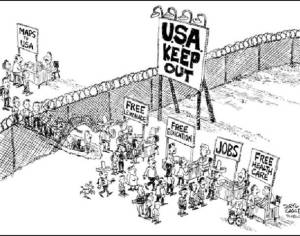
Illegal immigration occurs for a variety of reasons (economic opportunity, drug smuggling, social benefits, joining family, human trafficking, etc.) but only one principle applies: Incentive. People come here (or are brought here) illegally because they (or their abductors) perceive a benefit that outweighs the risk.

There are about 11-12 million people present in the US illegally.

Illegal immigration is not a felony, such as robbing a bank. It is a civil offense that comes in several forms: illegal entry and overstaying a visa are two. These violations carry relatively minor penalties. Nonetheless, illegal immigration is a violation of federal law.

PC police would have us believe the terms “illegal immigrant” and “illegal alien” are racist.  The reasoning goes that the terms should be treated as slurs because most (about 70-75%) of those to whom they apply are Hispanic and hale from Mexico and Central America, or because no person is illegal, only acts are. “Undocumented” is the preferred substitute. No doubt, there are racists who use one or other of the terms as code for those of Hispanic descent.  That does not mean everyone who uses the terms is making a slur. If I drive faster than the speed limit, I am a speeder.  If I steal candy from a convenience store, I am a shoplifter. People who commit such minor offenses and misdemeanors earn themselves appropriate sobriquets, which do not brand them for life. Likewise, people who are illegally present in the US, especially those who remain so of their own free will, have earned a descriptive moniker; “illegal immigrant” is factual, fit for polite company, just like “speeder” or “shoplifter,” and it can be overcome.  It certainly has a more benign connotation than many other terms one can think of.

Amnesty has been granted at least once before: By Ronald Reagan. Whatever their opinion or stance on amnesty, Republican politicians are generally not in favor of providing a path to citizenship, because, as has been mentioned, the vast majority of those who would benefit from such a path are Hispanic, and Hispanics, as a demographic, tend to vote for Democrats. By the same token, whatever their stated rationale may be for supporting a path to citizenship, Democratic politicians are aware of the huge voting bloc that would accrue to them if “path to citizenship” legislation came to pass.

In my opinion, this entire problem can be greatly reduced in the following ways:

  1. Legal immigration is a nightmare unless you are related to a citizen, rich, or eminent. We need to bring back the “Ellis Island” style of immigration: One shows up at the port of entry, gets documented, enters legally, and works towards citizenship. No quotas.
  2. We need to eliminate the incentives for immigration that stem from dysfunctional governance, such as minimum wage laws that incentivize paying paltry wages under the table to migrant workers, draconian drug laws that ensure the street prices attract the most ruthless minds to the narcotics trade, and “in-state” tuition rates at colleges and universities.
  3. Any “amnesty” or “path to citizenship” for those already here illegally must include paying the routine fine for the applicable original offense(s). Amnesty should only be from deportation, not from being cited and fined for the original immigration offense. Exemptions should be given for those who were brought here as minors or demonstrably against their will. Any “path to citizenship” should not be rewarded to those already here illegally simply because they are here illegally. It should include being placed last on current applicant lists – in other words, people who have followed the law and are waiting to gain entry, legal residency, and/or citizenship should be ahead of “path” applicants for citizenship consideration. Public or military service for qualified candidates could serve as an alternative mechanism, provided the same opportunity is given to standard applicants.
  4. We need to secure our borders.

A Response to TIME Magazine’s Mark Thompson

Veterans-Day

By Mike Cronin

Writing for TIME magazine, Mark Thompson asks: Are U.S. Veteran’s Selfish?  

In the article, he argues that since veterans have received substantial pay and benefit increases since 9/11, they should not be so testy about recent cuts to the cost-of-living raises for retirees and proposed cuts to commissary subsidies.  I wrote the following response: (full disclosure: I am a military retiree).

Veterans aren’t selfish for wanting to keep the benefits they were promised and that they earned with their blood and sacrifice, anymore than any civilian corporate employee is selfish if they get upset when their company unilaterally cuts pay and/or benefits. Veterans understand the need for cuts and savings; they simply demand that ways be found to do it honorably. Regardless of how military compensation has increased over the last decade (those increases were meant to close a significant pay gap, by the way), there is no moral justification for reducing promised compensation to those who held up their end of the bargain. If cuts to military pay and benefits must be accomplished, it would be moral to make new promises to new troops (before they sign on the bottom line), but cuts could also come from other sources that are, at the moment, off the table.

We are in the current predicament because Congress has boxed the military in by not allowing more strategically considered fiscal savings, such as a round of stateside and/or overseas base closures, or cancellation of major weapons systems.  It’s simply not politically expedient for an elected official to face their constituents and tell them the base is closing or that they won’t be needed to build ships, tanks, or fighters.

That political expediency is further exposed by Congress’ refusal to reign in the Fed’s “qualitative easing” to the tune of $85 billion per month. If we need to make spending cuts so bad, (and we do) how about we start by picking the ridiculously-low hanging fruit first and turn off the free-money tsunami?

So Mr. Thompson: who is really selfish?  The vets who more than earned what they were promised through their sacrifices, or the politicians who make empty promises and no sacrifices at all?

Read more: Veterans fighting benefit cuts sought by Congress and the Pentagon | TIME.com http://swampland.time.com/2014/01/26/are-u-s-veterans-selfish/#ixzz2rf7JYtI5

Your Income: Earned or Distributed?

tumblr_mht7sopr8g1qg4lyzo1_1280

By Mike Cronin

When you received your pay check, was it because you earned it by trading your time and skill for money, or because it was just “distributed” to you?  I suspect you answered that you earned it. Most of us do. That’s why talk about the vast “income inequality” in our country can be very misleading.

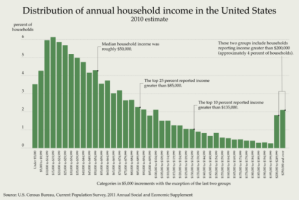
When a statistician talks about income distribution, he or she is referring to how income brackets fit in a bell curve, like in the chart above.  When a politician or a pundit talks about income or wealth distribution, we are supposed to just act as if our money has been unfairly distributed and not earned, and  certain adjustments are necessary to make things “fair.”  These adjustments take the form of taxes, if you “received” too much, or hand outs and benefits, if you “received” too little.

The statisticians’ usage of the term distribution is neither bad nor good, it’s just math. The politicians’ and pundits’ usage of the term distribution is insidious, because it sounds so fair, but it drops contexts in at least two ways.  Every dollar that is “given” by the politicians to those who didn’t have “enough” income “distributed” to them, either:

  1. Had to be taken away from those who had produced it, then “redistributed” to the “have nots;”
  2. or, it had to be minted, printed, or digitally conjured up out of thin air and “pumped” or “quantitatively eased” into the economy.

The first is literal and direct theft (though we call it income taxes) and the latter is indirect theft, because it steals value from our existing money. (Full disclosure: I work for the government, so almost my entire income during my working life has come from your taxes – and my own. The part of the government I work for is clearly derived from the enumerated powers in the Constitution, and I favor The Fair Tax vice the confiscatory taxation system we have today. Decide for yourself whether I am a hypocrite. The thought has given me pause from time-to-time.)

So, statistically speaking, we have a vast disparity between the highest income earners and the lowest. That does not mean income distribution is unfair, because it does not mean that the “haves” with huge incomes somehow just got lucky and received an unfairly large distribution of money. Maybe they earned it, maybe they inherited it, maybe they embezzled it. The fact that they have It is not proof that they got it unfairly. Likewise, the fact that “have nots” at the low end of the income bell curve don’t have more doesn’t mean that they have somehow been cheated. Perhaps it means that they can work hard, gain skills, and climb into higher income brackets.

Is Your Water Organic?

Organic water_1

By Mike Cronin

Have you heard that scientists have found that our drinking water contains dihydrogen monoxide (DHMO)? Something needs to be done!  No it doesn’t. Dihydrogen (DH or H2) monoxide (MO or O) IS water: DHMO = H2O. Dihydrogen monoxide sounds scary, because it’s a chemical term, and because it contains the word monoxide, which is also in carbon monoxide, the harmful gas that can be released in your house by a leaky furnace or into your car from a leaky exhaust system.

OK, dihydrogen monoxide is safe, but what about sodium chloride? Surely you’d be concerned if you were eating that? After all, it contains chlorine, the same stuff that’s in bleach! Well, too much of it can certainly be bad for your blood pressure, but you probably eat it every day. Sodium chloride (NaCL) is just table salt!

“Organic” food is better for you than inorganic food, right?  Well, consider this: The diet & health industry has smuggled a new meaning onto the word “organic.” We’re supposed to think that “organic” food is better for us because it contains fewer chemicals than non-organic food. In some cases it may actually be true, but there’s a catch: In its truest sense, the word “organic” simply means “containing carbon.” By that definition, almost any food you care to name is technically organic (I’m not sure about Twinkies).  Just as our “fossil” fuels, i.e. hydrocarbons, are organic, our body fuels, i.e. carbohydrates and proteins, are also organic. that means that if a food manufacturer labels an item “organic” that doesn’t pass the government’s criteria for “certified organic” food, the firm can get in trouble for mislabeling the package, when in fact if the item has carbs or protein it most certainly is literally and factually organic! About the only food items we put into our bodies that are truly not organic are salt (sodium chloride – no carbon!), trace minerals (iron, zinc, selenium, etc. – no carbon!) and WATER! (Dihydrogen monoxide – no carbon!)

So what’s the point of these scientific word tricks?  Only this: Sometimes you can be lead to worry, or to panic, or to pay more by folks selling you snake oil – especially if it’s factually accurate but misleading (in the case of organic food) or when it’s packaged in double speak, as in “organic water.”

Are You Guilty of Enjoying White Privilege?

quote-i-look-to-a-day-when-people-will-not-be-judged-by-the-color-of-their-skin-but-by-the-content-of-martin-luther-king-jr-102475

By Mike Cronin

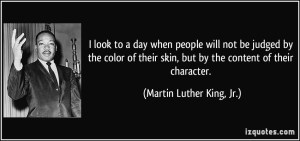
On the occasion of Martin Luther King, Jr. Day, I find myself recalling a class on multiculturalism in my MA program. During the class, one of the topics was “white privilege.”  The essence of white privilege is that being born white, especially as a male, comes with certain privileges that members of other demographic groups don’t get.  The course hinted that white men could and should feel guilty about this privilege, and that they should take unspecified actions to atone for this guilt. 

I had very mixed feelings about this. I acknowledge that, as a white American male, compared to most people in the US and the world, I have a relatively benign position in life. I even accept that due to the accident of my birth, I began life with more advantages than most. If life is a game, then I acknowledge that I started on the easiest setting.  What I could not, (and still cannot) accept, is that I should feel guilty about it.  Guilt implies wrongdoing, and wrongdoing implies a choice between right and wrong. Infants have no understanding of right and wrong, and have not developed the mental faculties to make conscious choices. I cannot be guilty of being a white male, because it is not wrong, and because I had no choice in the matter. 

That means I have nothing to atone for. On the other hand, knowing that just about every other demographic may be “playing life” on a more difficult setting than I am requires that I ask: As an adult with the ability to understand right and wrong and to make conscious choices, what should I do, if anything, about “white privilege?”  I cannot undo history, nor can I change  anyone’s heritage.  I could give money to various causes, but that would have mixed results at best. 

The answer that I arrived at: Context matters.  While, as whole, white males may get the best “starting position” of any group, all groups are made of individuals, and individual circumstances vary. Some white males had it worse than I did, and some had it better. Likewise, while as a group, Asians, blacks, Hispanics, women, or others might not have had as good a starting position as white men, there are individuals in each cohort that started life out in an even better position than I did. In other words, the answer to “white privilege” is not to feel guilty and attempt to atone for something outside of one’s control, but rather to see and interact with every person as an individual, not as a representative of a demographic group (race, ethnicity, gender, etc.). The best thing anyone can do to create a level playing field is not to dole out compensatory advantages to some members of this or that “underprivileged” group, but simply to not hate or act against others because of their differences – to not purposely be bigoted, prejudiced, misogynistic, homophobic, racist, etc. Instead, respect individuals, and be a proponent of individual rights. Since the smallest possible minority is an individual, individual rights ARE minority rights.

Is Your News Real?

250px-Adnan_Hajj_Beirut_photo_comparison

Image comparison: L: actual image. R: “Photoshopped” image published by Reuters in 2006.

By Mike Cronin

No matter how hard you try with diets, make-up, and exercises, you will never look as good as a celebrity or model in a magazine.  That’s because they don’t even look that good in real life! It takes professional make-up artists, photographers, and designers to produce such photos, but it doesn’t end there. Photoshop is used to alter almost all celebrity/model photographs:

http://www.youtube.com/watch?v=YP31r70_QNM

Likewise, if you run the propaganda department for your local dictator, Photoshop is your best friend…if you can use it without botching the job:

http://www.thewire.com/global/2011/07/tour-worlds-worst-photoshop-propaganda/39932/

The motive for “Photoshopping” in the above cases is s clear: To improve on reality. In this next case, the motive for faking reality is not so clear. Several CNN and HLN reporters are in Phoenix covering the Jody Arias trial. Four of them are in the same place covering the same story. Two of them are in the same parking lot, a few yards apart.  So why do they conduct split-screen “satellite” interviews with each other as if they were on opposite sides of the country?  Perhaps because, while it does nothing for the story itself, it does pump up the visual “action” level:

http://www.thewire.com/national/2013/05/nancy-grace-ashleigh-banfield-cnn-parking-lot/64965/

While Photoshoping and adding “drama” with split screens may improve on reality, sometimes the “news” is just outright faked: In Nov of 1992, NBC Dateline ran a story about the alleged propensity of Chevrolet/GMC pick-ups to catch fire in a side-impact collision due to the placement of the fuel tanks. The video in the story included two “test” accidents. During one of the tests, flames did indeed erupt from one of the pick-ups. GM conducted its own investigation into the story and found that the contractors NBC had hired to set up the test accidents had rigged the trucks with model rocket motors to ensure there would be a fire if fuel leaked.  NBC aired an apology in February 1993, and several of the journalists involved in the story were fired or resigned:

http://www.nytimes.com/1993/02/10/us/nbc-settles-truck-crash-lawsuit-saying-test-was-inappropriate.html

The morals of the story:

1. Don’t base your self-image on a comparison against celebrities or models enhanced by professional image-makers.

2. Even the “news” is sometimes rigged to present you with a filtered and scrubbed reality. Watch skeptically.