A Capital Idea: an “-ism” for Freedom

By Mike Cronin

Last week, I offered the view that adopting socialism is a recipe for disaster. Most of the political “-isms” (socialism, communism, fascism, imperialism, etc.)  “-chies” and “-cracies” (monarchy, anarchy, theocracy, democracy, plutocracy, oligarchy, etc.) sound different on paper, but they all have two things in common: the rule of one human or few humans over the rest, and the absence of individual freedom.

There is an alternative.  Our founders gave us a Constitutional republic which enshrined the rule of law and individual liberty.  The essential element of freedom is property rights, including self-ownership.  The political-economic system that arises where freedom reigns is called capitalism.  It has never been fully embraced by any country.  Our own country perhaps came the closest, which greatly contributed to the vast economic achievements and ever-increasing prosperity we came to expect as Americans.

Yet our failure to fully adopt it has had a profound effect on our history. The institution of slavery was a direct affront to the concept of freedom, and it convulsed our country from its beginnings through the Civil War and beyond. I’ve written elsewhere of slavery and unjust war as two of the four major dysfunctions that have afflicted our country.

Want some examples of how capitalism is better than socialism?

The Ukraine is a geographic bread basket, similar in productive potential to the US Midwest; yet the Union of Soviet Socialist Republics (of which Ukraine was once one of the socialist republics) had to import grain from us during the height of the cold war. Why couldn’t they produce and distribute enough to feed themselves?

Virtually every labor saving and communications device and other technological advancement since the Dark Ages was invented or perfected in the US or another semi-capitalistic country. (E.g. the electric light bulb, the car, the airplane, the microwave oven, the TV, VCR, and DVD, the laser, vaccines, etc.). Have you ever considered buying a car designed and manufactured by an Iranian or North Korean company?  Does such a thing even exist? Why aren’t such things invented in dictatorships and socialist utopias?

In most cases, landlocked nations are doomed to economic mediocrity or worse. (Examples: Afghanistan, Mongolia, and Bolivia). But a few, such as Switzerland and Lichtenstein, are incredibly well off.  What separates them? The ones that are well off have a much higher degree of individual freedom and capitalism than the others.

China was once every bit the communist leviathan that the Soviet Union was.  Why didn’t China go the same way the USSR did? Conversely, why is the US going through a decline?

China is ascending to the same degree it has adopted limited capitalistic market reforms. Our country is declining to the same degree we adopt the socialist dysfunctions that destroyed the Soviets and continues to hamper the Chinese. Imagine the productive energy that could be unleashed if 1.4 billion people enjoyed a fully free existence!

Despite the vast body of historical evidence that capitalism works and socialism doesn’t, capitalism has been given a bad name.  Individual freedom requires individual responsibility for one’s own actions and living with the consequences of one’s choices.  For that reason, capitalism will always be a hard sell compared to the free goodies and cradle-to-grave care promised by the heralds of the other “-isms.” On top of that, where capitalism has some influence, prosperity follows. Prosperous people are easy for envy-baiters to blame in order to gain an audience…and power. In virtually every human system of organization other than capitalism, anyone with wealth could only attain it by taking a bigger share of “the pie” than everyone else. Capitalism is unprecedented – it allows the productive to enlarge the pie!  But the envy mongers can’t or won’t see that.  They say capitalism fosters greed.  There’s no denying that greedy people exist,  and some of them advance quite far under semi-capitalistic economies, but socialism is absolutely powered by greed and envy!

It is easy for the prophets of utopia to blame capitalism for the sins of the other systems. The latest example is the appellation “crony” capitalism.  The proper term for companies using influence, connections, and campaign donations to get laws passed that stifle their competition is “corporatism.”  Using the coercive power of government to stifle your competition when you can’t win competitively through offering better value is not capitalism at all, though it has some capitalistic trappings (namely the privately-owned nature of the corporation).

The really ironic thing about the other “-isms?”  They need the productivity of capitalism.  A greedy socialist can’t “redistribute” wealth from the productive to the parasitic if there isn’t any wealth to start with.  He must decry capitalism even as he robs the capitalistic in order to buy votes from those he has bamboozled.

Socialism Seems Free, but You WILL Pay for it!

By Mike Cronin

No doubt you’ve heard the word socialism being bandied about a lot lately. Democratic presidential candidate Bernie Sanders is an avowed socialist. A recent poll shows that 36% of millenials favor socialism.  And whys shouldn’t they? Free education!  Free healthcare!  Subsidized housing, food, & utilities! Socialism sounds really good. But it isn’t.

It might help if we have a common understanding of what socialism really is.

Simply, socialism is a political/economic theory where all property is owned “by the people.” What could be better than a place where all property is shared and nothing is owned?  That’s the theory.  In practice, It results in the state asserting primacy in all aspects of life and individuals having few, if any, rights. It is a form of collectivism – which means the group, or collective, is prioritized over the individual. Bee hives, ant colonies, and human “communes” are collectives. Under any form of collectivism, the majority can do away with the rights (and often lives) of the minority (of which the individual is the most basic element).

Collectivism/socialism comes in various forms, such as communism, which the Union of Soviet SOCIALIST Republics (USSR) subscribed to, and “Nationalsozialismus” (the German term for National SOCIALISM, from which the term “Nazi” is derived).  Some might argue that the Nazis were in fact fascist, not socialist.  Fascism was also the system of socialism that Mussolini oversaw in Italy. (The term fascism derives from the Latin term “fasces,” a bundle of sticks with an axe protruding from it. Fasces was the Roman symbol of power.)

Some political scientists argue that communism is on the political left, while fascism is on the right, as depicted in this graphic:

I argue that the only practical difference between communist variety of socialism practiced in Soviet Russia and the fascist-flavored socialism animating Nazi Germany and Italy was that the fascists gave lip service to the idea of private property rights – as long as the property was used at the direction of the state.   There were no private property rights at all in the Soviet Union.

Whether people have no property rights at all, or have the “right” to own property in service to the state, is a distinction without a difference. Both systems had charismatic, murderous dictators in charge. Both systems had secret police, concentration camps, and mass murders. Both systems failed to create wealth; they could only steal it or destroy it. There was no freedom in either system.

Thus, a more accurate depiction of communism and fascism on the right-left political model would be to put them both on the left under socialism, with freedom and capitalism on the right.  The diagram below is closer to the truth:

Consider that every country that has adopted any form of socialism has been degraded or destroyed in direct proportion to the degree of socialism it enacted. Nazi Germany. The Soviet Union. North Korea. Cuba. Venezuela.

China and Vietnam were once in the same boat, but both have attained some limited reversal from the crushing oppression the others experienced through adoption of limited free-market economic reforms. But make no mistake, the Chinese and Vietnamese people are not free.

Consider Karl Marx’s famous aphorism: “From each, according to his ability; to each according to his needs.” It sound so wonderful, but it glosses over the essential question: Who decides what your gifts and needs are? (Newsflash – it sure isn’t going to be you!) “From each, according to his ability” means that the state will extract every bit of use out of you that it can, and your desires are irrelevant.  “To each, according to his needs” means that the state, not you, will determine what you need, and you will be lucky to get it.

So how bad is socialism?  At it’s best, socialism creates resentment and dependency; at its worst the people living under socialist governments are slaves – the ones who survived mass murder.


Government = Force

Government is not reason; it is not eloquent; it is force. Like fire, it is a dangerous servant and a fearful master. Never for a moment should it be left to irresponsible action.  - George Washington

By Mike Cronin

To commemorate President’s Day, let’s use the above quote, allegedly from George Washington, as the genesis of a thought experiment. What if we replace the word “government” with the word “force” and ask what it is properly used for?

Is force a moral way to protect yourself from violence initiated by others?  I say yes.  Therefore, by extension, using government to deter violent attack, or to retaliate for the same, is proper.  The policing, defense, and intelligence functions of government are legitimate for this reason.

Is it moral to enforce contractual agreements and hold fraudsters accountable?  Again, I say yes, and again, I say the criminal justice functions of government are legitimate for this purpose.

Is it moral to use force to entertain people?  I say no.  Government funding for the arts is immoral in this context, not to mention absurd.

Is it proper to use force to educate people?  Once again: it is the wrong tool for the job.

Is it moral to use force to prevent you neighbor from viewing material you believe to be objectionable?  I say no. By extension, it is improper to rely on government to tell us what we can and cannot view (unless that material is produced by violating the rights of others, as in the case of child pornography).

How about using force to provide people a retirement check, health insurance, unemployment compensation, or other “entitlements?”

Or using force to provide subsidies, corporate bailouts, tax “credits,” and to manipulate the economy?

I could go on, but I think you see where I am going with this. If it is wrong for an individual to initiate the use of force against his or her neighbor directly, then it is just as wrong to employ the coercive power of government to commit the same crime by proxy.

Force is not only immoral to use outside of the context of protection from violence, fraud, or other violations of our rights, it is also manifestly the wrong tool for most jobs.  Using force to educate, or entertain, or to invent and deliver entitlements, is like using a sledgehammer to wash windows. The most likely outcome will be glass shards on the floor.  Yet even if you manage to avoid  shattering the glass, you still won’t get the windows clean.

That is the reason the Founders wrote the Constitution: to restrict the forcefulness of government to only those very few functions where force is the proper response, and to prevent its absurdly destructive employment against us in every other facet of life.

Four Branches of Dysfunction in US Government, Part II

War

By Mike Cronin

“What’s the point of having this superb military that you’re always talking about if we can’t use it?” Secretary of State Madeleine K. Albright in 1993, to then Chairman of the Joints Chiefs of Staff Gen. Colin Powell, in reference to Bosnia

In Part I, I opined that slavery was the first of four major branches of dysfunction that plague our government, and that slavery led us to the worst instance of the second: the Civil War. George Washington once compared government to fire: “Government is not reason; it is not eloquent; it is force. Like fire, it is a dangerous servant and a fearful master.” Government attracts the power hungry, and war is the most attractive method for the power hungry to exercise their power. War negates reason, and provides a fertile field for yet more power to accrue to the government.  It changes the balance of power in the relationship between people and government – war gives unjust power to the government, powers NOT derived from the consent of the governed.

It is to America’s credit, and to the genius of the founders, that for the most part our government’s powers have retracted somewhat after our wars, but it is to our detriment that that power has never ebbed to the level it was at before each war.  In other words, our government assumes new and greater powers with each war, and then sheds some measure of the accrued power after the war, but never all of it. Hence, with each succeeding war, our government grows and become more intrusive.

Certainly, some wars are more just than others, and our nation must be prepared to them. I felt strongly enough about that to serve in the military, but not blindly. Which wars are just?  Smashing Al-Qaeda was (and remains) a national defense imperative. Going after Saddam Hussein was just, but appears to have also been unwise. Was the Spanish-American war just and wise? It put America on map as a great power, but was it necessary to the defense of the nation?  We weren’t attacked or threatened by Spain.  Historians have alleged that President Roosevelt pressured and goaded the Japanese in to attacking us in order to get us into WW II. We probably would have been drug into the war at some point, regardless, but, if true, was it just and wise to encourage and hasten it? If the Spanish-American War put us on the map as a great power, WW II left us (briefly) as the only superpower, and the Cold War left us alone on the superpower stage. It may be good to be the king, but is it wise to be the largest target in a hostile world?

Slavery and war have exposed us to several virulent strains of hypocrisy: Our founders held that all men were created equal…unless one didn’t count as a man. We abolished the chattel slavery of Africans and their descendants in the south, but periodically enslaved men of all colors and creeds through conscription until the 1970s.  We want to bring peace and freedom and prosperity to the world, but we have allowed (or engineered) ourselves to engage in the biggest wars in history, and suffered internal paroxysms as a result.  If there can be such a thing as a national psyche, these dichotomies are not conducive to its health.

Four Branches of Dysfunction in US Government, Part I

civilwar

By Mike Cronin

Ronald Reagan once said that government is not the solution to our problems, government is the problem. What did he mean by that? After all, he was president at the time; surely he must have felt that at least some government is good and necessary. As I have expressed in previous posts, our government has become dysfunctional. Just as cancers are flawed cells that grow uncontrollably, consume resources, and displace healthy tissue, dysfunctional government supplants healthy government.  This is what Reagan was referring to.  How is our government dysfunctional? In my opinion, there are four major, interlocking branches of dysfunction: Slavery, war, confiscatory taxes, and currency debasement. In turn, these branches of dysfunction are fueled by ignorance and ambition to power.

Our government was established to protect our rights to life, liberty, and the pursuit of happiness, but dysfunction was present right from the start. The founders articulated the notion that all men are created equal – but they didn’t recognize slaves as wholly men. Slaves counted only as 3/5ths of a person. Our nation began its life trying to cope with a terrible cognitive dissonance and human injustice – one that would cause arguably the greatest existential crisis it has yet faced: the Civil War.

You might argue that the Civil War was about states’ rights, not slavery. Well, there was one “state right” in particular that the South’s economy relied on: slavery. The Southern States seceded in order to hang on to the institution of slavery, but President Lincoln would not tolerate the dissolution of the union, so the first dysfunction led to the second: war. While Lincoln is widely hailed as the Great Emancipator and one of our best presidents, he assumed virtually dictatorial powers during the war, and expressly violated the Constitution and the Bill of Rights, thus setting precedent to his successors that might wish to do the same. One example: Lincoln ordered two newspapers critical of him to be shut down and had their owners and editors arrested for disloyalty.

While the aftermath of the Civil War may have seen the restoration of the country and the abolition of one form of slavery, it did not absolve us of the original dissonance slavery caused. It took another hundred years before the law and most of the nation accepted the full humanity of blacks, but vestiges of racism still haunt us, and our presidents still exercise more power than the Constitution allots them.

The Deficit, the Debt, and Unfunded Liabilities

images (1)

By Mike Cronin

You’ve heard politicians say we need to increase taxes on the wealthiest Americans. You may have also heard other politicians say our government is spending too much, because we have such a high national debt. Then, invariably, the first group of politicians will respond that they’ve cut the deficit. So how can the debt go up, when the deficit is coming down? What’s the difference?

The deficit is the amount the government has spent over and above what it has taken in during the current fiscal year. For 2013, that amount was over 1/2 trillion dollars. The national debt is the total amount of money, from all years, that the government owes to those from whom it has borrowed (namely US and foreign banks). This number is somewhere around 17 trillion dollars. That’s 17 thousand billion, or 17 million million. Written out, that’s $17,000,000,000,000. Because the deficit is overspending, whenever we have a deficit, any deficit, the debt will go up…even if the deficit is smaller than the previous year. A reduction in deficit spending doesn’t mean the government got it’s financial affairs in order, it just means they slowed down the overspending a little. in fact, the debt can go up even if we have zero deficit in a given year, because the interest on the debt keeps it growing.

If those facts & figures aren’t shocking enough, there is another number we must consider, but you almost never hear about it in the news. That figure represents the unfunded liabilities of the government.  That’s the amount of money it will take to pay for all of the benefits and entitlement payments the government has promised to pay in the future, such as Social Security and Medicare, to people who aren’t old enough, or otherwise eligible, to receive them now. That number is estimated to be anywhere from 55 trillion to 222 trillion dollars, depending on who is doing the estimating and what is included.   That is more than the gross national product of all of the countries in the world, combined.  In other words, our government has overspent, or will overspend, more money now and in the future than the total economic output generated by the entire world!

So, do you think  we have a revenue problem, or a spending problem?

Deficit: What the government overspent in fiscal year 2013 (about $700 billion, according to the US Treasury Dept.)

Debt: What the government has overspent in total (about $17 trillion)

Unfunded Liabilities: What the government has promised to pay in the future over and above what it is projected to take in ($55-222 trillion)

America: Republic, Democracy, or Empire? Part II

download (2)

By Mike Cronin

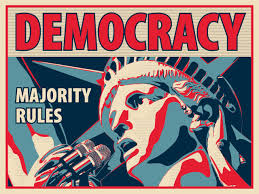
In modern usage, the original meaning of the word “democracy” has been camouflaged. Whereas most folks understand it to mean electing our leaders and having a say in the affairs of our government, that is not what democracy means.  The hard reality is more insidious: the word democracy comes from the Greek word dēmokratiā, which was coined from dēmos (“people”) and kratos (“rule”). Democracy literally means “the peoplerule.”  We interpret that as “majority rule.” That sounds pretty good, right?  Isn’t that what we are supposed to have in America?

“Democracy is two wolves and a sheep voting on what’s for dinner. In a republic, the sheep is well armed and able to contest the vote.” – multiple attributions.

But what if you are not in the majority?  Especially for an issue that has to do with your rights?  Should the majority be able to dispense with your rights just because they are the majority? The founding fathers didn’t think so; through the Constitution, they gave us the rule of law and a republic, not the rule of the majority. Our Constitution is designed to protect our rights – both from the government and from any majority who might wish to “democratically” vote them away. It does so via the techniques of splitting the government into three branches (legislative, executive, judicial) and by placing various checks and balances against them. For example, we elect our leaders, but they can’t legally impose any law on us that violates the Constitution. To make those laws requires great effort. First, both sides of Congress can pass proposed legislation, i.e. bills, by a simple majority vote, but they don’t become law unless the president signs.  If the president vetoes a bill, Congress can try again, but it takes a two-thirds majority to overcome the veto.  Meanwhile, if a law comes into dispute, the Supreme Court can rule it unconstitutional and order it struck down. In our system, the people are supposed to get their say by electing their representatives; the people don’t get a direct vote on legislation, and neither “we the people” nor our elected representatives can legally bypass the structures and processes our Constitution imposes on the government. Thus, we are supposed to have the rule of law, not a democracy (in the strict sense of the word).  In fact, believe it or not, the word “democracy” does not appear in either the Constitution or the Declaration of Independence! But  why shouldn’t we have a democracy? I’ll let historian Alexander Frazier Tyler explain:

“A democracy cannot exist as a permanent form of government. It can only exist until the voters discover that they can vote themselves money from the public treasury. From that moment on, the majority always votes for the candidates promising the most benefits from the public treasury with the result that a democracy always collapses over loose fiscal policies, always followed by a dictatorship. The average age of the world’s greatest civilizations has been 200 years.” 

Well, judging by the state of 237-year-old America today, it looks to me like the republic is giving way to democracy, but the transition is not complete, nor assured. Will we complete the transition and give in to dictatorship, or will “we the people” restore the republic?

America: Republic, Democracy, or Empire? Part I

framers

By Mike Cronin

At the close of the Constitutional Convention in 1787, Ben Franklin was asked what kind of government had been created. He replied “A republic, if you can keep it.”   Yet today, you almost never hear people call the U.S. a republic. It’s often called a democracy.  It is also sometimes spoken of as an empire, usually in a derogatory way.  So what are we supposed to have, and what do we actually have?

Let’s start with “republic.” The word republic, derived from the Latin res publica, or “public thing,” refers to a form of government where the citizens conduct their affairs for their own benefit rather than for the benefit of a ruler. It’s the form of government we are supposed to have, it’s the form of government our Constitution establishes, and that our presidents, military, and other public servants swear oaths to support and defend.   That’s what our founders gave us.

So, do we Americans conduct our affairs for our own benefit, or for the benefit of a ruling power?  How long do you have to work each year to pay your tax bill? How much paperwork do you have to fill out to file your taxes? Is the NSA spying on you? Can you sell your product without some kind of mandatory labeling to warn idiots not to do something stupid with it? If you decide to home school your kids, or send them to private school, do you still have to pay for your neighbors’ kids’ public schooling? If the local government thinks your house and yard would be put to better use as a shopping mall, will you be able to keep your own property?  Can you conduct any financial affairs without government scrutiny? Can you travel anywhere you like via any mode of transportation you want without having your papers checked and/or your property or your person searched? Are your particular vices allowed or prohibited?  Can you marry whichever mutually consenting adult(s) you’d like? Can a male over 18 NOT register for the draft without consequences?  If you decide to hire candidate X instead of candidate Y, are you going to get into hot water for not supporting affirmative action or diversity goals?  Once that has been settled, can you pay the candidate what the work is worth, or do you have pay them what the government says you must?  Are you obligated to provide a benefit package to boot? Do you have to take a drug test in order to work, so that the government can give some of your money to people who don’t work and couldn’t pass a drug test? Can you keep your insurance plan and /or your doctor this year? Are you in compliance with all of the millions of pages of other laws and regulations our government has levied on us over the last 237 years?

I think we can say, that based on the definition above, we are no longer fully functioning as a republic. To be sure, and for now, we still have many freedoms, including the freedom to write a blog like this one, and many other trappings of a republic, including the ability to vote. But are we truly able to conduct our own affairs for our own benefit?