Are You Guilty of Enjoying White Privilege?

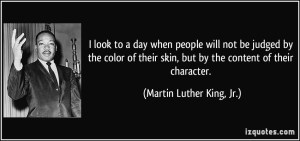
quote-i-look-to-a-day-when-people-will-not-be-judged-by-the-color-of-their-skin-but-by-the-content-of-martin-luther-king-jr-102475

By Mike Cronin

On the occasion of Martin Luther King, Jr. Day, I find myself recalling a class on multiculturalism in my MA program. During the class, one of the topics was “white privilege.”  The essence of white privilege is that being born white, especially as a male, comes with certain privileges that members of other demographic groups don’t get.  The course hinted that white men could and should feel guilty about this privilege, and that they should take unspecified actions to atone for this guilt. 

I had very mixed feelings about this. I acknowledge that, as a white American male, compared to most people in the US and the world, I have a relatively benign position in life. I even accept that due to the accident of my birth, I began life with more advantages than most. If life is a game, then I acknowledge that I started on the easiest setting.  What I could not, (and still cannot) accept, is that I should feel guilty about it.  Guilt implies wrongdoing, and wrongdoing implies a choice between right and wrong. Infants have no understanding of right and wrong, and have not developed the mental faculties to make conscious choices. I cannot be guilty of being a white male, because it is not wrong, and because I had no choice in the matter. 

That means I have nothing to atone for. On the other hand, knowing that just about every other demographic may be “playing life” on a more difficult setting than I am requires that I ask: As an adult with the ability to understand right and wrong and to make conscious choices, what should I do, if anything, about “white privilege?”  I cannot undo history, nor can I change  anyone’s heritage.  I could give money to various causes, but that would have mixed results at best. 

The answer that I arrived at: Context matters.  While, as whole, white males may get the best “starting position” of any group, all groups are made of individuals, and individual circumstances vary. Some white males had it worse than I did, and some had it better. Likewise, while as a group, Asians, blacks, Hispanics, women, or others might not have had as good a starting position as white men, there are individuals in each cohort that started life out in an even better position than I did. In other words, the answer to “white privilege” is not to feel guilty and attempt to atone for something outside of one’s control, but rather to see and interact with every person as an individual, not as a representative of a demographic group (race, ethnicity, gender, etc.). The best thing anyone can do to create a level playing field is not to dole out compensatory advantages to some members of this or that “underprivileged” group, but simply to not hate or act against others because of their differences – to not purposely be bigoted, prejudiced, misogynistic, homophobic, racist, etc. Instead, respect individuals, and be a proponent of individual rights. Since the smallest possible minority is an individual, individual rights ARE minority rights.

America: Republic, Democracy, or Empire? Part II

download (2)

By Mike Cronin

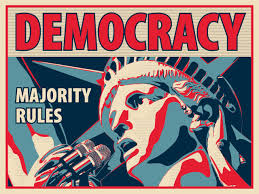
In modern usage, the original meaning of the word “democracy” has been camouflaged. Whereas most folks understand it to mean electing our leaders and having a say in the affairs of our government, that is not what democracy means.  The hard reality is more insidious: the word democracy comes from the Greek word dēmokratiā, which was coined from dēmos (“people”) and kratos (“rule”). Democracy literally means “the peoplerule.”  We interpret that as “majority rule.” That sounds pretty good, right?  Isn’t that what we are supposed to have in America?

“Democracy is two wolves and a sheep voting on what’s for dinner. In a republic, the sheep is well armed and able to contest the vote.” – multiple attributions.

But what if you are not in the majority?  Especially for an issue that has to do with your rights?  Should the majority be able to dispense with your rights just because they are the majority? The founding fathers didn’t think so; through the Constitution, they gave us the rule of law and a republic, not the rule of the majority. Our Constitution is designed to protect our rights – both from the government and from any majority who might wish to “democratically” vote them away. It does so via the techniques of splitting the government into three branches (legislative, executive, judicial) and by placing various checks and balances against them. For example, we elect our leaders, but they can’t legally impose any law on us that violates the Constitution. To make those laws requires great effort. First, both sides of Congress can pass proposed legislation, i.e. bills, by a simple majority vote, but they don’t become law unless the president signs.  If the president vetoes a bill, Congress can try again, but it takes a two-thirds majority to overcome the veto.  Meanwhile, if a law comes into dispute, the Supreme Court can rule it unconstitutional and order it struck down. In our system, the people are supposed to get their say by electing their representatives; the people don’t get a direct vote on legislation, and neither “we the people” nor our elected representatives can legally bypass the structures and processes our Constitution imposes on the government. Thus, we are supposed to have the rule of law, not a democracy (in the strict sense of the word).  In fact, believe it or not, the word “democracy” does not appear in either the Constitution or the Declaration of Independence! But  why shouldn’t we have a democracy? I’ll let historian Alexander Frazier Tyler explain:

“A democracy cannot exist as a permanent form of government. It can only exist until the voters discover that they can vote themselves money from the public treasury. From that moment on, the majority always votes for the candidates promising the most benefits from the public treasury with the result that a democracy always collapses over loose fiscal policies, always followed by a dictatorship. The average age of the world’s greatest civilizations has been 200 years.” 

Well, judging by the state of 237-year-old America today, it looks to me like the republic is giving way to democracy, but the transition is not complete, nor assured. Will we complete the transition and give in to dictatorship, or will “we the people” restore the republic?

Will You Vote for a Beekeeper?

1560419_10153711810335515_1801873282_n

Image from https://www.facebook.com/Capitalists

By Mike Cronin

The realm of politics is huge, and it can be confusing. Pundits are always talking about liberals & conservatives, Democrats & Republicans, ideologues & demagogues, and many other terms.  How can we make sense of it? In basic social studies or political science classes, teachers may introduce and discuss a model called the political spectrum. If you “google” images for “political spectrum,” dozens, if not hundreds, of different models will be displayed.  The most basic (and most commonly employed) model places Fascist totalitarianism (like Germany under Hitler) on the extreme right side of the scale, and Socialism or Communism (like the former Soviet Union or modern North Korea) on the extreme left side.  A government, a country, or a person’s political position can be gauged on this spectrum.

The problem with this model is that while the ideologies of Fascism and Communism may differ on the surface, in practice they result in the same conditions for the vast majority of people who live under them: tyranny, fear, and poverty. There may be distinctions between the two on paper, but in reality both ideologies are collectivist; that is, they believe that the state, or the party, or the race, or the group, i.e. the collective, is more important than the individual, and that the individual exists to serve the larger group. In other words, both of these forms of politics, communism and fascism, treat humans like bees or ants, i.e. as drones (or slaves). No individual is important, only the party, or country (or hive/colony, i.e. collective), matters.

The achievement of the founding fathers was in creating a nation founded on the concept that the individual has rights that are inherent, that is, they are not granted by the state, and that the purpose of the state is to protect those individual rights.

So, with mid-term elections coming this November, consider this: Whether a politician identifies as a liberal or a conservative, a Democrat or a Republican, does not matter as much as this: What does his or her character and voting record reveal about their understanding of individual rights?  Will you elect a defender of your rights, or a beekeeper?