The Death of Income Taxes

no_irs

By  Mike Cronin

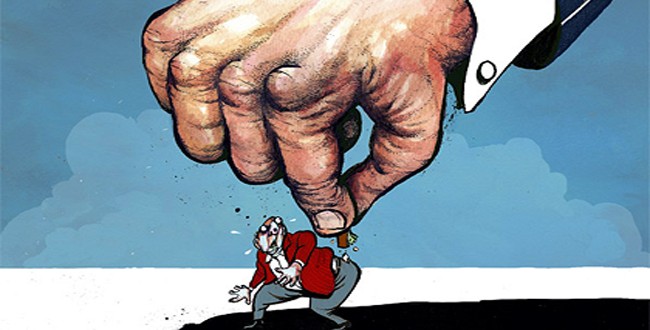
Imagine three of your neighbors come to you and tell you that as a group you are all going to vote on raising $10,000 for a playground. You’re don’t have kids, or they are grown and living on their own, so you vote no.  The other three all have kids, so they vote yes…and demand that you pay your “fair” share or they will beat you up.  They also decide that the more money you have, the more you have to pay.  Since you kids have moved out, you have more disposable income than any of them, so your “fair” share turns out to be half of the cost, or $5000, while each of their fair shares turn out to be about 1/6th of the cost, or about $1666 each. The three neighbors enter your house, find your safe, demand you open it, then they take $5000 from you.  They also demand that you assemble paper work that proves you don’t actually owe even more than the $5000, and give it to them by mid-April. You decide that it’s better to pay the $5000 and show proof that you don’t have to pay even more than to get beat up, so you spend several hours digging through your banking documents, and submit your financial “proof” that you paid enough.

The above scenario is a microcosm of how our tax system works today. The majority voted to take the property of the minority and use it to pay for something the minority didn’t ask for and doesn’t need or want. Our current system is confiscatory, that is, your money is confiscated from you. Worse, as your income goes up, so does the percentage the government (i.e. your neighbors) takes from you.

There are few ways you have of influencing the amount that’s taken from you: You can hide money at the risk of getting beat up by your neighbors and having even more money stolen (i.e. income tax evasion); you can make less money so you have to pay less (lowering your income – at the expense of your quality of life); you might find ways to protect some of your money for now in exchange for paying later (like certain retirement plans); and you might try finding different neighbors who will promise (but fail) to steal less of your money (i.e. elect a different set of politicians). Regardless of whatever trick you use to make the taxes a little less painful, you take it for granted that such a parasitical system is a permanent fixture of life.

It wasn’t always like this, and it doesn’t have to stay this way. The modern income tax didn’t become a constant monkey on the backs of Americans until 1913.  Imagine that: from 1776 until 1913, with a few exceptions, our government managed to function without stealing money from us.  It can be that way again.

What if instead of coercing you to pay for a playground (or any other bit of government) you don’t want, your three neighbors find enough like-minded folks to form a corporation, pitch in some seed money to buy or lease land, get the playground built, then they charge a small access fee to use it? No one forces anyone else or intrudes on their financial life. Government involvement is reduced to providing an enforcement tool for the contracts between the playground company and the builders, and providing routine police protection and emergency response. Government stays small, because it isn’t involved in building facilities or providing services that can and should be offered competitively in the private sector.  Your burden is tiny – your sales taxes pay for contract enforcement, emergency response, and the courts.

This method of raising funds for government is called a consumption tax.  You only pay for what you use, and only for how much of it you use. No one steals your money, and you don’t have to prove anything to anyone about your finances.

There have been various proposals for such a system.  The most comprehensive that I’ve seen is called “The Fair Tax.”  You can learn about it here: https://www.youtube.com/watch?v=DsqjW3_5Lhw

The Fair Tax is not perfect, and it has no shortage of critics.  Most of those critics would lose something if the Fair Tax were enacted.  IRS employees would no longer be required. Tax preparation businesses would become obsolete.  If our tax system wasn’t confiscatory and hideously complicated, there would be no reason for that entire industry to exist. Politicians would lose a lot of power under such a scheme. Regardless, the Fair Tax is a system that does not punish productivity or operate via the threat of force, so it is by default better than what we have now!

Random Absurdities– Pt I.

By Mike Cronin

sisyphus

Businesses can come under suspicion of discrimination if they don’t hire minorities and the “differently oriented” in proportion to the surrounding population…but they dare not ask what an applicant’s orientation, religion, race, ethnicity, etc. might be, because that could indicate an intent to discriminate.

If you want to keep what you earn, you’re greedy, but if you want to take what isn’t yours so you can buy votes you don’t deserve, you can get elected to high office.

Common Core in math is akin to asking a baby on the verge of walking to learn all of the anatomy and physiology of his little legs and having him explain to you what processes are going on with his muscles, bones, and balance while he is taking his first steps.

The tariffs and taxes on sugar make it twice as expensive here as in other countries.  The tariffs are meant to protect jobs in the sugar-raising industry. Instead, they cause loss of jobs in the industries that use the refined sugar, or force them to switch to high fructose corn syrup.

Ignorance of the law is no excuse…but no one can know of all the laws, because there are more than a person can read.  Worse yet:  even if you are aware of and follow a given law, you may be violating a different, contradicting law.  There is no law that obligates Congress to check whether proposed legislation might contradict current statutes.

Many people have to prove they do not take illegal drugs in order to get hired for a job. Once employed, they will have income taxes confiscated from their paychecks.  Money from those taxes will then be transferred to people relying on “government” assistance to make ends meet – people who don’t have to prove they are drug-free.  In fact, for some, the very reason they are receiving government assistance is because they have destroyed their employment eligibility through illegal drug use!

We send people to prison, comforting ourselves that the guilty are being punished for their crimes.  They will certainly not enjoy their stay, but while they are in, all too often they will learn to be even more ruthless, violent, and/or skilled at criminal activity.  Then they will get out and go right back to their predatory ways – but with a far greater degree of criminal impact.

Government-backed student loans, financial aid, and Pell grants are meant to help students cope with the high costs of post-secondary education.  Instead, by making it easier for more people to pay for school, the demand for higher education goes up…which drives the prices up. Put another way: even as Johnny gets his college loan and pays for school this year, the school raises its rates for next year.  Now Sally gets a bigger loan and pays for the higher tuition. The school raises its rates for next year. Now Jenny gets a bigger loan…lather, rinse, repeat.

We are supposed to equate “rich” with “high income,” resent high income earners, and demand that they pay higher taxes. People with high salaries have to pay high income taxes, but people with high net worth can live quite well off of the gains their investments make, and pay capital gains taxes instead of income taxes. (Capital gains taxes are much lower than the highest income tax bracket.) For example, the highest income tax rate is 35%, but the long term capital gain tax rate is 20%.  This can lead to a situation where a person who works his buns off and makes $500,000 in income (a cardiologist, perhaps) pays $175,000 in federal income tax, leaving $325,000. (This scenario is only about federal income tax vs capital gains tax – we’ll leave social security, states taxes, deductions, etc., out of the equation for simplicity’s sake). Now consider a person with $5 million in net worth invested wisely. Perhaps this person inherited the money.  Suppose this person makes capital gains of 10% per year – pretty good in this economy.  10% of $5 million is $500,000 – the same as our doctor’s income.  But capital gains taxes are only 20% ($100,000), not 35%.  That means the wealthy guy living a life of leisure off his investments pays $75,000 per year less taxes than the “rich” guy who worked his rear end off…on the same amount of taxable income!


Taxation without Confiscation

wealth-confiscation

By Mike Cronin

With income taxes dues in a little over a month and presidential hopefuls in the news every day, now might be a good time to consider some changes to our tax code.  I’ve opined in previous posts that it is not greedy to want to keep what you earn, but it is the essence of greed to want what others have earned.  Our current tax and fiscal policy system is fueled by the greed of politicians who promise things they have no right to give, and by the people who want what those politicians are promising. The primary weapon used for the plunder is income tax withholding, i.e. the taking of your money before you ever see it. This is called confiscatory taxation – your taxes are confiscated from you.

There is a movement afoot to take the government’s power to relieve you of your hard-earned money and put it back in to your hands.  The general idea is to replace the confiscatory income tax with a consumption-based tax – which means taxing you on what you buy and consume instead of on what you make. The most notable proposal for a consumption-based tax system is called the Fair Tax.

The philosophical difference between the confiscatory system we have now and a consumption based system is stark.

The confiscatory system requires the government take money from you by force (i.e. the threat of arrest and punishment for not filing/paying).  It encourages politicians to use taxes to fund elements of the government that have no Constitutional right to exist, and worse, to use taxes to change behavior. It places a huge compliance burden on you and businesses. Lastly, and perhaps most egregiously, it fuels envy politics by allowing demagogues to cry for the rich to pay an ever-increasing portion of the tax bill, while allowing nearly half the population to consume an enormous amount of government benefits and entitlements w/o consequence or motivation to change. Worst of all, the harder you work and the more you produce, the more you are taxed. Americans have accepted this for a while, but we are beginning to wake up and see that punishing productivity is insane – if you want more productivity, jobs, and economic growth.  On the other hand, if you want power over millions, a good way to obtain it is to divide and conquer by pitting the masses with low incomes against the few with extraordinary incomes.

A consumption-based taxation system more closely aligns government revenue collection with the morality most of us follow every day.   First, it allows the taxpayer much more control over how much tax he or she will pay, and it puts the government in the role of beneficiary instead of bully.  Second, it more logically aligns with how we pay for almost everything else in life. (E.g. if we don’t buy much jewelry, then we aren’t forced to pay for jewelry).  A person (or business) with large consumption habits is presumably using more government than someone with low consumption habits. Under a consumption-based taxation system, big consumers will pay more for government than the small consumer, and income will no longer be a factor.  In short, people will pay their taxes in direct proportion to how much they consume instead of how much they make.   This will return some of the power Washington stole from us and put back in our hands. Oh, and it will mean no more 1040s and no more IRS!

Sounds eminently fair to me.

Four Branches of Dysfunction in US Government, Part I

civilwar

By Mike Cronin

Ronald Reagan once said that government is not the solution to our problems, government is the problem. What did he mean by that? After all, he was president at the time; surely he must have felt that at least some government is good and necessary. As I have expressed in previous posts, our government has become dysfunctional. Just as cancers are flawed cells that grow uncontrollably, consume resources, and displace healthy tissue, dysfunctional government supplants healthy government.  This is what Reagan was referring to.  How is our government dysfunctional? In my opinion, there are four major, interlocking branches of dysfunction: Slavery, war, confiscatory taxes, and currency debasement. In turn, these branches of dysfunction are fueled by ignorance and ambition to power.

Our government was established to protect our rights to life, liberty, and the pursuit of happiness, but dysfunction was present right from the start. The founders articulated the notion that all men are created equal – but they didn’t recognize slaves as wholly men. Slaves counted only as 3/5ths of a person. Our nation began its life trying to cope with a terrible cognitive dissonance and human injustice – one that would cause arguably the greatest existential crisis it has yet faced: the Civil War.

You might argue that the Civil War was about states’ rights, not slavery. Well, there was one “state right” in particular that the South’s economy relied on: slavery. The Southern States seceded in order to hang on to the institution of slavery, but President Lincoln would not tolerate the dissolution of the union, so the first dysfunction led to the second: war. While Lincoln is widely hailed as the Great Emancipator and one of our best presidents, he assumed virtually dictatorial powers during the war, and expressly violated the Constitution and the Bill of Rights, thus setting precedent to his successors that might wish to do the same. One example: Lincoln ordered two newspapers critical of him to be shut down and had their owners and editors arrested for disloyalty.

While the aftermath of the Civil War may have seen the restoration of the country and the abolition of one form of slavery, it did not absolve us of the original dissonance slavery caused. It took another hundred years before the law and most of the nation accepted the full humanity of blacks, but vestiges of racism still haunt us, and our presidents still exercise more power than the Constitution allots them.

Your Income: Earned or Distributed?

tumblr_mht7sopr8g1qg4lyzo1_1280

By Mike Cronin

When you received your pay check, was it because you earned it by trading your time and skill for money, or because it was just “distributed” to you?  I suspect you answered that you earned it. Most of us do. That’s why talk about the vast “income inequality” in our country can be very misleading.

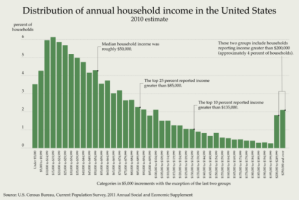
When a statistician talks about income distribution, he or she is referring to how income brackets fit in a bell curve, like in the chart above.  When a politician or a pundit talks about income or wealth distribution, we are supposed to just act as if our money has been unfairly distributed and not earned, and  certain adjustments are necessary to make things “fair.”  These adjustments take the form of taxes, if you “received” too much, or hand outs and benefits, if you “received” too little.

The statisticians’ usage of the term distribution is neither bad nor good, it’s just math. The politicians’ and pundits’ usage of the term distribution is insidious, because it sounds so fair, but it drops contexts in at least two ways.  Every dollar that is “given” by the politicians to those who didn’t have “enough” income “distributed” to them, either:

  1. Had to be taken away from those who had produced it, then “redistributed” to the “have nots;”
  2. or, it had to be minted, printed, or digitally conjured up out of thin air and “pumped” or “quantitatively eased” into the economy.

The first is literal and direct theft (though we call it income taxes) and the latter is indirect theft, because it steals value from our existing money. (Full disclosure: I work for the government, so almost my entire income during my working life has come from your taxes – and my own. The part of the government I work for is clearly derived from the enumerated powers in the Constitution, and I favor The Fair Tax vice the confiscatory taxation system we have today. Decide for yourself whether I am a hypocrite. The thought has given me pause from time-to-time.)

So, statistically speaking, we have a vast disparity between the highest income earners and the lowest. That does not mean income distribution is unfair, because it does not mean that the “haves” with huge incomes somehow just got lucky and received an unfairly large distribution of money. Maybe they earned it, maybe they inherited it, maybe they embezzled it. The fact that they have It is not proof that they got it unfairly. Likewise, the fact that “have nots” at the low end of the income bell curve don’t have more doesn’t mean that they have somehow been cheated. Perhaps it means that they can work hard, gain skills, and climb into higher income brackets.

The Deficit, the Debt, and Unfunded Liabilities

images (1)

By Mike Cronin

You’ve heard politicians say we need to increase taxes on the wealthiest Americans. You may have also heard other politicians say our government is spending too much, because we have such a high national debt. Then, invariably, the first group of politicians will respond that they’ve cut the deficit. So how can the debt go up, when the deficit is coming down? What’s the difference?

The deficit is the amount the government has spent over and above what it has taken in during the current fiscal year. For 2013, that amount was over 1/2 trillion dollars. The national debt is the total amount of money, from all years, that the government owes to those from whom it has borrowed (namely US and foreign banks). This number is somewhere around 17 trillion dollars. That’s 17 thousand billion, or 17 million million. Written out, that’s $17,000,000,000,000. Because the deficit is overspending, whenever we have a deficit, any deficit, the debt will go up…even if the deficit is smaller than the previous year. A reduction in deficit spending doesn’t mean the government got it’s financial affairs in order, it just means they slowed down the overspending a little. in fact, the debt can go up even if we have zero deficit in a given year, because the interest on the debt keeps it growing.

If those facts & figures aren’t shocking enough, there is another number we must consider, but you almost never hear about it in the news. That figure represents the unfunded liabilities of the government.  That’s the amount of money it will take to pay for all of the benefits and entitlement payments the government has promised to pay in the future, such as Social Security and Medicare, to people who aren’t old enough, or otherwise eligible, to receive them now. That number is estimated to be anywhere from 55 trillion to 222 trillion dollars, depending on who is doing the estimating and what is included.   That is more than the gross national product of all of the countries in the world, combined.  In other words, our government has overspent, or will overspend, more money now and in the future than the total economic output generated by the entire world!

So, do you think  we have a revenue problem, or a spending problem?

Deficit: What the government overspent in fiscal year 2013 (about $700 billion, according to the US Treasury Dept.)

Debt: What the government has overspent in total (about $17 trillion)

Unfunded Liabilities: What the government has promised to pay in the future over and above what it is projected to take in ($55-222 trillion)