Issues, Symptoms, and Oreos

By Mike Cronin

Most of the issues in the presidential debates are not issues at all but symptoms. How so? Let’s take an example: illegal immigration.

The real problem isn’t that the United States is racist and doesn’t want so many people coming into our country. It’s that the flood of people coming into this country illegally is a signal that other things are broken.  The mass of immigrants perceive the United States to be a better place to live and work than wherever they are from. In other words, their incentives to come here are greater than their incentives to stay home. That has always been the case with immigration to the United States. What has changed is the nature of the incentives.

Through much of the 19th and 20th centuries, the incentive to immigrate to United States was the opportunity to be free to work hard, own property, and succeed.  From the latter part of the 20th century to the present, that incentive has been morphing. There is still an incentive to come here to be free and succeed, but another incentive has been steadily taking the place of that original one.

The new incentive is to come to the United States and take part in the bounty of government benefits and handouts that we bestow on a significant portion of our population. Free K-12 education. Subsidized housing.  Free or subsidized medical care. Relatively high paying jobs (even jobs that pay immigrants less than minimum wage under the table may be paying them more than they could get in their own country.) Low risk of being deported.   Even the possibility of voting. Why stay at home and live in absolute poverty, when you can come to America and upgrade to relative poverty and dependence on Uncle Sam?

A related symptom is corporate off-shoring and outsourcing. Even as immigrants are poring in to find a better life here, companies that send jobs or work outside the United States are vilified as unpatriotic. But why do they send these jobs outside the United States? Does it have anything to do with patriotism?

Could it instead be because government interference and manipulation have incentivized them to outsource, just as it has incentivized illegal immigration?

Image result for oreo to Mexico

Consider the Oreo case.  Donald Trump vowed last year not to eat Oreos ever again because of reports that Nabisco’s parent company moved 600 jobs from Chicago to Mexico in order to lower labor costs.  What the reports left out of the equation is that the marginal tax rate and a key product ingredient (sugar) are also cheaper in Mexico than in the US.  Think about that.  A company moved 600 jobs to Mexico because operating conditions are more conducive to profitability there than they are here, the original business-friendly nation!

So what is the disease?  Government interference in the market, namely via ham-handed manipulation of incentives.

Government tells companies who to hire (Affirmative Action), how much to pay them (minimum wage), charges payroll taxes, Social Security taxes, and corporate income taxes. Government requires businesses, and many professionals, to have licenses, and it regulates everything. It makes raw materials, parts, and other materials more expensive by applying the same kinds of interference to suppliers and other business partners.  The costs of all of this are either absorbed out of company profits, or passed on to the consumer, and it drives companies to go elsewhere to do business, which kills jobs here.

In effect, our own politicians  drive unskilled and low-skilled jobs out even as they lure unskilled  and low-skilled laborers in! This drives companies to move entire production lines out, or to hire illegal immigrants and pay them under the table.  It puts drag on the entire economy with excessive regulation, excessive taxes, and excessive interference – then the politicians call the companies unpatriotic for wanting to escape.

Might the politicians be a few cookies short of an Oreo?

A Capital Idea: an “-ism” for Freedom

By Mike Cronin

Last week, I offered the view that adopting socialism is a recipe for disaster. Most of the political “-isms” (socialism, communism, fascism, imperialism, etc.)  “-chies” and “-cracies” (monarchy, anarchy, theocracy, democracy, plutocracy, oligarchy, etc.) sound different on paper, but they all have two things in common: the rule of one human or few humans over the rest, and the absence of individual freedom.

There is an alternative.  Our founders gave us a Constitutional republic which enshrined the rule of law and individual liberty.  The essential element of freedom is property rights, including self-ownership.  The political-economic system that arises where freedom reigns is called capitalism.  It has never been fully embraced by any country.  Our own country perhaps came the closest, which greatly contributed to the vast economic achievements and ever-increasing prosperity we came to expect as Americans.

Yet our failure to fully adopt it has had a profound effect on our history. The institution of slavery was a direct affront to the concept of freedom, and it convulsed our country from its beginnings through the Civil War and beyond. I’ve written elsewhere of slavery and unjust war as two of the four major dysfunctions that have afflicted our country.

Want some examples of how capitalism is better than socialism?

The Ukraine is a geographic bread basket, similar in productive potential to the US Midwest; yet the Union of Soviet Socialist Republics (of which Ukraine was once one of the socialist republics) had to import grain from us during the height of the cold war. Why couldn’t they produce and distribute enough to feed themselves?

Virtually every labor saving and communications device and other technological advancement since the Dark Ages was invented or perfected in the US or another semi-capitalistic country. (E.g. the electric light bulb, the car, the airplane, the microwave oven, the TV, VCR, and DVD, the laser, vaccines, etc.). Have you ever considered buying a car designed and manufactured by an Iranian or North Korean company?  Does such a thing even exist? Why aren’t such things invented in dictatorships and socialist utopias?

In most cases, landlocked nations are doomed to economic mediocrity or worse. (Examples: Afghanistan, Mongolia, and Bolivia). But a few, such as Switzerland and Lichtenstein, are incredibly well off.  What separates them? The ones that are well off have a much higher degree of individual freedom and capitalism than the others.

China was once every bit the communist leviathan that the Soviet Union was.  Why didn’t China go the same way the USSR did? Conversely, why is the US going through a decline?

China is ascending to the same degree it has adopted limited capitalistic market reforms. Our country is declining to the same degree we adopt the socialist dysfunctions that destroyed the Soviets and continues to hamper the Chinese. Imagine the productive energy that could be unleashed if 1.4 billion people enjoyed a fully free existence!

Despite the vast body of historical evidence that capitalism works and socialism doesn’t, capitalism has been given a bad name.  Individual freedom requires individual responsibility for one’s own actions and living with the consequences of one’s choices.  For that reason, capitalism will always be a hard sell compared to the free goodies and cradle-to-grave care promised by the heralds of the other “-isms.” On top of that, where capitalism has some influence, prosperity follows. Prosperous people are easy for envy-baiters to blame in order to gain an audience…and power. In virtually every human system of organization other than capitalism, anyone with wealth could only attain it by taking a bigger share of “the pie” than everyone else. Capitalism is unprecedented – it allows the productive to enlarge the pie!  But the envy mongers can’t or won’t see that.  They say capitalism fosters greed.  There’s no denying that greedy people exist,  and some of them advance quite far under semi-capitalistic economies, but socialism is absolutely powered by greed and envy!

It is easy for the prophets of utopia to blame capitalism for the sins of the other systems. The latest example is the appellation “crony” capitalism.  The proper term for companies using influence, connections, and campaign donations to get laws passed that stifle their competition is “corporatism.”  Using the coercive power of government to stifle your competition when you can’t win competitively through offering better value is not capitalism at all, though it has some capitalistic trappings (namely the privately-owned nature of the corporation).

The really ironic thing about the other “-isms?”  They need the productivity of capitalism.  A greedy socialist can’t “redistribute” wealth from the productive to the parasitic if there isn’t any wealth to start with.  He must decry capitalism even as he robs the capitalistic in order to buy votes from those he has bamboozled.

Socialism Seems Free, but You WILL Pay for it!

By Mike Cronin

No doubt you’ve heard the word socialism being bandied about a lot lately. Democratic presidential candidate Bernie Sanders is an avowed socialist. A recent poll shows that 36% of millenials favor socialism.  And whys shouldn’t they? Free education!  Free healthcare!  Subsidized housing, food, & utilities! Socialism sounds really good. But it isn’t.

It might help if we have a common understanding of what socialism really is.

Simply, socialism is a political/economic theory where all property is owned “by the people.” What could be better than a place where all property is shared and nothing is owned?  That’s the theory.  In practice, It results in the state asserting primacy in all aspects of life and individuals having few, if any, rights. It is a form of collectivism – which means the group, or collective, is prioritized over the individual. Bee hives, ant colonies, and human “communes” are collectives. Under any form of collectivism, the majority can do away with the rights (and often lives) of the minority (of which the individual is the most basic element).

Collectivism/socialism comes in various forms, such as communism, which the Union of Soviet SOCIALIST Republics (USSR) subscribed to, and “Nationalsozialismus” (the German term for National SOCIALISM, from which the term “Nazi” is derived).  Some might argue that the Nazis were in fact fascist, not socialist.  Fascism was also the system of socialism that Mussolini oversaw in Italy. (The term fascism derives from the Latin term “fasces,” a bundle of sticks with an axe protruding from it. Fasces was the Roman symbol of power.)

Some political scientists argue that communism is on the political left, while fascism is on the right, as depicted in this graphic:

I argue that the only practical difference between communist variety of socialism practiced in Soviet Russia and the fascist-flavored socialism animating Nazi Germany and Italy was that the fascists gave lip service to the idea of private property rights – as long as the property was used at the direction of the state.   There were no private property rights at all in the Soviet Union.

Whether people have no property rights at all, or have the “right” to own property in service to the state, is a distinction without a difference. Both systems had charismatic, murderous dictators in charge. Both systems had secret police, concentration camps, and mass murders. Both systems failed to create wealth; they could only steal it or destroy it. There was no freedom in either system.

Thus, a more accurate depiction of communism and fascism on the right-left political model would be to put them both on the left under socialism, with freedom and capitalism on the right.  The diagram below is closer to the truth:

Consider that every country that has adopted any form of socialism has been degraded or destroyed in direct proportion to the degree of socialism it enacted. Nazi Germany. The Soviet Union. North Korea. Cuba. Venezuela.

China and Vietnam were once in the same boat, but both have attained some limited reversal from the crushing oppression the others experienced through adoption of limited free-market economic reforms. But make no mistake, the Chinese and Vietnamese people are not free.

Consider Karl Marx’s famous aphorism: “From each, according to his ability; to each according to his needs.” It sound so wonderful, but it glosses over the essential question: Who decides what your gifts and needs are? (Newsflash – it sure isn’t going to be you!) “From each, according to his ability” means that the state will extract every bit of use out of you that it can, and your desires are irrelevant.  “To each, according to his needs” means that the state, not you, will determine what you need, and you will be lucky to get it.

So how bad is socialism?  At it’s best, socialism creates resentment and dependency; at its worst the people living under socialist governments are slaves – the ones who survived mass murder.


Quantitative Easing or Quantitative Fleecing?

By Mike Cronin

Q: You’ve heard the talking heads talk about quantitative easing, so what the heck is it?

A: Put in the most basic terms, quantitative easing, or QE, is weasel-ese for the Federal Reserve (aka “the Fed”) attempting to stimulate consumption by making up money out of nothing and injecting it into the economy.

Q: What’s wrong with that?

A: Multiple things:

  1. The Constitution gives the government the power to print and coin money. That is one of the functions of the Dept of the Treasury.  The Constitutionality of the government making monetary policy (i.e. manipulating interest rates or “stimulating” the economy) has been debated since the time of Jefferson and Hamilton.  The powers enumerated to the government in the Constitution manifestly do not include allowing it to charter a central bank (which is what the Federal Reserve is), but Congress created one anyway with the passage of the Tenth Amendment in 1913.
  2. The “money” that the Federal Reserve puts into the economy is created out of thin air. The process is convoluted, but the net effect is that the Fed accomplishes QE by changing the balance in the accounts it is “depositing” the money into, i.e. creating electronic “money” out of thin air. The theory is that by giving banks more money (quantitative) to lend at low rates (easing), more businesses will borrow that money and put it to work, which will in turn generate more commerce.  In other words, the economy will have been “stimulated.”  The problem is, after the financial crises in 2007-2009, banks are only lending money to those with top-tier credit ratings.  A great deal of the money that is meant to stimulate commerce has instead stimulated stock trading.  That’s why we can have record stock prices even as the rest of the economy (especially on the employment side) is unspectacular.
  3. Since the value of a thing, including money, is directly related to its relative scarcity, adding hundreds of billions, or even trillions of dollars into electronic circulation reduces, or debases, the value of our already existing money. If the money isn’t worth as much as it used to be, but the value of the things we buy hasn’t changed, the price will have to go up. That’s price inflation.  If your income rises with prices, inflation may not be alarming, but how often do you get a raise just because your money loses value?

Q: If I’m not going to make more money at work, making money in the stock market isn’t so bad, is it?

A: In and of itself, making money on stocks is not bad.  The problem is that there shouldn’t be any QE and there shouldn’t be a central bank!

In reality, instead of stimulating the economy, QE amounts to a second, insidious way to tax you.  The first way is income and capital gains taxes. They are painful, but at least they are overt and articulated in law.  The second is in currency debasement (the deliberate erosion of the buying power of the dollar to increase the amount of dollars moving in the system) by the unelected, unaccountable, and opaque Federal Reserve.  It is not nearly as overt, but it takes value from you just the same.

Becoming Antifragile: Beyond “Sissy” Resilience | The Art of Manliness

header

A bit of useful truth: it is nice to enjoy the abundance we are surrounded by, but it has led to a culture of entitlement. Reliance on entitlement comes at a cost: fragility.

Becoming Antifragile: Beyond “Sissy” Resilience | The Art of Manliness.

The Minimum Wage Makes Minimum Sense

Cartoon from: http://tunnelwall.blogspot.com/2014/03/political-populism-not-economics-behind.html


By Mike Cronin

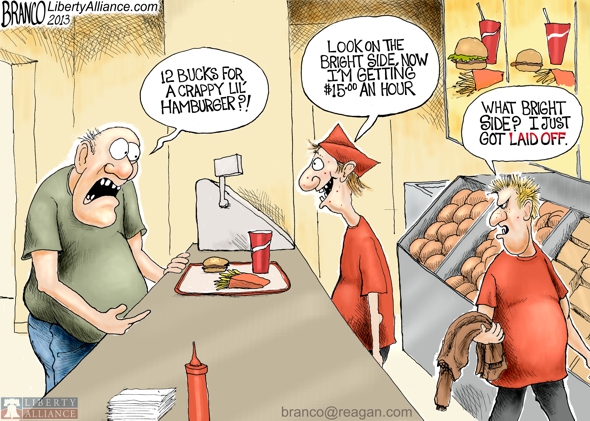
Minimum wage laws, which are meant to reduce poverty, actually cause dysfunction and increase poverty and criminality. The political architects of such laws know this, or remain purposely blind to it, so that they can make promises, get votes, and gain or remain in office.

So how does a mandated minimum wage increase poverty?  While the person who has a minimum-wage job may or may not be defined as poor, it is the person who can’t get a job that suffers the worst effects of minimum wage laws. Since there is no corresponding minimum revenue laws, minimum wage laws dis-incentivize job creation.  Business owners, especially small business owners, have to make a certain amount of money in order to break even, that is, just to pay for their business loans, employees, suppliers, landlords, taxes, and whatnot. Yet there is no law forcing anyone to buy the offerings of a given business.  If a business doesn’t earn enough revenue, they can’t afford to pay even the minimum wage to their employees, so they either have to hire less people than they otherwise might have, they have let people go, or they have to go out of business. In any of those cases, jobs were either lost or not created, which makes it harder for unskilled people to find work, which leads to increased unemployment and poverty.

For example:  If you are old enough, you might remember the days when movie theaters had ushers.  It’s an extremely low-skill job; you could teach it to a high-school kid in an hour or two – and pay him or her correspondingly low wages. There was a match between worker skill level, worker responsibility level, and worker pay.  These days, no one is going to pay a kid $8.00 or $10.00 an hour just to usher, so the usher’s duties got blended into other jobs (assistant manager?) and the job all but disappeared.

Similar entry-level jobs are hard to find anywhere, which makes it harder for high school kids to find work and establish an employment track record.  Instead, such kids either remain with their parents longer, causing the parents to have to support a child longer than they had planned, reducing the parents’ own wealth; or the kid lives on the streets, greatly increasing the likelihood he or she will resort to criminal conduct to survive.

There is a another way some employers skirt the minimum wage laws and pay cheap rates for low-skill labor: They pay illegal immigrants illegally low wages in cash under the table.  This incentivizes illegal immigration, which, in effect, imports more poverty. The illegal immigration “infrastructure” is an underworld, and it attracts other crime: tax evasion, prostitution and other forms of human trafficking, narcotics, gunrunning, gambling (esp. on illegal dog and cock fights), ID forgery, and so on.

To be sure, the minimum wage laws aren’t solely responsible for poverty, illegal immigration, and vice.  Rather, they are a large and obvious contributor to those maladies, even as they fail to produce the promised positive effect.  But they sure sound good.

Untangling the Illegal Immigration Knot

1972274_636147066434013_742855534_n


By Mike Cronin

Let’s wrap our head around the multi-faceted illegal immigration problem.

  1. If you are an elected Democrat, the problem is that there are millions potential voters out there who cannot legally vote for you or your pals. How to solve that problem? Adopt narratives that simultaneously paint the illegal immigrants as victims who need rescuing and those who see things differently as racists. Then legalize the immigrants (or some portion of them) somehow, and/or prevent the passing of laws that require voters to produce a photo ID proving their eligibility.
  2. If you are an elected Republican, there are millions of potential Democratic voters out there who might vote illegally or who might become legal voters at the stroke of a pen. How to solve that problem? Adopt narratives that illegal immigrants are by definition criminals just for being here, and who steal jobs from American citizens, who vote illegally, and who cost us a lot of money in “stolen” benefits and entitlements.
  3. If you run a manual- labor intensive business that can’t afford to pay the minimum wage, paying an illegal immigrant in cash under the table is an attractive option.
  4. If you are a desperate person from Mexico or an impoverished country to our south, getting to America for the opportunities and freebies is an attractive option.
  5. If you are a cunning and morally flexible person, exploiting the stream of immigrants headed north is an attractive option.

So how do we solve a multi-faceted problem?  With a multi-pronged strategy that is also consistent with smaller government :

  1. Economics is the driving factor. As long as immigrants perceive things as better here than wherever they are from, they will come here.  Immigration has always been one of America’s strengths. We can’t stop it and we shouldn’t but we need to do a much better job of managing it. Currently, unless one can claim one of the “Three R’s” (Relative, Rich, or Remarkable), it is next to impossible to attain a green card or citizenship. It should be easy for anyone to come here and start a new life…except for those who would do us harm (i.e. real criminals, terrorists, non-producers, etc.), so we need to secure the border. Immigration policy should be positive (you can immigrate here unless…) not negative (you can’t immigrate here unless…).
  2. We need to wind down the rhetorical panic. “Illegal immigrant” is no more a racist term than “speeder” or “shoplifter.” “Illegal immigrant” isn’t a race, it’s a status. “Mexican” isn’t a race, it’s a nationality.  “Latino” isn’t a race, it’s an ethnic identification. Yes, illegal immigrants broke a law. That doesn’t make them hardened criminals.   Also, “Illegal immigrants” can’t “steal” jobs from Americans, because jobs don’t belong to employees, they belong to employers.
  3. Lastly, as with most big-government problems, illegal immigration is an overlapping symptom, (along with unemployment), caused by another problem: Minimum wage laws. More on that can of worms in a future post.


How do You Like Your Economy?

By Mike Cronin

I’ve written previously about how our country is supposed to be a republic and not a democracy or an empire.  Similarly, our economy is supposed to be based on a free market and not centrally controlled. As with our political system, our economy has become mixed. It retains some free-market features, and it suffers under an ever-increasing burden of controls, regulations, and other government and central bank interference.

Why are controls bad? Because those who do the controlling cannot possibly know every way their actions will affect the market. Ignoring this simple fact brought the Soviet Union to ruin; acknowledging it has brought China a measure of prosperity. To understand how intricately complex the market is, consider the case of a simple pencil. It only has a few parts and some paint, yet it takes thousands, if not millions, of people using lots of other products and services in many other industries in order to make pencils and get them to stores.  Interference in any of those areas could affect pencil production, and interference in pencil production could set off a chain reaction into any of those areas. A mixed economy doesn’t just affect our wallets, it affects our morality. Ayn Rand explains it best:

“A mixed economy is rule by pressure groups. It is an amoral, institutionalized civil war of special interests and lobbies, all fighting to seize a momentary control of the legislative machinery, to extort some special privilege at one another’s expense by an act of government—i.e., by force. In the absence of individual rights, in the absence of any moral or legal principles, a mixed economy’s only hope to preserve its precarious semblance of order, to restrain the savage, desperately rapacious groups it itself has created, and to prevent the legalized plunder from running over into plain, unlegalized looting of all by all—is compromise; compromise on everything and in every realm—material, spiritual, intellectual—so that no group would step over the line by demanding too much and topple the whole rotted structure. If the game is to continue, nothing can be permitted to remain firm, solid, absolute, untouchable; everything (and everyone) has to be fluid, flexible, indeterminate, approximate. By what standard are anyone’s actions to be guided? By the expediency of any immediate moment. The only danger, to a mixed economy, is any not-to-be-compromised value, virtue, or idea. The only threat is any uncompromising person, group, or movement. The only enemy is integrity.” (http://aynrandlexicon.com/lexicon/mixed_economy.html)

Sounds a lot like 2014 America, doesn’t it?

Why Don’t Teachers Earn More?

By Mike Cronin

On average, elementary school teachers make about $53,000 per year as of 2012.  As a group, they are often thought of as deserving higher pay and better benefits. Indeed, in my state of residence, Arizona, elementary teachers earn one of the lowest mid-career salaries for bachelor’s graduates.  So why can’t teachers get more?  After all, they have higher education and they have some of the most powerful unions around, like the NEA. Is it because of oppressive state and local government or vindictive school districts?  Of course, some of that is going on, but there are a few simpler and and more widely applicable explanations:

First: Simple economics. In general, the supply of elementary teachers exceeds the demand by about double, so there is simply no need for districts to pay any more than they are – there is always someone else waiting for a job that would be willing to work for the going rate. I saw a graphic that lamented America’s priorities because teachers make less than cable installers in one area.  It has nothing to do with priorities, it has to do with supply.  Teachers make less because supply exceeds demand – and that’s not just true for teachers, it’s true for lots of industries. Soldiers, Sailors, Airmen and Marines, firefighters, and police officers, our protectors, make less than sports and entertainment stars for the same reason. Ditto for nurses and doctors – doctors make more because demand exceeds supply.  As long as there is an ample supply of teachers willing to work for the going rate, then the going rate will not rise much.

Second, the unions, especially powerful unions like the NEA, don’t do what’s best for teachers; they do what’s best for unions.  When teachers’ interests and the union’s interest coincide, teachers benefit.  When they do not, teachers lose. Since unions typically advocate for non-merit factors, like years on the job, to be primary in setting pay and achieving tenure, really good teachers of a given experience level will get paid the same as mediocre and bad teachers of the same experience level. Thus, the unions’ interests most often align with the mediocre and bad teachers, who get paid more than they might deserve thanks to union intervention.  This sucks for the superstars, since they don’t get paid what they are worth.

If you are a good teacher and you wonder why you can’t get paid more than you do, it’s because your union is better at advocating for your mediocre and poor colleagues than it is at advocating for you, and because there is no shortage of people willing to work for the going rate.