Tweets, Taxes, and the Pursuit of Happiness

68808176

By Mike Cronin

Socialists of all stripes decry capitalism, but cannot achieve their vision of a classless, egalitarian society without first stealing the wealth created by capitalists! Case in point:

Mayte Lara, an illegal immigrant, created a brouhaha on Twitter by describing how she bragged during her Valedictory speech about being “undocumented” and yet still achieved a “full ride” scholarship to the University of Texas.  Why?  Federal law does not prohibit states from providing in-state tuition to “undocumented students.”  Why should there be an uproar?  I mean, it’s not as if Texas taxpayers will have their hard-earned money taken from them via the coercive power of government in order to pay for Ms. Lara’s college education at the expense of whatever they might do with it themselves, is it?  It couldn’t be that the price of a UT education is going up in part because there is no such thing as “free” tuition, could it?

This isn’t about race or hatred of illegal immigrants.  We could change our laws to reform the immigration system to make it easier to be in this country legally.  It’s the dysfunction, the absurdity, the gall of having laws on the books that are enforced at virtual gun point (i.e. tax compliance) while facilitating the wholesale abandonment of other laws (immigration) in order to expand the welfare state and the vast pool of voters dependent on government.

As a human being, Mayte Lara has as much right as anyone to seek out the best life she can find for herself.  We might even refer to such a right as “the pursuit of happiness.” Doesn’t that phrase have a familiar ring?  You might have read it before in a modest historical document.  But the right to pursue happiness is not the same thing as being given the privilege to be made happy at other’s expense.  Ms. Lara has no right to the wealth, time, or property others have produced.  Yet (perhaps without realizing it), she flaunted the fact that she was given a license from government to dispose of the wealth, time, and property of others (in the form of her tax-payer funded education).

Taking wealth from the citizens you are supposed to protect, and giving it to illegal immigrants you are supposed to deport.  Absurd!

In a related note, the Democratic National Committee is putting a wall around its convention site.  A Secret Service agent said the wall was for security purposes. Really? You mean it’s not meant to be a canvas for taggers?  It’s for security? From what, Bernie Sanders supporters? Thanks for the enlightenment, Agent Obvious!

Aren’t the Democrats supposed to be the party of inclusion and multiculturalism? They are certainly against the idea of putting a wall along our border with Mexico. If there were such a wall, future Democratic voters like Ms. Lara would have a much harder time getting into the US!

(I am also against a border wall, by the way, but for a different reason.  I think the best way to fix immigration is to make it easier to be here legally under a variety statuses and in a way that doesn’t automatically confer a voter pool to one party and a tax burden to everyone.)

10 Thoughts for 2016

By Mike Cronin

Instead of resolutions, I suggest these 10 thoughts for the New Year:

Regardless of your party preference or which side of the political spectrum you align with, remember that even the politicians you like are more concerned about getting elected (or re-elected) than they are about representing you or your interests. (props to Thomas Sowell)

Similarly, the mass media news outlets exist make profit.  They do so primarily by selling advertising air time. Keeping you hooked is the goal of their programming tactics: dramatic music, constant movement, urgent tones, “alerts,” scrolling updates, etc. None are necessary to impart information; they are hooks. Keeping you informed is less important than keeping you watching.

Supreme Court Justice Oliver Wendell Holmes popularized the idea that the Constitution is a “living document.” This notion suggests the founders meant for us to interpret their words in the context of our time, not their own.  In fact, the founders did recognize that times change and the Constitution must be adaptable to those changes.  They meant for us to be able to make those changes by the formal process of amending the Constitution.  Getting an amendment passed and ratified is very difficult – on purpose. But it is possible – that’s why there are currently 27 amendments.  It’s a good bet that any party, pressure group, or court that attempts to re-interpret the meaning of the founders words knows it could never see its agenda come to fruition though the amendment process. The Constitution is not a living document, but it is an amendable one!

Confiscatory taxation: When your neighbors and co-workers use the coercive power of government to steal money from you to pay for laws and programs you don’t want.

When you hear about waste in government spending, you are told about “pork” (e.g. ridiculous projects to study cow flatulence, install “modern art” to “beautify” some government facility, build arenas and bridges, or make payments to farmers not to grow food, etc.). Pork barrel spending is certainly wasteful, but I submit that when a politician says we need to cut waste, then offers pork projects as examples, he is attempting to distract us from the most egregious form of government waste: spending money we don’t have on entire government departments, agencies, bureaus, etc. that do not protect anyone’s rights (the only proper function of government) and thus have no legitimate reason to exist.

You cannot reason with a person who does not value logic. (Props to Sam Harris)

Now that women are allowed in every specialty in the armed forces, there have been calls to require women to register for the draft – in the name of equal rights and equal opportunity.  How about we discuss ending all draft registration and disbanding the Selective Service System instead?  The draft is a form of indentured servitude if not outright slavery. If equal rights are the motivation driving changes in military gender composition, then men should have the same right women currently enjoy: to not register for the draft and to not serve against their will!

One definition of a “license:” When the government takes away a bit of your freedom, then allows you to buy permission to do the thing you were once at liberty to do.

Presidential candidates will make all kinds of assertions and promises about what they will do for the economy or crime control or the environment – but, short of invasion or natural disaster, all he or she can legally do in those areas is make proposals, sign bills into law, and direct the executive branch. The president’s real power lies in foreign relations, not domestic ones.  This is why the Secretaries of State and Defense are more prominent than the Secretary of the Interior, for example.

Some people judge Congress by the number of laws it passes. This is absurd.  The more laws there are, the harder it becomes to be law-abiding, and the easier it becomes to inadvertently break the law.  Supposedly, ignorance of the law is not an excuse to break it – but no one can know all of the laws, because there are too many!

When Everything is a Crisis, Nothing is a Crisis

248769_318723208232720_678404428_n

By Mike Cronin

Dear politicians, intellectuals, pressure-group leaders, and media mouths,

All day every day you bombard us with crisis after crisis. Drugs. Guns. War. Climate. Celebrity drama. International tensions. Rape culture. Income inequality. Racism. Sexism. Immigration. Political correctness. The list goes on ad-nauseam. Most are real issues that need reasoned efforts to solve or mitigate, but you spin them into crises, then you anoint yourselves as experts and saviors that can save us – if only we turn over our rights, our money, or our reason (or all three!) to you.

We understand that at some level you have to market and advertise your issue, your ideals, your narrative.  On the other hand, you need to understand that at some point we will succumb to crisis fatigue and stop caring about your cherry-picked and manicured emergencies.  We will become apathetic.  Most of you don’t want that; you want your pet cause to be solved or cured. But some of you do want an apathetic populace.  An apathetic populace is ripe for manipulation by a charismatic tyrant.

If you are one of the public figures I opened this letter to, and you genuinely want your problem solved, dial down the urgency settings on your rhetoric or you will defeat yourself!

If you are a tyrant in waiting:  know that your tactic is exposed.  You are not fooling anyone.

That is all.

Moderating the Chain-Reaction Gun Debate

guns

By Mike Cronin

The recent shootings in Paris, San Bernardino, and Colorado Springs have brought out the usual heated debate over guns and gun control.  Perhaps we can moderate the chain-reaction with a bit of reason by dispelling a few myths:

Myth: Gun violence is exploding in America. Mass shootings are up, and more people than ever are being killed by guns.

Fact 1: Not true. It’s very hard to find source material on this issue that is reasonably free from bias – either liberal or conservative.  The least-biased source I found, Pew Research, shows that “National rates of gun homicide and other violent gun crimes are strikingly lower now than during their peak in the mid-1990s, paralleling a general decline in violent crime, according to a Pew Research Center analysis of government data.

Fact 2: Even if we set aside any policy or philosophical agenda on the part of the media, consider that news organization select stories based on several factors of “newsworthiness.”  “Mass shootings” fit several of these criteria.  They are sensational stories. It is good business to hype sensational stories; ergo killing sprees get lots of coverage…and perpetuate a sense of dread or crisis.   It’s just not as sexy to report that “no one was shot today” when an armed citizen deterred a gunman from committing a violent act.

Myth: Why do you need a gun when you can just call the police?

Fact: The average number of police officers in cities with 50,000 or more residents is 17 cops per 10,000 people.  When you account for shift work, days off, and detectives, supervisors, and special teams (like SWAT), one quarter or less of those 17 will be uniform-wearing officers “on the street” available to respond at any given time.  You might be able to call the police, but it’s very unlikely they will arrive in time to get between you and whatever or whoever is threatening you.

Myth: The police have to protect me.

Fact: No they don’t.  They are obligated to protect society as a whole via the deterrent value of investigating crimes and arresting criminals, not protecting you as an individual.  Don’t take my word for it; the Supreme Court has maintained this position over several cases dating to at least 1981, including Castle Rock v. Gonzales and Warren v. District of Columbia.

Myth: The Second Amendment was about arming the militia, not the average citizen.

Fact:  The Supreme Court ruled in D.C. v. Heller that the 2nd Amendment affirms the individual right to keep and bear arms.  The founders themselves made clear in their writings independent of the Constitution and Bill of Rights that the people must not be prevented from owning and bearing firearms. Consider these few examples from some of the most prominent founders:

“Firearms stand next in importance to the constitution itself. They are the American people’s liberty teeth and keystone under independence … from the hour the Pilgrims landed to the present day, events, occurences  (sic) and tendencies prove that to ensure peace security and happiness, the rifle and pistol are equally indispensable … the very atmosphere of firearms anywhere restrains evil interference — they deserve a place of honor with all that’s good.” -George Washington

“The supposed quietude of a good man allures the ruffian; while on the other hand arms, like laws, discourage and keep the invader and plunderer in awe, and preserve order in the world as property. The same balance would be preserved were all the world destitute of arms, for all would be alike; but since some will not, others dare not lay them aside … Horrid mischief would ensue were the law-abiding deprived of the use of them.” -Thomas Paine

“The great object is that every man be armed.” and “Everyone who is able may have a gun.” -Patrick Henry

“Those who hammer their guns into plowshares will plow for those who do not.” -Thomas Jefferson

“The constitutions of most of our States assert that all power is inherent in the people; that … it is their right and duty to be at all times armed; … ” –Thomas Jefferson

“The best we can help for concerning the people at large is that they be properly armed.” -Alexander Hamilton

The bottom line: 1. Gun violence, though dreadful, is not as bad as you are lead to believe. 2. You are responsible for your own self-defense, not the police!  3. The right of the individual to own a firearm is absolutely what the founders intended to protect, and what the Supreme Court has upheld, in the 2nd Amendment.

Disagree?  let’s hear it!

Got Reason?

By Mike Cronin

It’s hard to know what to believe these days.  The mainstream media cares about ratings more than veracity or depth, so there’s always an undertone of urgency to the news.  Likewise, pundits are out to sell books, increase circulation of their columns, and keep their names on the air, so they make a living off of controversy.  Worst of all, sophisticated ideologues are adept at hijacking issues or movements and turning them to their own purposes.

How can we filter this constant stream of misinformation and disinformation and get to something resembling the truth?

We could do worse than to try using reasoned thought.   Here are a two examples:

The controversy:  Vaccines.  On the one hand, people argue that vaccines are safe and effective, and that not getting vaccinated puts not only the unvaccinated person at risk of contracting various diseases, but the vaccinated as well.  On the other hand, people argue that vaccines are not nearly as safe as they are touted to be, and they can cause more harm than the disease they are meant to protect us from.

A dose of reason:  Vaccines have proven highly effective (but not perfect) at greatly curtailing diseases such as Polio, Mumps, Measles, Small Pox, Typhoid, and Rubella.  Very few people, (but not zero) suffer any ill effects from receiving FDA-approved vaccines (unproven, or experimental vaccines, are a subject for another post).  A mercury-based preservative called thimerosal is used in some vaccines, but it was phased out of vaccinations meant for children beginning in 1999.  A sampling of anti-vaccine literature would have us believe thimerosal and other substances in vaccines can cause autism or other ill effects. There is no hard proof of this.

Bottom line: On balance, vaccines are an overall benefit, though they are imperfect. We should not disregard the good just because it is not perfect, especially if “good” is the best we have. The extreme low risk of side effects compared to the very real risk of contracting a disease suggest that it is generally safer to get vaccinated than to refuse to do so – but do your homework.

The controversy: Climate Change.  I have remarked on this in previous posts, so I will not go into it deeply here other than to sum up:  The climate may be changing, and human activity, especially carbon emissions, may be the main contributor, but that is far from proven.   To paraphrase Carl Sagan: if you intend to prove an extraordinary claim, you must exhibit extraordinary evidence.  You cannot do that when:

  1. Your change your theory to fit the times, but not the facts (the fear was global cooling in the 70s, then it became global warming in the 90s, now it’s “climate change”)
  2. You change your facts to fit your theory (Climategate)
  3. You vilify critics as heretics (aka “deniers”) instead of countering their arguments
  4. You use muddied language (e.g. “Consensus: 97% of climate scientists agree”). That’s the same as saying “the scientists that agree, agree. Those who don’t, disagree.” In other words, there is no consensus among climate scientists!
  5. Your organizing body is political, not scientific (IPCC)
  6. The “solutions” you propose penalize carbon-emitting activities in developed countries and allows the same activities in undeveloped countries – as if the climate recognizes borders or economics (e.g. Kyoto Protocol)

A reasoned view: Human-caused climate change may be real, but the “science” used to prove that is far from “settled,” and the implied catastrophe is far from certain. In fact, climate science is driven far more by politics and funding than by the desire to know the objective truth.

Bottom line: Take dire warnings of climate catastrophe with a grain of salt and don’t feel guilty for enjoying your modern standard of living, but don’t grossly pollute through sheer neglect or wanton disregard for the environment.


Why is the Trouble in Ukraine Newsworthy here?

Location of  Ukraine  (green)in Europe  (dark grey)  –  [Legend]

(image from Wikipedia)

By Mike Cronin

During the days of the USSR, Ukraine was one of the many Soviet Socialists Republics.  Ukraine is an energy producer, breadbasket (third largest food exporter in the world), and industrial power, similar to the US Midwest. Ukraine has Europe’s 2nd largest military (and for a little over five years, it was a significant nuclear power: Ukraine inherited nearly 2000 nuclear weapons during the dissolution of the USSR; it returned all of them to Russia for dismantling by 1996), and it hosts the Russian Navy’s Black Sea/Mediterranean fleet at Sevastopol.

Russian rulers have always felt the need for buffers between Russia and its potential adversaries. During the Soviet days, that buffer was made up of the various Soviet “republics,” such as Kazakhstan, Belarus, and Ukraine. When the Soviet Union fell, such republics became independent countries. Since Vladimir Putin came to power, Russia has been steadily trying to reassert itself in those countries that were once part of the USSR – including Ukraine.

Current events in Kiev matter because Ukraine is the northern edge (Turkey is the southern edge) of the intersection between the Russian, European and, to some extent, Muslim spheres of influence. In fact, the name Ukraine literally translates to “on the edge.” None of these factions wants to see a prize like the Ukraine fall into another’s orbit. Ukrainians themselves understand this, and want to be independent while playing all sides off each other – a risky, but profitable, strategy.  This is not new. Ukraine has been invaded many times over the course of Eurasian history; and it sits at the historical intersection of the Christian, Islamic and Eastern Orthodox spheres of influence. In the early 20th Century, World War I ended the Ottoman Empire, to which the southern portions of Ukraine belonged. Soon after, the Soviet Union was formed – with Ukraine as a founding member.

Expect periodic drama and conflict regarding Ukraine to continue for decades, if not centuries – it’s the normal pattern of life for valuable territory on the geopolitical fault lines between civilizations.

Is Your News Real?

250px-Adnan_Hajj_Beirut_photo_comparison

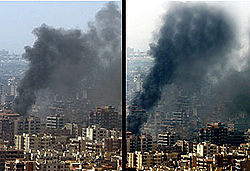
Image comparison: L: actual image. R: “Photoshopped” image published by Reuters in 2006.

By Mike Cronin

No matter how hard you try with diets, make-up, and exercises, you will never look as good as a celebrity or model in a magazine.  That’s because they don’t even look that good in real life! It takes professional make-up artists, photographers, and designers to produce such photos, but it doesn’t end there. Photoshop is used to alter almost all celebrity/model photographs:

http://www.youtube.com/watch?v=YP31r70_QNM

Likewise, if you run the propaganda department for your local dictator, Photoshop is your best friend…if you can use it without botching the job:

http://www.thewire.com/global/2011/07/tour-worlds-worst-photoshop-propaganda/39932/

The motive for “Photoshopping” in the above cases is s clear: To improve on reality. In this next case, the motive for faking reality is not so clear. Several CNN and HLN reporters are in Phoenix covering the Jody Arias trial. Four of them are in the same place covering the same story. Two of them are in the same parking lot, a few yards apart.  So why do they conduct split-screen “satellite” interviews with each other as if they were on opposite sides of the country?  Perhaps because, while it does nothing for the story itself, it does pump up the visual “action” level:

http://www.thewire.com/national/2013/05/nancy-grace-ashleigh-banfield-cnn-parking-lot/64965/

While Photoshoping and adding “drama” with split screens may improve on reality, sometimes the “news” is just outright faked: In Nov of 1992, NBC Dateline ran a story about the alleged propensity of Chevrolet/GMC pick-ups to catch fire in a side-impact collision due to the placement of the fuel tanks. The video in the story included two “test” accidents. During one of the tests, flames did indeed erupt from one of the pick-ups. GM conducted its own investigation into the story and found that the contractors NBC had hired to set up the test accidents had rigged the trucks with model rocket motors to ensure there would be a fire if fuel leaked.  NBC aired an apology in February 1993, and several of the journalists involved in the story were fired or resigned:

http://www.nytimes.com/1993/02/10/us/nbc-settles-truck-crash-lawsuit-saying-test-was-inappropriate.html

The morals of the story:

1. Don’t base your self-image on a comparison against celebrities or models enhanced by professional image-makers.

2. Even the “news” is sometimes rigged to present you with a filtered and scrubbed reality. Watch skeptically.

Bias and the Seven Criteria of Newsworthiness

Be selective about what you pitch and be sure to pitch to the right people

By Mike Cronin

In the “About” section of this blog, I say that bias is one of the main “filters” we have to apply in our media consumption in order to make sense of it all.  The mainstream media (ABC, CBS, NBC, The New York Times, CNN, MSNBC, Fox News, and others) are notorious for being biased. The right wing maintains that (with the exception of Fox) the bias is unabashedly liberal. Liberals are certain that Fox News is a propaganda machine for conservative Republicans.  There is no shortage of examples of bias to be found on each side; but for us to detect that bias reliably, it might help to first know what a “pure” news story is supposed to be about. The foundation of a news story is its newsworthiness.  In Journalism 101 courses throughout the country, students are taught several criteria to apply in order to determine if a story is newsworthy. There are various versions of the model, all of which boil down to roughly the same basics. The version I am familiar with has seven criteria:

Impact: The significance, importance, or consequence of an event or trend. The greater the consequence, or the more people affected, the greater the newsworthiness. “If it bleeds, it leads” fits here. National election results, wars, terrorist attacks, mass murder, natural disasters, and major industrial or transportation accidents are prime examples. 9-11 is the quintessential example.

Timeliness: This is the new in news. The more recently the event happened (or the more recently new information became available about an historical event), the more newsworthy it is. It doesn’t get much newer than when an event is broadcast live (or nearly so) as it happens. On the other hand, one can get headline fatigue when a “Breaking News” or “News Alert” ticker demands attention for reportage of every minor development in an ongoing major story.

Prominence: The doings and antics of prominent people (or corporations, major league sports teams, government agencies, etc.) are newsworthy – because they are prominent. Thus, almost anything a sitting president does is newsworthy, but nothing I routinely do is newsworthy.

Proximity: The closeness of an occurrence, either geographically or in terms of connections or values, is a factor in its newsworthiness.  The astronauts making the Apollo 11 moon landing were as far away from us as any humans ever have been, yet they were fellow Americans making momentous history, and that made them “close” in the sense of this criterion. (Of course, the first manned moon landing was newsworthy according to just about all of these criteria!)

Bizarre: The classic “man bites dog” headline is a classic example of the essence of this category.  It’s not news when a dog bites a man, but when the tables are turned, the situation is freaky, so it becomes newsworthy. There are entire publications devoted to this critieria:

Conflict: Controversy, drama, hypocrisy from leaders, investigative reports, political wrangling, etc.

Human Interest: Those stories that are funny, charming, cute, heartwarming, or otherwise entertaining fit here. Here’s a great example.

These criteria can give us a “baseline” to use when examining stories for bias. Sometimes it is not what a newscaster or reporter says or doesn’t say that exposes bias, it’s the selection of what is to be reported, or the time span a particular story spends in the headlines. If you read or watch a story that doesn’t seem to meet any of the newsworthiness criteria, or you know of a newsworthy story that has been ignored or downplayed, or you note that story X has received much more coverage than story Y, even though both are newsworthy, you are be observing bias in action.