Social Justice and the Straw Man

By Mike Cronin

This is probably no surprise to anyone, but you might not have seen it expressed this way before.  The driving force behind many of the ideological rifts in this country isn’t genuine disagreement; it’s the lust for attention and power. Social justice warriors (SJWs) especially, will twist any fact, issue, or term into a grievance so that they can have a protest or riot in furtherance of their purported aims, when all they really want is attention, validation, and power.

Here’s a case study: President Trump’s so-called “Muslim ban.”  The facts of the ban are summarized here: “There are 206 nation states on Earth. People from 199 of them, Muslim or not, can get US visas. People from 7 of them, Muslim or not, cannot. The twelve nations with the largest number of Muslims are all on the “A-OK” list. There is no “Muslim ban.” (h/t to Michael Z. Williamson) But judging from the vitriol and even violence emanating from SJWs, you would think Mr. Trump had begun rounding up Muslims and putting them into camps. They invariably describe Trump’s action as racist.

I’m not going to defend Mr. Trump.  I get why he is instituting this ban: Because terrorists from the groups most likely to try to execute another 9/11 on our soil would be most likely to come from one of the countries on the list. But his ban holds a large class of people accountable for crimes yet to be committed by a potentially very small subset of that group.  Since that group isn’t race-based, that is not a racist policy, but it is collectivist.

But wait! Here comes SJW logic: since the ban “targets” predominately Muslim countries, it is against Muslims, and is therefore racist. Even if Islam isn’t a race?  Yes, say the SJWs. Because Islam is a culture, the ban is a case of “cultural racism.”  Even if, as described by Mr. Williamson above, the ban doesn’t apply to all, or even most, Muslims?  SJWs just ignore that inconvenient fact.

Ah. If you don’t like someone, or something they are doing, find a way to twist it into the most heinously-motivated act you can think of. Invent new terms to describe it. All so you can be seen to be fighting against it. (Oh, and let’s not forget, if someone you liked did the same thing? Forget it happened.)  In other words, the modus operandi for the SJW: If you can’t find it within in you to go to the Middle East and fight the real oppressors, stay comfortably ensconced in the US, find some objectionable policy, and make it into oppression so you can have a tantrum.  It’s the “straw man” fallacy writ large.

My World View, Pt. 2

bluemarbleearth_npp_8000

By Mike Cronin

I left off last week by asking, “…how can we overcome the pain of the past without inflicting all new pains now and in the future?”  In my world view, the answer lies in the opposite direction from what most politicians, pontificators, and pundits would have us follow. The answer lies in treating human beings as individuals first and foremost, not as mere units of whatever contrived victim or oppressor collectives the “divide and conquer” crowd has tried to bin us into. In other words, quite often the pathological power seekers in this world seek to divide us in the name of diversity, while the way to a just, peaceful, and united society is by recognizing and protecting individual rights and liberty.

That means tolerating all kinds of behavior and relationships one might find personally distasteful – so long as such behavior violates no one else’s rights.  In my view, there simply should be no government purview to ban any intoxicants a competent adult might chooses to use – but neither should it allow intoxication to mitigate any criminal or negligent act taken while intoxicated.  It also means the government should have no interest in regulating consensual activities between competent adults.  That means there should be no laws against – nor any kind of tax breaks for – any kind of consensual domestic relationships. The only role government should play is in the realm of contract enforcement: Those who choose to register their relationship and codify any such agreements in writing may turn to the government for dispute resolution if necessary.

Of course, that would also mean the tax code would have to be reformed. As well it should be.  There is only one reason for the government to levy taxes:  to pay for the legitimate, Constitutional functions of government. Likewise, there is only one morally acceptable way to apportion taxes: According to how much government one “consumes,” not according to how much income one earns.  Of course, collecting taxes via income confiscation is right out.  A consumption tax, such as The Fair Tax, is the way to go in my book.

Speaking of books, when did the United States of America become a democracy?  According to more than one of the social studies text books my kids have used over the years, the US is just that: a democracy.  That can be taken in two related ways. The first is simply common usage. At some point in the past, the term “democracy” was corrupted from its original meaning to accommodate nearly any government that has adopted some form of constitution, has separation of powers, leaders chosen by elections, and has a more-or-less open market.  The other way to take it is that some of the same corrupt people who want to chivy us into collectives are in charge of the education-industrial complex.  They want to smuggle into our heads the idea that our government operates according to the concept of majority rule (i.e. pure democracy) vs. the rule of law (i.e. as a republic) – with the ultimate goal being to amass enough of a collectivized majority to gain control of all three branches of government at the same time, undo the Constitution, and turn the US into a Venezuela – all the while believing they are making it into a Sweden (or at least, what they imagine Sweden to be like).

Indeed, one such lament we are always hearing from such quarters is that our “public” school system is failing, always accompanied by the clamor for more and more money to fix it. What if our government schools are not failing?  What if they are doing exactly what they are designed to do?  Given the model our school system is based on (Prussia’s) and the sentiments expressed by many of its promoters and pioneers, (e.g. “The role of the schoolmaster is to collect little plastic lumps of human dough from private households and shape them on the social kneading board.” Edward Ross, Sociologist, and “We want one class of persons to have a liberal education, and we want another class of persons, a very much larger class of necessity in every society, to forgo the privilege of a liberal education and fit themselves to perform specific difficult manual tasks.” –Woodrow Wilson) a strong case can be made that our school system is just fine: It is not designed to produce critical thinkers; it is designed to produce compliant mass consumers, and it does.  When the most pious prophets of the public school systems tell you the system is failing, they mean that it hasn’t yet succeeded in removing all independent thought from the labor and middle-management classes quite yet!

Now don’t go thinking that because I’m critical of government schools that I must be a snob for a snob for parochial schools.  Faith-based private schools, at least of the Catholic variety (of which I have some passing familiarity) may have a better record of producing literate, college-bound graduates than government schools, but they are very comfortable following the Prussian model as well, in some ways to an even greater degree than government schools (case in point: Uniforms and corporal punishment).  It just would not do to give your flock too great a taste of independent thinking, lest they come to question their faith, and ultimately the Church!

My World View, Pt. 1

sed_wall_1920x1200

By Mike Cronin

Every so often it helps to re-examine one’s goals and purposes.  My goal and purpose for this blog is to help others learn to look at the world through the lenses of reason and liberty.  Sometimes that means offering dry descriptions of how things are vs how they ought to be, other times it means promoting an independent viewpoint on a hot-button political issue. No doubt I have appeared to be a right-wing radical to someone on the left, while I might seem to be a leftist to the right-winger. To others, it might seem like I’m simply sitting on the fence and refusing to take sides.

I have never claimed to be unbiased.  In fact, I have described my bias on more than one occasion, but I haven’t ever really described my full worldview.  I thought I might do so now:

It starts with reality. As Ayn Rand said: “Existence exists, and only existence exists.”  Carl Sagan said that the cosmos is “all that is, all that was, and all there ever will be.”  The evidence that existence exists is axiomatic:  If it did not exist, there would be no one to ponder its nature – there would be no nature.

Speaking of nature: Humans are part of nature. Everything humans have ever made, from bone tools and mud huts to spaceships and iPhones, and every action humans have ever taken, from procreating to mass destruction, is ipso-facto natural. That is not to say it is good or bad.

Evil exists.  There are good people and bad. Context matters: good people are sometimes capable of bad things, and evil people may sometimes perform a benevolent act.  Hitler might have treated a pet well, for instance…but that cannot begin to atone for the fact that he inspired and led the industrialized murder of millions. Because Hitler was human, his actions were natural…but because he failed to credit whole segments of humans with having any humanity, he dehumanized himself. He became a monster of natural, not supernatural origin.

Nor was he the only one. Stalin. Pol Pot. Mao Tse-tung. Saddam Hussein. Every era of history has its brutal dictators and ruthless rulers who don’t hesitate to bathe in the blood of millions.  The rational failing of all of these monsters is their inability or refusal to recognize the worth of other humans as humans, or to even recognize other individuals as human at all.  They have actualized the ultimate expression of collectivism: the subsuming of the individual human being into a collective. Collectives that can be branded sub-human and disposed of at whim.

Humans have been ruled by such men as could take control of the levers of power since we were clans of hunter-gatherers.  Every so often, a breakthrough would occur and the building blocks of civilization were laid, even if technology advanced at much more stately pace. The Mesopotamians or other earliest civilizations gave us agriculture and the division of labor.  The Egyptians gave us paper and the concept of a massive library to store the sum of human knowledge.  The Greeks gave us the concepts of reasoned philosophical debate, and democratic and republican forms of government, and more.  The Arabs gave us Algebra, the concept of zero, and names for many stars we see in the night sky. The Persians or their predecessors gave us Indo-European languages, the wheel, chess (probably by way of India), and more. Largely unbeknownst to the west, the Chinese developed many of these same foundations earlier, or at roughly the same time, as their Western counterparts.

All throughout history, threads bind early developments to later ones.  The Greek concepts of democracy and republicanism found a circuitous path that eventually led to the founding fathers and the Declaration of Independence, the Constitution, and the Bill of Rights…and the United States of America. An imperfect country, established with imperfect, yet eloquent documents, written by imperfect, yet remarkable men…the first country ever founded on the basis of an ideal: recognition of individual rights, liberty, and the rule of law, protected by a government chartered for that sole purpose. Imperfect though it is, via the combination of the freest form of government, ample natural resources, and the best geographical location, the US rose to become the most dominant economic and military power in the world, and to raise the standard of living for more people than any other nation, empire, or civilization in human history. That much power attracts pathological personalities –both to wield it, and to destroy it.  Thus it became inevitable that the US would make enemies. No matter how benevolent the US might be or might have been, our very existence as de-facto world hegemon is a threat to those who aspire to great power, such as Hussein or Osama bin Laden. To wit: something like 9/11 was inevitable.

As beautiful as the founders’ vision of the US was, the implementation of their vision was flawed from the start by four major areas of dysfunction, which I examined in five posts in 2014.

Slavery was chief among those, as it was incompatible with the spirit of the Charters of Freedom.  Our earliest Congress partook of the same sin as Hitler, if perhaps to a slightly lesser degree and without the nationalistic zeal: they justified slavery by willfully neglecting to grant the status of “human being” to slaves. It took nearly 3/4 of a century from the founding to end slavery, and nearly 200 years to reverse most of the direct damage of that failure. We are still dealing with the indirect damage to this day.

This is not to say that things can be put right by going the other direction. Dehumanizing and hating whites, especially white, middle class males, cannot free the long-dead slaves of times past, nor can it improve the lot of the descendants of slaves living today. Holding inter-generational grudges leads to incessant conflict – such as that between the Israelis and Palestinians, which is but a proxy for the much older conflict between Arabs and Jews.

How can we overcome the pain of the past without inflicting all new pains now and in the future?  More on that next week.

Infotainment?

tesla-model-s-2

By Mike Cronin

Most of my blog posts have been, I hope, informative, perhaps even instructive. However, I have to admit they probably are not very entertaining. Time to lighten up a little.

Medicine and law love to use exclusive language. Lots of Greek and Latin words.  The military, being full of hyper-competitive types, had to go one better, and develop an entire language using jargon and acronyms and the occasional bit of “poetic vulgarity.”  I mean, why use a simple term like “car bomb” when a multi-syllabic mouthful like “VBIED” (vehicle-born improvised explosive device) will do?

All news is fake; some news is useful:

94c041dd3a0d6d0223e0b45e5e65991b

I got called up for jury duty. When my group showed up at the appointed place and time, clerks showed us a propaganda video explaining how jury service was a civic duty because we have all enjoy a right to a trial by jury.  A little cheesy, but valid.  Then the video tried to pump up our patriotism by showing waving flags and national landmarks while the narrator gushed that jury service was crucial to our democracy. Since we don’t have a democracy, and since jury duty can be required or not of citizens under almost any form of government, I had to wonder who put together and/or approved the video, and whether they deserved a trial by jury for inflicting that pious excrement on us!

While commuting, I sometimes see a pink Jeep on my route.  Said Jeep has a custom license plate that says: “PINK JEEP.”  Thank you, Captain Obvious.

Sometimes my office has to assess whether an engagement mission between the USAF and a foreign air force has had the effect of building a partner relationship.  It is extremely difficult.  How does one detect “love-trons,” let alone “count” them?

The 1960s TV show Get Smart, a spoof of James Bond movies and the secret agent genre in general, was prophetic in its portrayal of absurd spy gadgets that were meant to keep conversations secure, but actually hindered the agents using them while making the goings-on clearly understandable to any bystander.  The “Cone of Silence” was one such ludicrous device. When lowered over the heads of agents, they could not hear each other clearly, but anyone not under the cone could hear the agents perfectly well.  The modern security environment on government computers is sadly reminiscent of such shenanigans. It is becoming increasingly difficult for users to actually communicate and collaborate using the communications and collaborations tools meant for the purpose. Hopefully it is not as easy for those who wish us ill to get our information as it was for the opposition on Get Smart!

9f55b0d9f86c986aed24aae0b814d4ab


Another Crack at Illegal Immigration

170126-mexico-us-border-wall-1214p_b70d64f76c9ced7e1290cdbc853a4d16-nbcnews-ux-600-480

Mike Cronin

This is a revision of my post dated November 23, 2014.

President Trump has partially fulfilled one of his most controversial campaign promises.  Earlier this week, he signed an executive order to build a wall along the Mexican border, and his administration floated the idea of a 20% tax on Mexican imports to pay for the construction.  The mainstream media is predictably up in arms.

While I am encouraged by Mr. Trump’s attention to the illegal immigration issue, I find myself in disagreement that a wall is the right solution – but not for the same reasons as the crowds of critics assailing the president.  I’ll explain in a bit, but let’s untangle the knot a little first:

If you are an elected Democrat, the illegal immigration “problem” is: how to make it legal for illegal immigrants to vote? There are millions potential voters out there who cannot legally participate in national elections. How to solve that problem? Adopt narratives that simultaneously paint the illegal immigrants as victims who need rescuing and those who see things differently as racists. Then legalize the immigrants (or some portion of them) somehow, and/or prevent the passing of laws that require voters to produce a photo ID proving their eligibility.

If you are in one camp of elected Republicans, the illegal immigration problem is that there are millions of potential Democratic voters out there who might vote illegally or who might become legal voters at the stroke of a pen. How to solve that problem? Adopt narratives that illegal immigrants are by definition criminals just for being here, and who steal jobs from American citizens, who vote illegally, and who cost us a lot of money in “stolen” benefits and entitlements.

If you are in another camp of Republican lawmakers, the problem of illegal immigration is that you are fearful of alienating constituents of Latino or Hispanic origin, so you go along with Democrats on immigration issues.

If you are in yet a third camp of elected Republicans, the illegal immigration problem is that you receive significant campaign funds from donors who employ illegal immigrants, so you also tend to vote along Democratic lines on immigration.

If you run a manual-labor intensive business that can’t afford to pay the minimum wage, paying an illegal immigrant in cash under the table is an attractive option.

If you are a desperate person from Mexico or an impoverished country to our south, getting to America for the opportunities and freebies is an attractive option.

If you are a cunning and morally flexible person, exploiting the stream of immigrants headed north is an attractive option.

I believe the real problem with illegal immigration is: too much government.  Here’s what I mean:

  1. Our federal and state governments blatantly disregard current immigration law via policies like “Catch and Release,” “sanctuary cities,” and the “Deferred Action for Childhood Arrivals” directive (i.e. President Obama’s executive order that established the so-called “Dreamers”). Our federal government maintains at least two federal police agencies (Immigration and Customs Enforcement and Customs and Border Patrol) charged with enforcing those same laws. In so doing, our lawmakers are essentially telling our protectors: “Your written job description says ‘enforce the law,’ but your real job is just to have a job so that I can tell voters I did my job by creating your job.” How dysfunctional is that?
  2. In addition, our current immigration law is too byzantine and restrictive. Currently, it’s fairly easy to visit the US, but unless one can claim to be one of the “Three R’s” (Related to a citizen, Rich, or Remarkable), it is extremely difficult to attain a green card or citizenship.

I think Mr. Trump’s actions show promise for resolving the dysfunctional aspect of immigration enforcement, but a wall is too dystopian, sinister, and unnecessary. Functional enforcement policies and increased presence all along the border will reduce the flood of illegal immigrants to a trickle. On the other hand, the bureaucratic burden to those aspiring to remain here longer than a visa allows still remains to be addressed.

So how do we solve such a multi-faceted problem?  With a multi-pronged strategy that is consistent with limited government:

  1. Enforce existing law
  2. Control the border via increased presence
  3. Update the law to minimize bureaucracy and maximize freedom – by addressing all of the competing interests and reducing or eliminating the motivations that lure our government into violating its own laws:
    • Make it much easier to become a legal “permanent resident” and moderately easier to become a citizen. This benefits immigrants wishing to live and work here permanently, and it would benefit lawmakers in both parties who represent immigrant constituencies.
    • Create a migrant worker visa AND migrant worker wage scale & tax status. This legitimizes hiring migrant workers and paying them less-than-minimum wages. This would benefit migrant workers by making it legal (and safer) to do what they are already doing, and it would benefit industries that can’t be profitable paying the regular minimum wage to unskilled workers. It will be perceived and promoted as a threat to citizen minimum-wage earners…but that is another Gordian knot – which I addressed here.

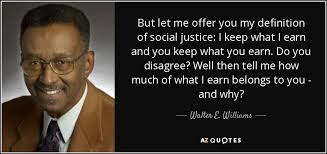
Social Justice: Still a Weasel Word

download

By Mike Cronin

Some time ago, I wrote about the squishy-ness of the term “Social Justice.” It still rankles.

In addition to this blog, I frequently answer questions on a forum called Quora.  Therein, I recently had a debate with a fellow over “social justice” in general, and whether whites should pay reparations to blacks to atone for slavery/Jim Crow/Segregation specifically.

I’ll state right up front: Reparations are a bad idea, and no, I don’t hate blacks.

As I’ve mentioned elsewhere, I believe in individual liberty, limited, rights-protecting government, and Capitalism.  I am also a bit of a skeptic, mildly contrarian, and I tend to prefer rational responses over emotional ones.  I don’t waste energy on hatred, I don’t see any race as superior or inferior to any other race, and I generally deal with people as individuals vice members of some group. It also means I think of justice and injustice in terms of individual action and consequence.

This brings us back to Reparations.  I can’t support the idea because, regardless of how blacks were oppressed or injured by slavery (or later on Jim Crow laws and Segregation), the people who were slaves have been dead for generations – just as the people who held them as slaves have been dead for generations. Treating blacks as a race of sub-humans then was a morally repugnant act committed by more than a few whites, most especially the relatively few whites who actually owned slaves.  But not every white person was an oppressor then, nor were all slave owners white, nor was every black person a slave.

In my mind, government-sponsored racial discrimination based on benign prejudice is just as noxious as discrimination inspired by malicious prejudice.” – Clarence Thomas

Indeed, social justice warriors seeking to impose reparations on whites always seem to ignore or forget that 360,000 Union soldiers, mostly white by far, died in the service of reuniting the country and limiting the spread of slavery to the west.  The Union Army and Navy killed 260,000 Confederates, again mostly whites, who were trying to keep the South, which was wholly dependent on slavery, independent.  Let’s make that point a little more succinct: Whites trying to reunite the country and limit, if not outright eliminate, slavery fought and killed other whites – by the hundreds of thousands, to do it. Between the end of the butchery of the Civil War and Dr. Martin Luther King’s civil eloquence, most blacks (but not all) were still treated poorly by many whites (but not all). Black incomes and living conditions took an overall upward trend.

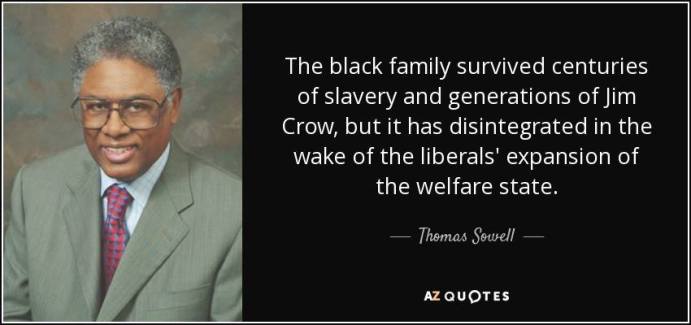
Then came the War on Poverty.  Welfare. An insidious form of wealth transfer. Take money from those who earned it, and give it to those who didn’t.  It put many blacks (and others) right back into bondage – into the slavery of perpetual dependence.  Reparations is a smoke screen word to do more of the same.

15940362_1630282206988368_7273752908148723957_n

During the exchange, I attempted several different ways to make the case that the historical injustice done to the blacks who were slaves and the subsequent victims of post-bellum hatred and discrimination can never be corrected – because the victims and victimizers are long gone.  No one alive today can be responsible for transgressions committed generations in the past – because they weren’t even alive, much less involved, in committing the transgressions.  Thinking that one race is responsible for, and must atone for, the plight of another race is every bit as racist a notion as thinking that one race is superior to another.  It is a large step down the path to perpetual grievance and resentment that plagues much of the rest of the world.

I maintain that “social justice” is a weasel word.  Seeking “social justice” in the form of unjust “wealth transfers” and reparations can never correct the uncorrectable sins of the past.  Real justice can prevail when everyone stops attributing the traits, or actions, or intelligence, or habits, or crimes, etc. of individuals to all the members of a race, or tribe, or nation, or ethnic group, or gender, etc. and starts treating individuals as individuals.

Despite my denunciation of social justice and my espousing of individualism, my interlocutor kept pressing me for details of my plan to bring social justice to blacks today.  We were both using English words, but he was speaking weasel-ese.


Know Your Narratives

quote-if-you-tell-a-lie-big-enough-and-keep-repeating-it-people-will-eventually-come-to-believe-joseph-goebbels-83-20-28

By Mike Cronin

Last week I offered three tips for Filtering the Feed.  I thought I’d end 2016 with one more tip:

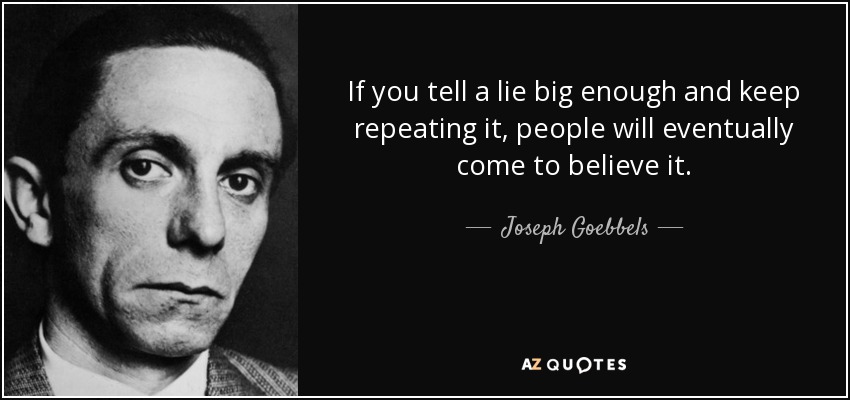
Understand “The Narrative(s).” As mentioned in tip one last week, the news is almost always fake to one degree or another.  One of the driving factors in most main-stream media outlets is maintaining a certain narrative. But the mass media are not the only purveyors of “the narrative.”  In dictionary terms, a narrative is simply a story.  In the sense of modern ideological competition, narratives are essentially the story that is supposed to be happening.  This striving to present the world to the rest of us in a certain way is especially favored by liberals / progressives, but conservatives are not immune to doing so either.  The liberals have elevated maintaining “The Narrative” to an art form, as they control most of the machinery for advancing their version of it: Entertainment, Academia, Education, and Mass Media.  Here are some of its major hallmarks:

  1. Your membership in a group defined by your skin color, ethnic heritage, income, or other attribute is more important than your individual identity.
  2. Ergo, whites are oppressors, or at least privileged, especially white heterosexual men. White men can be held to account for virtually any unfavorable outcome experienced by virtually any other group. In extreme instances, simply being white is racist, while any form of bias, discrimination, or exclusionary behavior directed against whites by other groups cannot, by definition, be racist.
  3. Human beings are destroying the planet
  4. Wealth is distributed unfairly and must be redistributed
  5. Guns are evil
  6. Abortion is a sacred right
  7. Marijuana should be legal
  8. Gays should have the right to marry
  9. Everyone has the right to free speech…unless it’s offensive to anyone except white males or Christians – then it should be doubly illegal.
  10. Everyone has a right to education, health care, food, etc.
  11. It wasn’t Hillary’s fault
  12. Everyone is equal, so everyone should have equal outcomes (except white males – see above)
  13. We should have pure democracy
  14. Big Government is the solution to all of our problems

While liberals have practically “weaponized” narrative advancement, conservatives have their own version of a narrative, which generally espouses opposite positions from the liberal orthodoxy, but not 100%:

  1. Your membership in a group defined by your skin color, ethnic heritage, income, or other attribute is perhaps as important as your individual identity.
  2. Some whites were oppressors while other whites defeated them during the Civil War. Later on, there will still some whites that were oppressors, while others stood with Dr. King in the 60s. Whites don’t have a lock on being oppressors, nor do non-whites have a lock on being the oppressed, as the relatives of the 6 million Jews killed during the Holocaust, or of the Cambodians killed by Pol Pot, or of the Russians killed by Stalin, or the Chinese killed by Mao can attest.
  3. Global warming is a hoax. Human beings might be destroying the planet – you’ll need to prove it without cooking the books and without resorting to calling skeptics “deniers” as if they are heretics.
  4. Wealth is distributed unfairly and must be redistributed…just not by nearly as much as our liberal colleague want.
  5. Guns are a God-given right
  6. Abortion is murder
  7. Drug use is evil
  8. The government must protect the sanctity of marriage as being between one man and one woman
  9. Everyone has the right to free speech…unless it’s flag burning, oh, and you need to say the Pledge of Allegiance.
  10. Everyone has the right to seek out education, health care, food, etc.
  11. It WAS Hillary’s fault
  12. Everyone deserves equal treatment under the law
  13. We are supposed to have a republic
  14. Big Government is the cause of most of our problems…but we’ll let it grow…just more slowly than our liberal colleagues.

There is an alternative to the combating narratives. Call it the moderate, or libertarian, or independent view.  It would probably make more sense to more people than either of the others, except that it has far weaker advancement machinery. I happen to ascribe to this view:

  1. Your membership in a group defined by your skin color, ethnic heritage, income, or other attribute is irrelevant compared to your individual identity.
  2. Some individuals do oppressive things against others. In a rights-respecting country, you can’t rationally hold an entire group accountable for the sins of an individual member of that group, especially if those sins were committed before any of the current members of that group were born.
  3. Human beings might be contributing to climate change, which is, and always has been, a natural phenomenon. We’ll be better off adapting to it than disrupting society with draconian, rights-destroying measures to try and stop it.
  4. Wealth is created by productive people, not distributed. No one has a right to the fruit of someone else’s labor. Coerced charity is theft, but voluntary charity is just fine.
  5. Guns are a protected right because self-defense is a right, to include defending oneself from common criminals, or uncommon criminals, such as tyrannical government.
  6. A woman has the right to do what she will with her own body…but killing a human being is murder. When does a fetus become an individual human being? Before that point, abortion is merely a medical procedure; after that point, killing the baby is murder.
  7. The government should have no say about what intoxicants competent, consenting adults put into their own bodies – but such use cannot mitigate acts committed while voluntarily intoxicated.
  8. The government should have no say in the relationships between competent, consenting adults, except as regards fraud and contract enforcement.
  9. Everyone has the right to free speech…especially if it’s offensive, but not if it takes away something someone else had a right to. Conversely, no one has a right to make others provide a platform, venue, or to make anyone else listen.
  10. The only rights that are proper can’t involve taking anything from anyone else…in violation of their rights!
  11. It WAS Hillary’s fault
  12. Everyone deserves equal treatment under the law
  13. We are supposed to have a republic
  14. Government has a singular purpose: the protection of our rights. When it does anything else, it ends up violating our rights and making the problem it was supposed to correct even worse.

Three Tips for Filtering the Feed

louie-psihoyosinforevolution-e1447273790627

By Mike Cronin

Last year I wrote about the war on Christmas. This year the election of Donald Trump has overshadowed the usual brouhaha over nativity scenes at City Hall. So this year I thought I’d go with something a little more practical. The guiding purpose of this blog is to make sense out of the vast array or “manufactured truth” that we are constantly bombarded with. Here are a few tips and tricks to deal with it every day:

201016msm

  1. Consume news skeptically: the first thing you need to remember about the news media is that their first concern is to sell advertising. Their second concern is often to reinforce a narrative or advance an ideological or even partisan agenda. Running in third place is actually informing you about the new events of the day. There has been much ado recently about fake news. Given the first and second criteria just outlined, almost all the news is fake to one degree or another. When there is some crisis happening, such as 9/11, and the news “breaks in” to tell us about the event as it’s happening, they haven’t had much time to adapt it to their preferred narrative. In those cases we are usually getting real news, even if some of the details are inaccurate while the debris is still falling or the smoke is still rising. As soon as one of these stories acquires its own theme music, it’s no longer breaking news. At that point you must start taking it with a grain of salt. In reality, the best way to glean something of the truth may be to examine headlines from multiple news sources, to include some foreign outlets such as the Economist, BBC, and perhaps even Al Jazeera or Xinhua.  Even so, while those sources may tell you what’s happening and why, they seldom articulate what it means and what will likely happen because of it. Personally, I like to scan the news headlines, but I also like to read intelligence. One of my favorite sources is StratFor; a private “intelligence” firm that uses the lens of geopolitics to explain the world.

geopolitics

  1. Geopolitics, as you might have guessed, is not just about geography or politics, but about how geography enables or constrains political and/or economic action between nations and other actors. For example: The United States is largely regarded to have the largest economy and the most powerful military, and we are generally thought of as being the world’s only superpower. But it is not only our military might or our form of government that has led us to this condition. The United States is this way in part because of where it’s at and what it has. The most striking example of this is our river and coastal waterway system. “The Greater Mississippi Basin together with the Intracoastal Waterway has more kilometers of navigable internal waterways than the rest of the world combined. The American Midwest is both overlaid by this waterway and is the world’s largest contiguous piece of farmland. The U.S. Atlantic Coast possesses more major ports than the rest of the Western Hemisphere combined. Two vast oceans insulated the United States from Asian and European powers, deserts separate the United States from Mexico to the south, while lakes and forests separate the population centers in Canada from those in the United States. The United States has capital, food surpluses and physical insulation in excess of every other country in the world by an exceedingly large margin.” (From StratFor’s “The Geopolitics of the United States.”) Give these advantages, it would have been a shock if the US had not become an economic powerhouse! By way of contrast, consider the difficulties faced by a landlocked country. Afghanistan, for example, is estimated to have over $1 trillion worth of natural resources in the form of valuable ores and minerals. Yet owing to the difficulty of getting to and from Afghanistan and navigating within its borders, and the fractured nature of its tribal society, Afghanistan has never realized its economic potential, and is unlikely to do so in the foreseeable future. Where the United States has abundance of access, Afghanistan has a dearth. Geography has dealt a difficult hand to landlocked countries, but there is at least one way to overcome that difficulty: adopt a Western form of governance that recognizes individual rights and promotes liberty. Switzerland is the epitome of a country that can overcome geographic isolation by staying neutral in the conflicts of its neighbors and giving its people freedom.
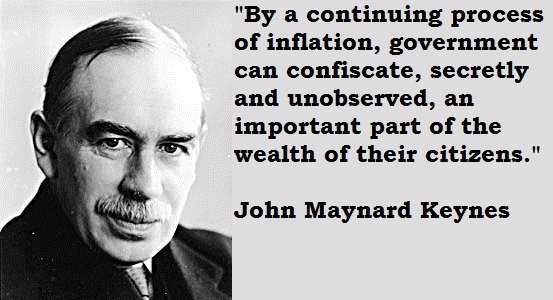
  1. Like most, I’ve had geography classes, and classes on US. Government, but I never had a “geopolitics” class per se in my formal education. Our schools are set up to teach material as discreet subjects, but our brains are not set up that way. We learn and make memories by association. Another example might be economics. The word economics conjures up thoughts of central banks, such as the Federal Reserve, changing interest rates and conducting “quantitative easing.” Those elements of economics were among the set popularized by John Maynard Keynes, and “Keynesian Economics holds sway among the vast majority of economists today.  9i7jfxdepbiuxmllhv6wxoykazrjmeynuapn20ngnu0But in a broader sense, economics is the study of human activity. This goes hand in glove with geopolitics, as does history. Come to think of it, so does psychology. What if there was a way of learning economics (and other subjects) in a way that more closely mimics the way the human brain learns? Under such a rubric, there would be far fewer barriers between what we think of as the traditional subjects. Such a field exists.  It’s called “praxeology.” In short, praxeology is the study of volitional human action, and it is a basis for the Austrian school of economic thought.  We can borrow the concept to help us understand the world without trying to become economists ourselves.

Using these three tools (skeptical news consumption, understanding how geography can enable or constrain political and economic action, and removing the artificial barriers between “subjects,” and examining human action holistically), we can better learn to Filter the Feed.

Random Matter 2

968361

By Mike Cronin

The tidal wave of angst unleashed by the election of Donald Trump is not wholly explainable by his crudity, political outsider status, media and polling industry failures, hacked emails, possible election tampering, or Hillary Clinton’s campaign style.

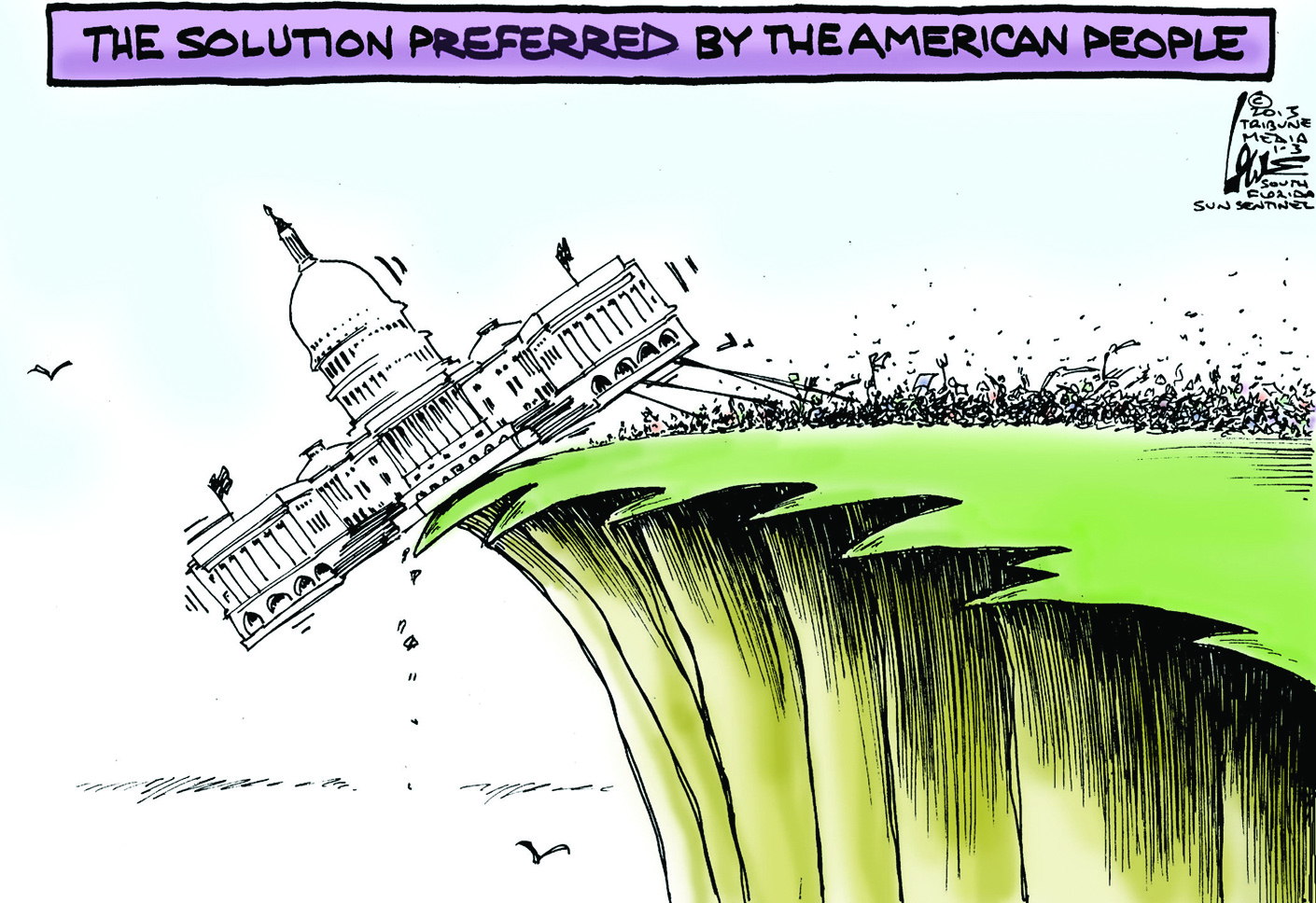
For too long, the beltway establishment has been driving this country down a two-lane country road that ends at a cliff: tyranny. When the liberals where at the wheel, the conservatives would call the cliff “socialism” and say the Democrats were racing us towards it, while the liberals would say that conservatives were steering us headlong towards the “fascism” cliff when Republicans had the wheel.

It was always the same cliff.

lowe-cliff1

Now the liberals are howling that Trump will stomp on the accelerator, and the “Never Trump” branch of the conservative establishment isn’t sure that he won’t do just that.  Nor am I.

What I am more confident of is that for perhaps only a brief moment, by electing Trump, the passengers have made ALL of the drivers slow down and take notice of the impending danger. Even if Trump turns out to be wise at the wheel, we may be in for a period of painful adjustment.

***

0094e7c2-675b-4b13-b325-e846ce30e305

Have you ever been irritated by Pecksniffian pipsqueaks who take any statement that does not absolutely validate or corroborate what they say and allege it means exactly the opposite?

Pipsqueak: We have to raise the minimum wage for the poor. (Sips his latte.)

Host: But won’t that mean there will be fewer jobs?

Pipsqueak: Hate speech! What do you have against poor people?  Are you a one-percenter? I can’t believe we still have troglodytes like you in this country!

Host:  But I was just-

Pipsqueak: I have to go. My limo is double parked, and I’m late for therapy.

***

6189757e341e0250bd04e817c3808ffe

Congress is now considering bills that would make it mandatory for females to register for the draft with Selective Service.  In my opinion, obligatory service of any kind is anathema to freedom.  You cannot protect freedom by taking it away. It is also not very effective to staff a high-tech, professional military with conscripts. It takes an inordinate amount of effort to train, motivate, and discipline people who are potentially there against their will…though it can, and has, been done.

It is far more efficient, effective, and easier to train qualified and self-motivated volunteers.

Wisely, the US stopped the draft in 1973…but unwisely kept the Selective Service, and is now taking a step in the wrong direction, IMO.  Instead of making females register, it should stop requiring anyone to register!

On the other hand, I would be in favor of examining the idea that we stop automatically conferring citizenship by birthright.  The idea that one should have to earn citizenship, with public service being one avenue to that end, has some interesting potential.

Globalism vs. Trumpism

9yedzw-1

By Mike Cronin

A common thread in the alarms raised by the election of Donald Trump is the concern that his brand of nationalism/populism will turn the US isolationist, or worse, into a fascist dictatorship. Why are globalists, themselves no friends of individualism, alarmed at such a prospect?  It might help to understand more about the complexities of globalism/globalization.

According to http://www.globalization101.org/what-is-globalization/;

“Globalization is a process of interaction and integration among the people, companies, and governments of different nations, a process driven by international trade and investment and aided by information technology. This process has effects on the environment, on culture, on political systems, on economic development and prosperity, and on human physical well-being in societies around the world….

…Globalization is deeply controversial, however. Proponents of globalization argue that it allows poor countries and their citizens to develop economically and raise their standards of living, while opponents of globalization claim that the creation of an unfettered international free market has benefited multinational corporations in the Western world at the expense of local enterprises, local cultures, and common people. Resistance to globalization has therefore taken shape both at a popular and at a governmental level as people and governments try to manage the flow of capital, labor, goods, and ideas that constitute the current wave of globalization.”

Don’t get me wrong.  There is nothing inherently wrong with globalization per se.  In fact, taken at face value, it is probably a net benefit to humanity. Think about the spread of modern medicine and information technology, for example.  I think unfettered international free markets would be a great thing.  I have often presented my bias for free-market capitalism.  My bias has no border.  Unfortunately, the only unfettered free markets that exist today are the “black” markets for illicit goods, and unfortunately, human trafficking.  The rest of the global market is beset by trade imbalances, currency manipulation, defaults, sovereign debt crises, bailouts, and other “fetters.”

Given that explanation, the shape of the globalist critique against Mr. Trump (and the recent “Brexit” vote) begins to emerge.  Among the proponents of globalism are those who have been unethically enriched by manipulating matters at the diplomatic, international finance, and CEO levels.  Many of the proponents of globalism are not proponents of an unfettered free market. They seek to establish and/or perpetuate imbalances that they can profit from.  These are not productive people; they are more like vultures or parasites. These are the globalists who fear that Donald Trump’s administration, a Republican majority Congress, and a conservative Supreme Court will upend the existing “globalist” order – the globalists who have the most wealth and power to lose.

And that is why we must also examine nationalism.  The elite manipulators of international intercourse may be parasitical; but that does not make their concern over a rise in Trump-branded nationalism baseless.  Extreme nationalism has led to dark places before. Consider the word “Nazi.” It’s a German abbreviation for Nationalsozialist, i.e. “Nationalist Socialist,” hence the anti-Trump crowds’ easy conflation of Trump’s “America First” populism with fascist nationalism.

Will Mr. Trump’s brand of nationalism lead to that same dark place?  Did we just elect a tyrant-in-waiting?  Time will tell.  If Trump does become a dictator, I wonder: will the lachrymose legions lamenting Hillary’s loss begin to see the wisdom of the Second Amendment?