Ten Observations on Election 2016

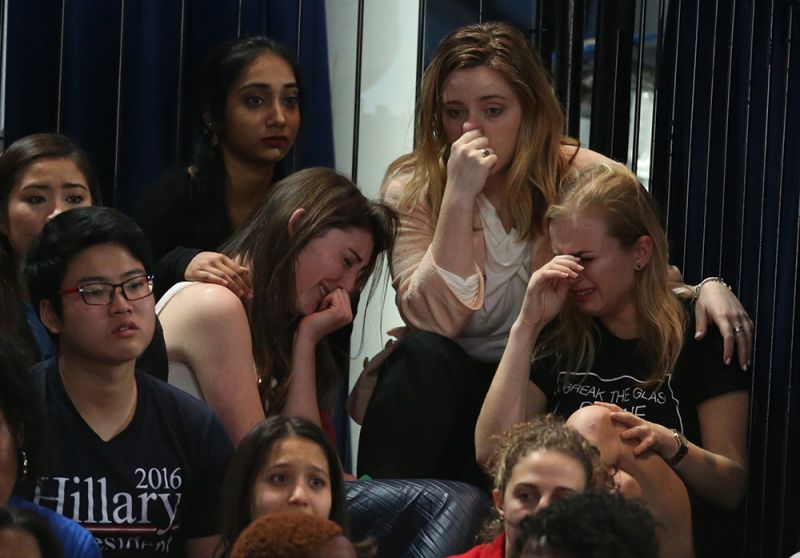
hillary-clinton-supporters-cry-over-election-loss

By Mike Cronin

Donald Trump’s victory certainly stirred up a lot of clamor and noise this week.  Let’s see if we can herd some of the cats:

  1. Democracy has failed. The people chose Hillary Clinton by 200,000 votes, but the electoral victory went to Trump. Our “democracy” cannot fail if we don’t have one, which is in fact the case. We were given a federalist republic under the rule of law. We use democratic processes for some decisions to give the people a voice, but we are not supposed to have a system of straight-up majority rule. As to the electoral vote: It remains to be seen whether any electors will “go rogue” and vote against their “pledge” on Dec 19th, but it has happened before (as recently as 2004).  Of course, it’s never been by enough margin to change the outcome of an election.  In this case, at least 38 would have to be “faithless electors” to get Clinton to 270.
  2. Trump hates immigrants. He hates Mexicans. He hates Muslims. He’s racist.  We’ll, he might. Only he knows for sure.  However, he is married to an immigrant and he has people from all walks of life working for him.  He certainly doesn’t think people should be here illegally, which is not the same thing as hating the people who are or the people who want to be.
  3. Trump is a misogynist sexual predator. His caught-on-camera crudities certainly lend themselves to this narrative. There’s little actual evidence and no credible accusers that demonstrate he hates all women or has assaulted any of them, but Trump’s verbal vulgarity in this area is one of the most troubling things about him. Still, while Trump has been caught speaking like a sexual predator might; Hillary Clinton continues to aid and abet one.
  4. Trump is going to destroy all of the progress progressives have made over the last eight years. Possibly, but presidents seldom accomplish their full agendas.  Yes, Trump will have a Republican-majority Congress, but it won’t be a super-majority, and the Republican establishment doesn’t like him.  Trump bills himself as a deal maker.  He’ll have to be to get his agenda anywhere.
  5. Trump is going to elevate nationalism over globalism. Both are euphemisms for collectivism; only the boundaries are different. Neither is as good for individuals as unfettered free market capitalism.  There might possibly be temporary beneficial effects for Americans in the shift, especially if our troops come home and small businesses can thrive again.
  6. Trump is an idiot/outsider/politically inexperienced. He certainly does not articulate himself with Obama’s grace, but he is no dummy. In fact, he’s likely quite adept at persuasion (see items five and six on this list). He is certainly gifted at getting free publicity (or at least notoriety) from the very mass-media that hates him. Also, his lack of political experience, i.e. his NOT being a career politician or D.C. insider, is one of the fundamentals that led him to get elected.
  7. What happened with the polls? They consistently gave Clinton the edge! Bottom line: garbage in/garbage out.  The pollsters drew their samples from the same body of “likely voters” they always used, and in some cases “oversampled” Democrats.  The former was neglectful and led to the Democrats believing in their own invulnerability; the latter was a nefarious attempt to convince would-be Trump voters to stay home on Election Day. Once exposed, the revelation likely caused the exact opposite effect. Either way, the pollsters failed to obtain accuracy because they could not, or would not, sample validly.  
  8. FBI Director Comey’s shenanigans (i.e. his announcements regarding the on-again/off-again investigation into Clinton’s email debacle vis-à-vis Huma Abedin’s laptop) comprised the quintessential October Surprise, and it hurt Clinton. It certainly didn’t help, but it’s much more likely that Clinton’s shenanigans hurt Clinton.
  9. Why were Clinton and Trump our candidates? What secret weapon did they employ that none of their competitors had? 30-plus years of universal name recognition.
  10. What does it mean that Republicans gained more seats in Congress, strengthening their majority? They didn’t get a super majority, so there are a few (rare) actions they would have to earn Democratic support for in order to act: Impeaching the president and overriding his vetoes are two such cases. 2. Republicans will get to shape the Supreme Court for the next generation. 3. Republicans now have an opportunity to reverse much of the Democrats’ work over the last eight years. Whether they will actually do so, or get complacent and/or get caught up with internal divisions remains to be seen.

Choosing a Beekeeper?

 hillary-clinton-and-donald-trump-face-off-ap-photos-640x480

By Mike Cronin

Today’s item is an update of “Will You Vote for a Beekeeper,” originally posted January 2, 2014.

The most basic (and most commonly employed) model of the political spectrum places Fascism (like Germany under Hitler and Italy under Mussolini) on the extreme right side of the scale, and Socialism or Communism (like the former Soviet Union or modern North Korea) on the extreme left side.  A government, a country, or a person’s political position can be gauged on this spectrum.

The problem with this model is that while the ideologies of Fascism and Communism may differ on the surface, in practice they result in the same conditions for the vast majority of people who live under them: subjugation. There may be distinctions between the two on paper, but in reality both ideologies are collectivist; that is, they espouse that the state, or the party, or the race, or the group, i.e. the collective, is more important than the individual, and that the individual exists to serve the larger group. In other words, both of these forms of politics, Communism and Fascism, treat humans like bees or ants, i.e. as drones (or slaves). The individual’s rights don’t matter (or even exist), only the party, or country (or hive/colony, i.e. collective), matters.

The achievement of the founding fathers was in creating a nation founded on the concept that the individual has rights that are inherent, that is, they are not granted by the state, and that the sole purpose of government is to protect those individual rights. The implementation of this idea was flawed, but still gave rise to a nation that brought more liberty and prosperity to more people than any other in history. One of the hallmarks of the system the founders built is the peaceful transition of power that has attended every presidential election and inauguration (save perhaps Lincoln’s).

One of our most contentious campaign seasons will culminate with the general election on Tuesday.  Consider: Whether a politician identifies as a liberal or a conservative, a Democrat or a Republican, does not matter as much as this: What does his or her character and voting record reveal about their understanding of individual rights?  Mrs. Clinton and Mr. Trump are remarkable as candidates in that each was chosen by their party seemingly on the strength of name recognition over any other factor.  (Both have been in the public eye on a national scale for 30+ years, far longer than any of the other candidates on either side.) They certainly haven’t been selected for their “sterling” personal attributes.  Will we elect one of them based solely on popularity (or notoriety)?  Can either of our candidates be considered defenders of our rights, or are we choosing between beekeepers?

RIGOROUS RED OR BOGUS BLUE, PT III

87971b3eb353cf89fdefdd9941bb76bb

By Mike Cronin

The focus of the last two posts was on the “blue pill” as it regards our “progressive” education system.  I have written several previous posts dealing with political prescriptions for “blue pill” thinking.  The imagery and tone of those pieces and this one may lead you to assumes I am associating all things “blue pill” with liberal/Democrat/ “blue state” politics, and red pill rigor with Republican/conservative/”red state” politics.

You would only be partially right.  Our education and media elite are certainly dominated by those who would prefer a tame, conditioned electorate, but that desire is not exclusive to the panoply of progressive poohbahs.  There is no shortage of conservatives/traditionalists that would like to impose their own brand of “blue pill” virtuality upon us using the existing, Prussian-model school system.  The pill would be “branded” quite differently, of course: Teaching of creationism/intelligent design as science and mandatory recitation of the pledge of allegiance (a loyalty oath) by children too young to understand the concept of total commitment are two ways that come readily to mind.

“In our secular society, school has become the replacement for church, and like church it requires that its teachings must be taken on faith.” ― John Taylor Gatto

So what can be done?  Ultimately, a “red pill” solution would entail the separation of school and state, in the same way and for the same reasons we have separation of church and state.

Whoa! How can you say such a thing, Cronin?!  If we don’t have public education, we’ll have a bunch of uneducated kids running around that can’t think critically, getting into mischief and gangs and criminal conduct! We won’t be competitive in the global market!

How would that be different than what we have now?

Believe it or not, before the imposition of public schooling, and especially the Department of Education, the literacy rate in this country was actually higher than it is now across many demographic groups. (Admittedly, that is a tough comparison to accept. It requires that one omit slaves from the calculation, for instance, as the first public schools appeared while slavery was still legal; teaching slaves to read was often prohibited.)

I ask you: If a thing can be done privately, what business does the government have doing it?

But if we don’t have public education, won’t the private education system be just as much of a “blue pill?”

Unlikely. The key ingredients missing from education in a system monopolized by government are competition and choice. In a competitive education market, schools would have to meet their customers’ expectations or go out of business.  Good teachers would be highly sought after and well compensated.  Bad teachers could be fired. Government is force. Government performs exceedingly well where force is the required tool to solve a problem.  At best, government achieves a desultory mediocrity at everything else it does. Is force the correct tool to use to educate our children?

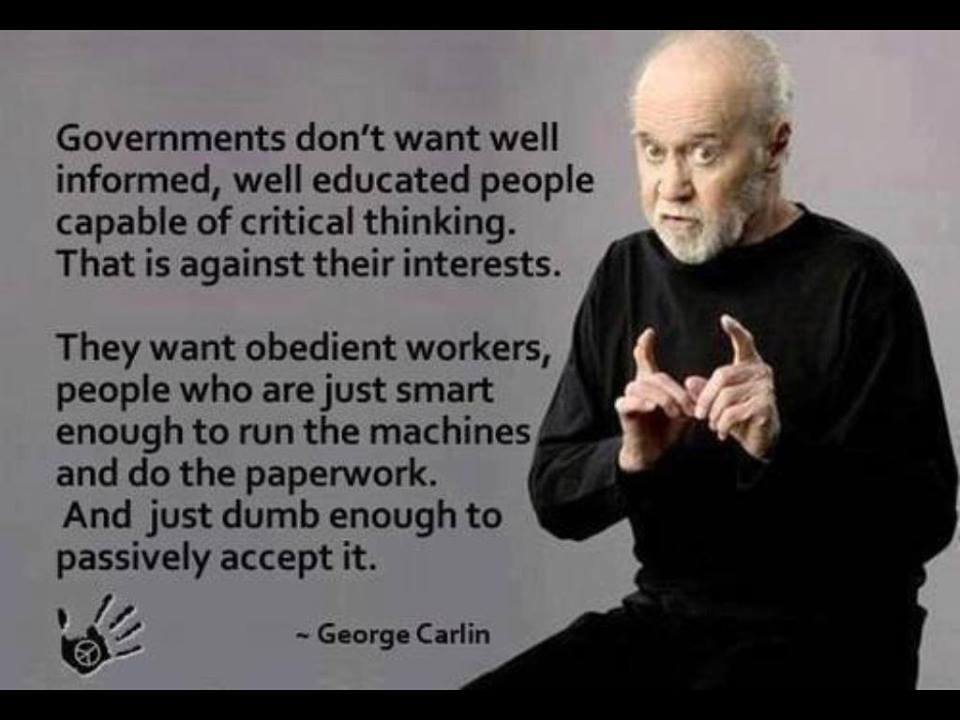
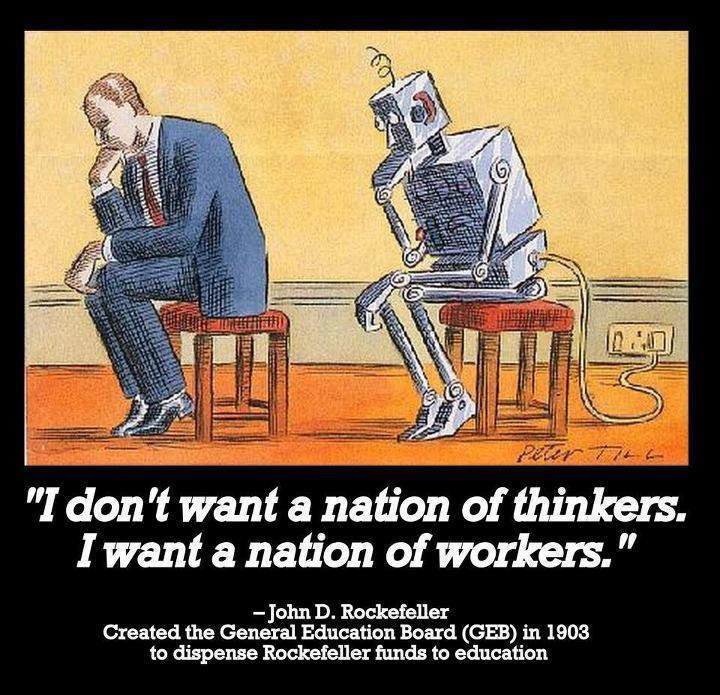
We are indoctrinated by a school system designed to mass-produce workers and consumers, “informed” by a mass media machine that continuously keeps us alarmed, and led by politicians whose only concern is getting elected or re-elected.  How could anything be wrong?

Rigorous Red or Bogus Blue? Part II

64555_333787396719890_1465346194_n

By Mike Cronin

Using the analogy of the Matrix movies, last week I posited that two philosophical traditions are vying for primacy over our minds.  One of them, the “blue pill,” offers a fantasy.  Conversely, “red pill” traditions require mental rigor.  They are not so easy to follow, but they flow from and describe the true nature of reality.

The most insidious facet of the “blue pill” is that it works best when it is proffered early in a child’s development…and its greatest efficacy lies in “armoring” the developing mind against the “red pill” before the child even knows there is an alternative. Our school system is the primary dosing mechanism for instilling “blue pill” thinking.

“Education is a system of imposed ignorance.”Noam Chomsky, Manufacturing Consent: The Political Economy of the Mass Media

How can that be? Our kids learn reading, math, and science, don’t they?  With those subjects, they are equipped to learn anything else, aren’t they?

Our schools certainly present those topics. It is in how they are presented that the crime lies. Our education system “standardizes” kids by teaching them facts and theories but neglecting context. It forces the “blue pill” on kids in several basic ways:

  • School as a state function, with attendance becoming compulsory.
  • Regimentation and Pavlovian conditioning (age segregation, dividing the day into lesson periods, sitting in rows, bells, uniforms, etc.)
  • Discouraging holistic comprehension by segmenting knowledge into disjointed subjects (reading, math, science, art, “social studies,” etc.) taught in incomprehensible order.
  • The “professionalization” of teaching. Aspiring teachers, themselves graduates (victims?) of the same system, are given to understand that it is their role to fill minds…instead of to remove obstacles and let young people be their own teachers. This lead to the decline of parent-as-mentor – and of kids who could already read before entering school at six or seven.
  • Employers and higher education institutions began demanding evidence that proved completion of the prescribed program (diplomas).

This model was imported from Prussia and/or instituted in the early-to-mid-1800s. The Prussians devised their system independent of any relationship to individual liberty or freedom.  The Prussian system had three tiers.  The vast majority (94%) of the population was to be adequately prepared to function and contribute, but not think for themselves or lead, at volksschulen.  The other 6%, those from elite families, were destined to rule or manage.  They received educations more geared to critical thinking.

In the US, the Prussian model was implemented in part to “Americanize” (i.e. instill WASP values in) the many Catholic immigrants coming in from Italy and Ireland.

According to former award-winning teacher turned public-school critic John Taylor Gatto:

“A small number of very passionate American ideological leaders visited Prussia in the first half of the 19th century; fell in love with the order, obedience, and efficiency of its education system; and campaigned relentlessly thereafter to bring the Prussian vision to these shores. Prussia’s ultimate goal was to unify Germany; the Americans’ was to mold hordes of immigrant Catholics to a national consensus based on a northern European cultural model. To do that, children would have to be removed from their parents and from inappropriate cultural influences.”

So, you know how we are often told that our kids are continually ranking lower on literacy and math than other developed nations, i.e. that our schools are failing?  That we must “invest” more public funding in the schools?

Understand that in the most basic sense our schools are not failing at all; they are doing exactly what they were designed to do: make the vast majority of kids swallow the blue pill and grow them into good consumers who are smart enough to run the machines and think what they are told to think by their betters, but not smart enough to think for themselves and run the businesses or lead the country.

Rigorous Red or Bogus Blue? Part I

0d8621c

By Mike Cronin

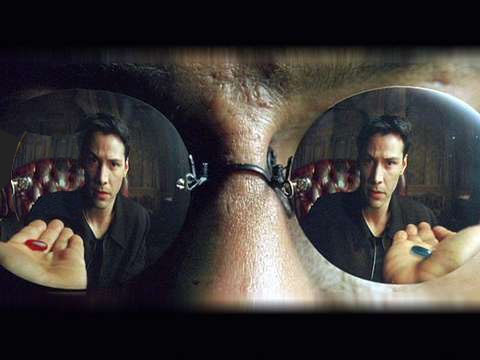
In the 1999 movie “The Matrix,” the future is presented as a dystopia where the vast majority of human beings are caged in pods that capture their body heat to energize a vast, governing machine intelligence.  In order to keep people in such a state, the machines created a virtual reality and plugged the brains of the human “batteries” directly into it – this constructed reality is the eponymous Matrix.

There are a few human rebels who escaped the machines, fighting an almost hopeless battle against them. These rebels are able to plug themselves back into the Matrix with full awareness of its virtual nature, and work to free the rare human “battery” who has begun to suspect the Matrix is not reality.  In the process of freeing such a mind, the leader of the extraction team confronts the skeptical person within the Matrix, hints at the truth, then offers the candidate two pills, one red, the other blue.  If the candidate takes the blue pill, he will remain trapped in the Matrix.  If he takes the red, he will be unplugged, rescued from his pod, and shown the true nature of reality.

There are some people today who believe we are living in a Matrix.  I don’t subscribe to that at all, but I do believe nearly all of our society’s ills can be attributed to a conflict between two philosophical meta-traditions, with schools of thought that promote collectivism & altruism on one side; and the philosophies of  individualism & reason on the other.  The traditions of collectivism & altruism have some Matrix-like qualities.

“Children who know how to think for themselves spoil the harmony of the collective society which is coming where everyone is interdependent.” ― John Dewy, hero of progressive education.

Like the machines in the Matrix, the elite of these traditions would prefer their subjects remain ignorant of the true nature of things, i.e. to take the metaphorical blue pill.  Creating critical thinkers is not a goal for the education of the masses in systems dependent on these models; nor is it a priority for the media to expose truths that contradict the narratives of the anointed elite.  But unlike the “batteries” of the Matrix, We the People are not trapped in energy-sucking pods. Metaphorical red pills can be found.

“We want one class of persons to have a liberal education, and we want another class of persons, a very much larger class of necessity in every society, to forgo the privilege of a liberal education and fit themselves to perform specific difficult manual tasks.” ― Woodrow Wilson, 28th President of the United States

Promoters and adherents of philosophies of individualism and reason are, like the rebels in the Matrix movies, very much a minority who see things much closer to the way they truly are. A thinking, reasoning mind is valued among such rebels, skeptics, and extremists, but represents a threat to the purveyors of the blue pill.

“To fill the young of the species with knowledge and awaken their intelligence… Nothing could be further from the truth. The aim… is simply to reduce as many individuals as possible to the same level, to breed and train a standardized citizenry, to put down dissent and originality. That is its aim in the United States… and that is its aim everywhere else.” – H.L. Mencken, journalist and author

The conflict between “blue” and “red” thinking has been with us since humans first started using tools to make tools – probably as far back as the invention of the wheel.  Blue thinking started with superstitions and pagan religions.  It has always had the advantage of being easier to sell and easier to believe in, so it has always flourished in some form or fashion, while red thinking has always required intellectual rigor, which meant it was not preferred by people looking for the path of least resistance. In fact, ours was the first nation to be founded on the principles of individual liberty and capitalism – i.e. The United States of America is the original red state!

5 Ways to Fight Hobgoblins

panic-button

By Mike Cronin

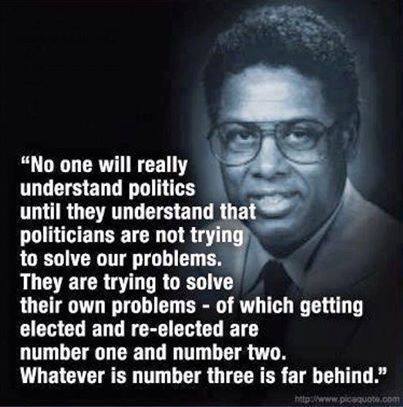
I often refer to H.L. Mencken’s “hobgoblins” quote: “The whole aim of practical politics is to keep the populace alarmed (and hence clamorous to be led to safety) by menacing it with an endless series of hobgoblins, all of them imaginary.” We see this every day, often with the enthusiastic pot-stirring of the main stream media.

Take today’s headlines, for example.  Rising tensions with Russia over the imbroglio in Syria. Hurricane Matthew. Gold prices. Stock prices. Jobs growth. Giving up control of the internet.  Hillary’s scandals. Trump’s crudities.  Duterte’s bombast. NFL ratings. Crazy clown sightings.

How is all of that really important? How can we ignore the hobgoblins and glean the “ground truth?”

A few rules of thumb can be useful:

  1. Always keep Mencken’s quote in mind, together with Thomas Sowell’s observation:1931497_10156430011180515_9052930332313088412_n
  2. Get your news from a variety of sources. Journalism has evolved, or more precisely, de-volved, in the face of 24/7 cable news cycles, citizen-chroniclers, and the web.  According to the authors of Blur, the old media’s apex occurred at about the time of the Three Mile Island incident in 1979. CNN came online shortly after in 1980, and the 24/7 news cycle was born. The term spin as euphemism for truth-shaping entered the lexicon at about the same time. Consumers have had to contend with an ever more clamorous, ratings-driven media ever since. Every outlet is biased, but some do a better job of admitting what their bias is (my own, for example, is for individualism, reason, and laissez-faire capitalism) and/or mitigating for it (this reporter, for example, does a commendable job on reporting from Washington D.C. without interjecting his ideology). Alternately, check out the US news from a foreign source, such as BBC, Al Jazeera, or Xinhua.  They are biased as well, but perhaps not about the same things we are. It can be enlightening.
  3. Once the main-stream media have added unique theme music to a particular story, it’s not breaking news anymore. They are trying to turn it into a cash-cow and milk it for ratings.
  4. Most mainstream media operations lean left/liberal/progressive/Democrat, while Drudge, Breitbart, and Fox News (at least until the recent departure of Roger Ailes) tilt right/conservative/Republican – but what if both of those factions are two sides of the same coin? In order to see liberals and conservatives as opposites, you are supposed to accept a left-right political spectrum model with socialism on one end and fascism on the other. To the subjugated souls living under either, there is no practical difference. As the saying goes: All models are wrong, some models are useful.  A left-right / liberal-conservative model keeps you scared of the hobgoblins.  What if we look through a different lens? What if we put individual liberty on one end, and absolute tyranny on the other?  I contend that on such a model, “liberal” and “conservative” establishment politicians are continuously dragging us closer to the tyranny cliff, with only the flavor of tyranny at issue. Using a better model might get us closer to “ground truth.”  Who will lead us to liberty or drag us to tyranny?
  5. One kind of real hobgoblins we must watch for: luminaries with enough wattage to force the public eye to “look away.” Such wattage could come in the form of personal charm or charisma, whereby the figure is judged by their reputation instead of earning a reputation based on considered judgement (e.g. President Obama’s anticipatory Nobel Peace Prize), or via “wagging the dog” (e.g. President Johnson’s incandescent “Gulf of Tonkin” lie).


The Philosophy of Invincible Ignorance

ignorance3

By Mike Cronin

I once heard an anecdote about a female engineering student who spoke up in the classroom and opined that 50% of engineers should be women.  The professor requested that the student take a look at the class make up. (It was overwhelmingly male.) The professor then observed that before 50% of engineers could be women, 50% of engineering students would have to be women.

A quick web search indicates science, engineering, technology, and math (STEM) are still largely male-dominated fields of work…and college study, with engineering being extremely so – to the tune of roughly 80% male to 20% female. (There was no accounting for any “alternately gendered” engineers/students.)

I don’t know how to get more females into STEM programs, or even if gender parity in STEM is a must-do, but I do know that destroying scientific rigor is not the answer.

Apparently, that is a misogynist attitude on my part.  According to a study by Laura Parson of the University of North Dakota, STEM course syllabi (and by extension all of STEM) alienate women because of the way they are worded. Her study was undertaken through the lens of “poststructuralist feminist thought.” For those of us uninitiated in the arcana of ivory-tower academician-speak,   “Poststructuralism ‘rejects objectivity and the notions of an absolute truth and single reality.’” Ahh, now that explains a few things.

Under such a system of thought, you can do or say anything you want, because in your subjective reality you’ve decided it’s OK.  That kind of junk philosophy may be the foundation (or the excuse) for the pervasiveness of what the late William F. Buckley, Jr. called “invincible ignorance.”  Imagine a world underpinned by such mental guidance: People could do whatever they felt like and get away with it…as long as they were of the anointed class approved by the elite, who could do or say whatever they felt like in their own little realities.

I mean, under such a regime you could have a central bank pump funny money into the big investment banks and the stock market even as the rest of the government taxes the bejesus out of the people’s real earnings and accumulated wealth, and call it “economic stimulus” or “quantitative easing.” Or you could have members of the elite who think the laws don’t apply to them, or that when they are caught breaking the laws, claim they made a “mistake” and not even get charged with a crime, let alone tried or convicted. Or you could wage endless wars against conditions and actions like obesity, poverty, drugs, and terrorism instead of naming your enemies and destroying them.  Or wealth could be distributed and redistributed, instead of earned and taken. Or the Supreme Court could call the Constitution a “living document” and interpret it to mean anything they liked, vice what it actually says.

I wonder how soon it will be before travelers will have to fly in an airplane designed by an engineer who went to the “Laura Parson School of Subjective Sciences and Mathematics,” who “felt” her math was correct under her own alternative understanding of the laws of physics?


Trolling by Polling

funny_hillary_clinton_vs_donald_trump_election_postcard-ra42557157e2745d582361c25dfe3b9db_vgbaq_8byvr_630

By Mike Cronin

Now that the presidential campaign season is in full swing, we are being treated to the usual inundation of “demographic” polling results (i.e. how are “soccer moms,” Hispanics, gays, white men, etc. going to vote?)  Taken individually, as they are usually reported, the vast majority of these polls tell us nothing useful.  Piolls that tell us how a state will vote are getting closer to valuable.

Consider: This page at Real Clear Politics lists numerous polls with entries similar to this one:

Race/Topic: State X:         Poll : Qunipiac                Results  Trump 44, Clinton 38                            Spread: Trump +6

Trump is up by six points over Clinton in State X.  Sounds dire for Clinton, right?

You still might be getting “trolled.”

Regardless of how you’d like the race to go, we need to remember how presidents get elected: by winning the Electoral College vote.  The popular vote heavily influences the Electoral College, but the nature of that influence is determined by state laws. As we’ve seen as recently as 2000, it is possible to win the popular vote but lose the electoral vote and the election. In terms of polls: It means that generic surveys of this or that demographic, such as the one cited above, are almost useless by themselves for telling us how an election might go, especially in “solid” red or blue states. It makes no difference if a candidate’s poll numbers go up in a state that was already going to vote for them.  It makes a great deal of difference if a candidate’s numbers change in a battleground state with a lot of electoral votes, such as Florida or Ohio – such a shift could move electoral votes from one column to the other, perhaps enough to get to 270.

Thus, even taken in aggregate, “demographic” polls aren’t much of a barometer.  A much more instructive product would tell us how every state is currently trending, with caveats for the states (Nebraska and Maine) that are not “winner take all.”  Such a tool would give us a much better predictive assessment of the electoral college votes likely to go to each candidate.

Such a beast exists: http://www.270towin.com/. They have broken down the race several ways.  If we look at their map that “kluges” current polling data with expert forecasters’ opinions, Mrs. Clinton already has 272 votes in her camp, two more than are needed to win.  But  if we look at their chart that displays the accumulation of polling data only and omits “expert opinion,” then Clinton has about 200 electoral college votes in her camp (out of 270 needed to win), while Mr. Trump has 163.  Either situation sounds much more troublesome for him than “Trump up by six” sounds for Clinton, doesn’t it?

If “demographic” polls vice “electoral vote” polls do little to predict the outcome of the Electoral College race, why publish them? At least two possibilities come to mind:

  1. There’s nothing like stirring the pot in order to keep you tuned in and watching advertisements.
  2. To shape voters’ behavior in some way favorable to whomever commissioned the poll. Example one: Clinton’s current lead only translates to victory on Election Day if enough voters actually go to polling places and pull levers.  If you want Clinton to win, maybe you paint her as losing ground in the polls in order to generate a hint of doubt. Maybe that will motivate folks to go vote that might have stayed home if they felt comfortable she was going to win. Example two: If you want Trump to win, you might commission such a poll in order to generate enthusiasm by painting him as an underdog coming from behind and pulling ahead – a narrative that always does well in America.

Manifestly, Donald Trump still has an uphill battle.  In his best case scenario, he has to take 107 more votes and keep Clinton from gaining, while in his worst case he needs to take at least three of Clinton’s existing votes away!

Despite being much more instructive than run-of-the-mill poll reporting, even such tools as the “270towin” charts are not infallible, nor is the sentiment recorded today going to be the same on election day.  Clinton’s recent bout with “pneumonia,” clumsy messaging regarding her overall health, and “deplorable” commentary on Trump supporters certainly helped Trump’s polling tick up a bit, but did it affect the electoral vote trend?  Time will tell – and we still have to get through the “October Surprise.”

While such and event or revelation may yet upend the race, there is sure to be a battle over the next few weeks for the remaining available electoral votes. Poll results that don’t tell you how that aspect of the election is going are probably not worth your consideration.

Testing our Constitution

constitution-print-c10314518

By Mike Cronin

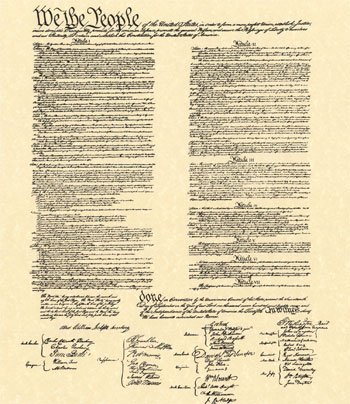
Today ought to be a national holiday.  229 years ago today, the Constitution was created.  It was ratified and became the highest law of the land two years later in March of 1789.  Contrary to popular opinion, or even popular “fact” taught in many of our schools, the Constitution didn’t give us a democracy, even though it specified certain democratic processes for electing the president and members of Congress and for proposing and enacting legislation.  It gave us a republic – a form of government where the people’s rights were protected by law and could not be voted away at the whim of the majority.  It gave us the first country in the history of mankind founded on the ideal of individual liberty and personal freedom.

The Constitution, and our republic, has been under attack, either literally or rhetorically, ever since.  Some, like Supreme Court Justice Thurgood Marshall, would have us believe the Constitution is a “living document,” i.e. open to re-interpretation through whatever cultural lens exists at a given time.  The Framers knew better than that.  They knew America would not be the same in 1887 or 1987 as it was in 1787, so they crafted a mechanism into the Constitution that would allow for it to be changed: via amendments. They deliberately made the amendment process challenging, but not impossible.  It has worked just fine at least 17 times over the last 229 years.  The most recent, the 27th Amendment, was ratified in 1992.  (Yes, there are 27 amendments, but the first ten were enacted simultaneously as the Bill of Rights, hence 17 instances the amendment process has been carried out.)

One of those amendments, the first in fact, is being tested right before our eyes today. There is a public controversy over several NFL players who are refusing to stand during the playing of the National Anthem.  As a veteran, I am in the curious position of both feeling pained and proud.  It pains me to see people disdain the anthem, because so many have fought and died to protect the freedom and liberty the flag stands for. And yet, the very first freedom protected by the Bill of Rights is the freedom of expression.  As much as it galls me to admit it, our country has not always acted in accord with its own highest law.  As I’ve mentioned elsewhere, for nearly a century after the Constitution was ratified, men could own other men in this country…if they were black. Our history has other examples of its failure to abide by the Constitution and the principles of individual freedom it protects: Confiscatory income taxes. The draft. Excessive bureaucracy and scandalous deficits and debt. Spying on citizens. Obamacare. Failures to hold officials accountable for their transgressions in office. The list is not short.

So when an NFL player refuses to stand for the National Anthem, and no government sanction ensues, I can be proud to witness an instance where the Constitution itself is being honored by the government, even if those who have given everything in its defense are being dishonored.

Of course that works both ways.  Just as those few players have the right not to stand, the fans, the teams, and the league have the right to express their displeasure at the offending players.  It would not pain me at all to see the league fine, or the teams discharge, the players in question!

Comfortable Lies and Painful Truths

13315357_10157039180120515_1796738583331847165_n

By Mike Cronin

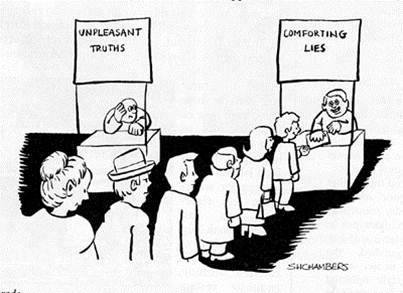
Comfortable lie: The one-percenters have too much money. They should have to pay their fair share of taxes so the rest of us can have more government benefits.

Painful truth(s): 1.The 99-percenters in the developed world (especially in the US) are the one-percenters compared to the rest of the world. If you have food, (even if it wasn’t prepared by a private chef) a car (even if it’s a used beater), a roof (even if it’s a crappy apartment or trailer), multiple changes of clothes (even if you got them second hand), air conditioning, a microwave, and a flat screen TV (or could have those things if you didn’t blow your money on tattoos, booze, drugs, or lotto tickets) then YOU ARE NOT POOR, even if you are living “below the poverty line.” 2. Regardless of how much money a rich person has, it is their money.  If you elect politicians to take money from the rich via taxation, you are no different than a gangster who hires thugs to rob people at gunpoint (unless it can be proved that a given rich person obtained their wealth via theft, exploitation, or other criminal means – and even in such circumstances, the only people who deserve their “fair share” of that wealth are the direct victims, not the rest of us).

Comfortable lie: Your employer owes you a “living wage” and medical benefits.  People who don’t get those things are being exploited.

Painful truth(s): 1. Your employer owes you what you agreed to work for when you signed on and not a dime more.  2. The idea that your employer OWES you medical coverage is fallacious – unless such coverage was part of the compensation you agreed to before you started working there.  The practice of offering medical insurance became popular as a way to increase compensation to deserving employees during World War II without violating the government-imposed wage freezes of the time.  3. You OWE IT TO YOURSELF to increase your knowledge, skills, and abilities in order to increase your worth to your current employer (in order to merit raises and promotions) or to progress up the career ladder at subsequent employment – if you want to increase your income, increase your value.   4. You OWE IT TO YOURSELF not to start, or increase the size of, your family while you are working low-wage/low-benefit jobs. 5. If the pay in your chosen field is generally lower than you might like, it’s probably because there is no shortage of people waiting in line that can take your place. If people with similar skills sets to your own aren’t scarce, there is no need for employers to offer higher compensation. Again – if you want to increase your income, increase your value.

Comfortable lie: We have a right to life, liberty, and happiness. The government must take care of all of our needs from birth to death.

Painful truth: You have the right to life, liberty, and the pursuit of happiness. The government is supposed to protect those rights by not allowing others to interfere with you, so long as you don’t interfere with others.  The government cannot “take care of” everyone without violating those very same rights.  Consider: if the government MUST provide your health care, then it MUST force doctors and other medical professionals to deliver that care. In so doing it has violated the medico’s right to life and liberty and pursuit of happiness (because the government has directed, under threat of penalties, how some portion of the medic’s life is to be spent).

Comfortable lie: We must nurture every kid’s sense of self-esteem by awarding participation trophies, de-emphasizing grades, and eliminating every objectionable word or insensitive influence, etc…

Uncomfortable truths: “If you look like food, you will be eaten.” (Clint Smith) 1. All life is competitive. Predators have to catch prey; prey has to outrun predator. Even plants compete for sunlight.  If you try to protect your kids from competition instead of teaching them how to function in a competitive environment, you are doing them a disservice. (Oh, and by the way, sports are an excellent place to do that…but they are not the only arena!) 2. A kid who has never felt the sting of losing or the “thrill of victory” isn’t going to have healthy self-esteem; he or she is going to have a dysfunctional sense of being entitled to things he or she didn’t earn.