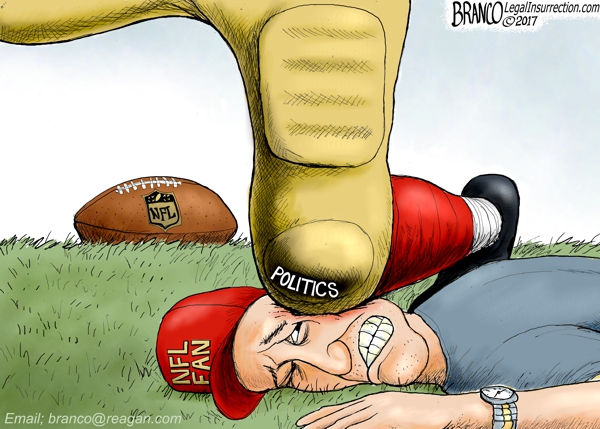
Taking a Knee (to the Face)

By Mike Cronin

After several highly-publicized shootings of young black men by white police officers in 2015 and 2016, San Francisco ‘49ers quarterback Colin Kaepernick refused to stand for the national anthem at the beginning of football games. In one post-game interview, Kaepernick explained: “I am not going to stand up to show pride in a flag for a country that oppresses black people and people of color.”

Since then, Mr. Kaepernick has lost his job, but several players, and in some cases entire teams, have begun emulating his actions. Many fans have been outraged, including President Trump. Both attendance at stadiums and ratings for televised games are way down. This story is vitiating the country.  So, what gives? Let’s unpack it a bit.

First and foremost is whether the protests are having, or can have, the desired effect: eliminating racism, especially alleged police brutality driven by alleged white racism against blacks. That will be hard to measure, since each and every case of alleged racially-driven brutality must be judged against the context of the situation and the facts of the incident that precipitated it. We cannot rationally, automatically infer that just because a young black man is shot and killed by a white cop that there was any racial bias (or injustice of any kind) involved; that has to be proven.  In some cases it is, in many more, the opposite conclusion is reached.

Second is the issue of context and message delivery. While Mr. Kaepernick told the press his actions were taken in protest to police brutality, in his statement above he conflates police brutality with the entire country being oppressive against blacks and other minorities: “I am not going to…show pride in a flag for a country that oppresses black people…” This is perhaps the most contentious aspect of the entire affair. Mr. Kaepernick may have been the subject of racism and police brutality himself at some point (I have no idea), but as someone who made more money in a single game than most NFL fans will make in several years, he is at best an unlikely spokesperson against oppression. He brought further ambiguity to his alleged anti-oppression message by wearing socks depicting a pig in a police hat during training camp:

And by attending as press conference wearing a pro Fidel Castro T-shirt:

That tone-deafness has now been amplified by entire teams of seven- and eight-digit salary earners “taking a knee” for the anthem (in stadiums often built with the aid of tax subsidies) to protest the “oppression” of the nation that gave them the opportunity to become one-percenters, while the people that defend that opportunity in some cases don’t even make enough to buy groceries without resorting to food stamps.

Maybe Mr. Kaepernick really is just trying to turn the national conversation towards the elimination of police brutality and racism. Or, perhaps Mr. Kaepernick hates cops and hates America. Or both, or neither. The trouble is: his message is mixed, and those who are emulating him are diluting it further. Are we to accept that our entire country is racist and oppressive? Racism and oppression have certainly existed and will continue to exist, in this country and elsewhere, as long as humans refuse to treat others as individuals, instead of as units. Even so, I don’t think we have to accept the premise that the entire country is that way now. After all, every racial barrier to high office or position has been broken: President of the United States. Senator. Chairman of the Joint Chiefs of Staff. Secretary of State. Ambassador. CEO. Doctor. Lawyer. Astronaut. General. Police Officer. Professor. Sports Star.

That leaves police brutality. Are we instead to infer that all police are brutal, racist thugs? That’s a ludicrous proposition that I won’t even dignify with a rebuttal.

Third: Rights. The players protesting the anthem absolutely have the right to do so, but they do not have the right to usurp someone else’s platform to spread their message, nor can they reasonably expect that they can piss off their employers’ customers and keep their jobs.

Lastly: Importance. In the grand scheme of things, the NFL, its games, its ratings, and its stadium attendance are irrelevancies, but the issues of racism, police brutality, and patriotism are not. I don’t know, or care, what Mr. Kaepernick really believes or what message he thinks he was really trying to get across, but he certainly started a national conversation about…something. To borrow from Lt. Gen. Jay Silveria, Superintendent of the US Air Force Academy:

If you cannot treat your fellow Americans with dignity and respect, then get out.

Stop The Hurricane Blame Game

By Mike Cronin

“You never let a serious crisis go to waste.” Those are the words of Rahm Emanuel, Mayor of Chicago and former Chief of Staff under President Obama. Plenty of people are taking him up on that advice by exploiting notable natural disasters (presently, Hurricane Irma is their wellspring) to further their own agendas. Curiously, people on (supposedly) opposite spans of the ideological spectrum are finding ways to blame Irma (and Harvey before her, and Katrina before both) on human activity they don’t like:

The first variety are stories that repeat the oft-heard statistic that Hurricane Irma is the most powerful Atlantic hurricane in recorded history and that she is a result of human-caused global warming. Let’s break this down.  First, whether or not a given natural phenomenon is the “most powerful” in recorded history makes good headlines, but it’s almost irrelevant – because recorded history is a vanishingly small slice of time on the geologic clock. If we scale the lifetime of the earth to be represented by a human lifespan – say eighty years, then all of recorded human history represents the span of an eyeblink or two.   Indeed, reliable recordings of meteorological phenomena such as hurricanes have only been commonplace for perhaps the last 150 years or so.

Another angle: Right now, there are three hurricanes: Katia in the western Gulf of Mexico, Irma, and Jose east of the Caribbean. Some articles are noting this as another bit of evidence that global warming is to blame – but there have been at least two recorded occasions when four hurricanes existed at one time, and the earliest of those dates to 1893.

Then there are the religious extremists who claim that natural disasters are God’s punishment for our sins, especially homosexuality and abortion. This pastor claims Hurricane Harvey is God’s punishment of Texas for failing to pass an anti-LGBT law. Actor Kirk Cameron claims Harvey and Irma have been sent by God to teach us humility and to make sinners repent. The same tone was on offer from some of the more extreme branches of the religious right for Hurricane Katrina over a decade ago.

Bottom line: We have no way to know whether Irma is in fact the most powerful hurricane in Atlantic history, ergo we can’t possibly know if her notable strength is truly the result of human-caused global warming, or of natural climate change, or if she is merely a “normal” large hurricane among the millions that have crossed the Atlantic over the eons. Since the conditions that cause hurricanes pre-date human industrial activity, we can safely assume the sin of emitting too much carbon dioxide is not the cause of Irma. What about biblical sin?  As the late Christopher Hitchens once pointedly observed, Hurricane Katrina, allegedly sent to punish us for the sins of homosexuality and fornication, destroyed almost every part of New Orleans except the French Quarter, wherein lies the red-light district!

The jury is out on the effects of humans on climate change, but the fact that the climate is changing is irrefutable – it is always changing. Likewise, the idea that God punishes us through disasters is ancient, but “disasters” only result when humans are affected by specific incidents of naturally occurring phenomena that have been occurring since before the rise of humanity.  The real tragedy of disasters is that we continue to put faith ahead of reason. Reason tells us that if you occupy a place that is in a hurricane zone, you are at risk. You can either mitigate that risk by being well-prepared to evacuate or to survive, or you can deal with the consequences of failing to make such preparations. Neither God nor global warming are responsible for that, you are.

The Gouge on Price Gouging

By Mike Cronin

In military slang, the word gouge can mean information or intelligence. For example: One person tells another a trick or hack for getting a task done quicker. The second person might say “thanks for the gouge.”

On the other hand, people are very much not thankful for what they perceive to be the price gouging happening in Houston and the rest of the Hurricane Harvey impact zone.  Loosely defined, price gouging is when a vendor radically raises their prices, as often occurs in and near disaster zones. Potential customers believe such vendors to be vultures, capitalizing on the misery of others.

But is that what is really going on?

In a recent Facebook post, A group called  “Educate the People” shared pictures of a convenience store billboard showing gas prices over $8.00 per gallon, and a case of bottled water going for nearly $45.00.  The caption beloe the pictures read “Heartless Capitalist Texas Store Owners.”

“Educate the Public” indeed! It’s not heartless. If millions of people are trying to “get out of Dodge,”(or stockpile at the last minute) because a disaster is imminent or in-progress, then supply trucks aren’t going into Dodge. When that happens, the things we normally take for granted are suddenly in much more demand, soon to be much scarcer, and thus suddenly much more valuable. When the demand for something skyrockets, but the supply is shrinking, the price must skyrocket as well. It sucks if you want to buy the thing that has quadrupled in price (so you have some to spare), but if you genuinely need it for survival, there just might still be some available because the people who merely wanted it weren’t willing to fork over the cash. It may seem like the store owner is profiteering, but consider: The store is still open and doing business when everyone else is trying to flee or hole-up!

If the store owner left his prices at the normal level (or was forced by the government to do so), he’d be out of stock in hours – or even minutes, with no routine resupply on the calendar. What is he, or his customers most in need, to do then?

The purveyors of “Educate the Public” should consider taking some remedial economics lessons instead of pandering to a generation of Americans who are being taught that they are entitled to something just because they think they need it.

To save them some time, here are the applicable points:

Price, cost, and value are not the same thing; however, in a functional system of mutual trade to mutual benefit, they are closely related. If the thing is becoming scarcer because the gap between supply and demand is increasing, the price will go up as a message to the consumer that the scarcity of the thing has increased.

When some force, usually in the form of government, compels a vendor to ration items, or to limit prices, the system is no longer about mutual exchange to mutual benefit. It has become dysfunctional, shredding the relationship between price, cost, and value. The price of an item no longer communicates the scarcity to the consumer. This increases the risk that hoarders and black-marketeers will buy up all the stock in a short amount of time, leaving the shelves bare, and leaving people in crisis with far fewer options. This will in turn lead to more desperation and lawlessness, not less.

In short: price gouging is not evil, though radically increased prices may shock and offend our sensibilities during a crisis, lulled as we are by generations of living in the stability of the largest economy in the world. On the other hand, anti-price gouging and rationing laws just might be evil, because they create more harm than they cure – by causing or exacerbating  shortages in the guise of mollifying the unthinking and easily offended.

BAD MEDICINE: A DEBATE ON QUORA

Mike Cronin (M.C.):

Yes:

  1. Everyone has the right to life, but not at the expense of other’s rights, such as their right to dispose of their time, skills, knowledge, and materials as they see fit.
  2. Socialized medicine, AKA “universal healthcare,” violates those rights by demanding that others must pay for my care (or vice versa), and it violates the rights of providers by coercing them to to give said care to me at government prescribed rates vice market rates, which means: at a loss.

THE 7-INGREDIENT FORMULA FOR A “LUCKY” LIFE

By Mike Cronin

Have you ever noticed that the people who complain the loudest about wealth inequality, or global warming, or racism, or (insert social malady here) always only ever have one solution? To take something away from you. They say you’ve won life’s lottery, so they need you to “give back.” By that, they mean they are going to take your money through taxes. They are usually also trying to take away some of your comfort by banning or restricting something: low-flow shower nozzles, incandescent light bulbs, plastic shopping bags, etc.

They never seem to admit to even the possibility that the single greatest contributing factor to one’s “station” isn’t “luck,” it’s the life choices one makes. They never seem to admit to the possibility that one can improve one’s standard of living over time.

Superstitious people often cite “seven” as a lucky number.  Well, I have a seven-ingredient formula to have a “lucky” life. It doesn’t require anything from anybody to accomplish, only that you are made aware of its existence. The formula is simple to understand, but hard to follow. It’s almost never taught in school:

  1. As early as possible, adopt the attitude that you are responsible for everything you do or fail to do, because once you turn eighteen, that is the way the law sees it, and that’s the way your employer sees it. The people who will allow you to not see things that way, i.e. the people who would encourage you to always play the victim and blame others, are merely trying to get you hooked on a cycle of dependency: your vote for their “assistance” against your purported “victimizers.” It’s a recipe for a life of perpetual resentment.
  2. Graduate from high school. A diploma is better than a GED, which is better than “dropped out.”
  3. Don’t become a single parent. If you cannot or will not abstain, then Males: wrap that rascal. Ladies: pick a birth control method, AND make him wrap his rascal.
  4. “Live on less than you make.” (h/t to Dave Ramsey.) You don’t need to live like you are rich. Fun fact: many, many rich people became rich by not living like they were rich! You don’t need designer clothes, blinged-out or brand-new cars, the latest model cell phone, flat screen, and Blue-Ray, etc. The people who matter don’t give a crap whether you have those things.
    1. Corollary 1: If you think you can afford something because you can “afford” the monthly loan or credit card payments – you can’t afford the thing! (One exception usually applies: a home mortgage). If you are making interest payments on car loans, credit cards, etc., you couldn’t afford those things.
  5. Improve yourself. Never stop learning. Increase your opportunities to advance by increasing your value to the market place – continuously improve your knowledge, skills, and abilities, and/or continuously add new ones to your repertoire. Note that going $100,000 into debt to pay for a degree from a big-name university is not required. Heck, a college degree is not required (though it is highly advisable!). There are ways to get a degree on a budget and stay out of debt. Bottom line: the more you follow item 5, the higher your income will go, and the easier it becomes to follow item 4.
  6. Invest in yourself. “Spend” money on an emergency fund, a retirement plan, and health insurance. Save up to pay cash for big-ticket items. Again: The more you follow items 4 & 5, the easier following item 6 will be.
  7. Don’t become an addict or a criminal. Just don’t.

Not one of the things on the list requires that one have “white privilege,” or that you start out in the 1%, or that you belong (or not belong) to a certain race, or gender, or religion, or that you grow up in a given neighborhood. None of them require a college degree (although that is often helpful!), professional-caliber athletic ability, cover-model good looks, or keen intellect. Most of them do require understanding the concept of delayed gratification: if you practice some discipline now, the reward will be greater later on!

Following the formula is not a guarantee you will have a successful life, nor are you guaranteed to have a crummy life if you don’t follow it…but I estimate that 80% of the people who follow this formula will be better off than 80% or more of the people who don’t.

Some of the things on the list are hard.  I know I only avoided violating number 3 by random chance. Complying with number 4 was touch-and-go for nearly a decade after high school.  But all of the things on the list can be done, and they don’t require anything from anyone besides you (see item number 1).

Two Fallacies used against you

By Mike Cronin

If you don’t put this ribbon magnet on your car, it means you don’t care about kids starving in Elbonia.

“Senator Do-right voted no against my bill to fund Program Y with higher taxes – He hates blind people.”

“You’re either for me or against me!”

Sound familiar?  These are example of the False Dichotomy/False Dilemma/False Choice fallacy, and we are surrounded by examples every day. It takes critical thinking to spot them and see them for what they are.

Let’s have another look:

If you don’t put this ribbon magnet on your car, it means you don’t care about kids starving in Elbonia.” Maybe.  It might also mean I find it pretentious to brag about my charitable giving, or I don’t like to advertise my activities, allegiances, or involvements for security reasons; or it means I don’t want the sticker to damage my car, or it means I care about something else more than I care about starving kids in Elbonia, etc.

“Senator Do-right voted no against my bill to fund Program Y with higher taxes – He hates blind people.”  Or maybe he found out Program Y is corrupt, or he doesn’t like pork-barrel spending, or he’s a budget hawk, or he won’t agree to anything put forward by a political enemy, etc.

“You’re either for me or against me!” Or, maybe you have a far higher opinion of your significance than I do!

False dichotomies are a staple technique of politicians, especially during election campaigns.  Advertisers love them, too: “If you bought brand X, you’re paying too much!” How do they know? Maybe you got a great deal.

Whenever you see an either-or proposition on offer from somebody who wants something from you, it’s a safe bet to assume you are being offered a false choice.

Another popular fallacy that professional debaters (politicians, talk-show panelists, pundits, etc.) love to use is the “Straw Man” argument.  Simply put, it means exaggerating or misrepresenting something someone else said in order to (attempt) to make a clever rebuttal.  Here’s an example:

A large corporation announces it’s going to close a major plant in the US and move it to Mexico. One of the reasons given is the too-high labor costs here due to the minimum wage, workman’s comp, and payroll taxes in the US.

Professional blabbermouth:  “Company X announced today that it’s moving to Mexico.  I guess they think it’s OK to exploit Mexicans and pay them slave wages.  How unpatriotic.”

The blabbermouth ignored the full context.  It’s quite possible that a Mexican working in the new plant will make much less than his or her US counterpart; what is not mentioned is how far that pay might go in the Mexican economy, or how much better off the Mexican might be working in the new factory than her or she would have been without that opportunity. The blabbermouth also ignores the very real possibility that rather than the corporation being unpatriotic for moving, it may be that our law makers have been unpatriotic by creating the conditions that are driving the company to move!


You can’t get there from here

By Mike Cronin

I recently read an article that chronicled the lamentation of employers that college graduates today are not well versed in critical thinking skills. On the other hand, the graduates themselves thought they had a good understanding of critical thinking.  If employers and graduates disagree on graduates’ thinking skills, who is correct?  Turns out it depends on your definition of critical thinking.

The employers relied on the classical understanding of critical thinking: Objectivity, evidence, logic, reason.  The grads’ understanding of critical thinking tended towards “… opposition to the existing ‘system,’ encompassing political, economic, and social orders, deemed to privilege some and penalize others. In essence, critical thinking is equated with political, economic, and social critique.” Huh. Critical thinking has become “critique-al” thinking. That explains how an ever-growing segment of our population seems to fall for every “feel-good” con for giving up freedom and liberty in the name of “social justice” or “diversity” or “environmentalism” or “wealth redistribution” or any other socialist trap.

For the record:

You cannot cure poverty by taking wealth from others, because poverty is not only a financial condition, it is also often a mindset.  Consider that most millionaires in this country are entrepreneurs. Most business start-ups fail, and many of the successful entrepreneurs have been “poor” at some point.  They earned, then lost, a fortune and became “poor,” only to earn and keep a bigger fortune by applying what they learned from their original mistakes.  On the flip side, many “poor” people would, given sudden wealth, blow it all on luxuries and trappings, then fall back into poverty when the wealth dried up.

You cannot cure hunger in other parts of the world by decrying food excess here.  Wasted food here cannot change the conditions causing starvation elsewhere.  If you want to cure world hunger, you must first rid humanity of power lust and superstition and territoriality.

You cannot eliminate racism and bigotry and hatred by hating and being racist and bigoted. You cannot end “discrimination” by changing which group is “discriminated” against. You cannot avenge long-dead victims of a crime by punishing the descendants of the long-dead criminals. Change the words “crime” and “criminals” to “oppression” and “oppressors,” and the same truth obtains. (The old adage “fight fire with fire” works…in very few contexts. Fighting injustice with more injustice isn’t one of them.)

You cannot change reality by smuggling new meaning into old worlds. “Unemployment” comes to mind.  The most widely used unemployment figure from the Bureau of Labor Statistics (BLS) has been around 5% for some months (4.7% as of February 2017).  But that number uses a very narrow definition of “unemployed” and a very generous definition of “employed.”  If you are out of work and haven’t been looking for four weeks, you are no longer counted as “unemployed;” you are counted as “out of the labor market.” On the other hand, if you are out of work but exchanged at least one hour of labor for at least $20.00, you are counted as “employed.”  The real unemployment rate, i.e. the number of working-age adults that are not working and earning regular paychecks, is more like 40%!

You cannot build a Utopian health care system that relies on doctors (and other providers) whom you dis-incentivize.  Doctors have spent a lot of time and money to earn their degrees, and they expect to be able to run their practices and make good money.  Take that away from them, and all of a sudden there will be less doctors working and less people going to medical school. The doctors that do stay will be of lower caliber, and the quality of care will diminish greatly.

Likewise, you cannot produce a well-educated populace with a public school system purposely designed to prevent critical thinking by producing critique-al thinkers!

Social Justice and the Straw Man

By Mike Cronin

This is probably no surprise to anyone, but you might not have seen it expressed this way before.  The driving force behind many of the ideological rifts in this country isn’t genuine disagreement; it’s the lust for attention and power. Social justice warriors (SJWs) especially, will twist any fact, issue, or term into a grievance so that they can have a protest or riot in furtherance of their purported aims, when all they really want is attention, validation, and power.

Here’s a case study: President Trump’s so-called “Muslim ban.”  The facts of the ban are summarized here: “There are 206 nation states on Earth. People from 199 of them, Muslim or not, can get US visas. People from 7 of them, Muslim or not, cannot. The twelve nations with the largest number of Muslims are all on the “A-OK” list. There is no “Muslim ban.” (h/t to Michael Z. Williamson) But judging from the vitriol and even violence emanating from SJWs, you would think Mr. Trump had begun rounding up Muslims and putting them into camps. They invariably describe Trump’s action as racist.

I’m not going to defend Mr. Trump.  I get why he is instituting this ban: Because terrorists from the groups most likely to try to execute another 9/11 on our soil would be most likely to come from one of the countries on the list. But his ban holds a large class of people accountable for crimes yet to be committed by a potentially very small subset of that group.  Since that group isn’t race-based, that is not a racist policy, but it is collectivist.

But wait! Here comes SJW logic: since the ban “targets” predominately Muslim countries, it is against Muslims, and is therefore racist. Even if Islam isn’t a race?  Yes, say the SJWs. Because Islam is a culture, the ban is a case of “cultural racism.”  Even if, as described by Mr. Williamson above, the ban doesn’t apply to all, or even most, Muslims?  SJWs just ignore that inconvenient fact.

Ah. If you don’t like someone, or something they are doing, find a way to twist it into the most heinously-motivated act you can think of. Invent new terms to describe it. All so you can be seen to be fighting against it. (Oh, and let’s not forget, if someone you liked did the same thing? Forget it happened.)  In other words, the modus operandi for the SJW: If you can’t find it within in you to go to the Middle East and fight the real oppressors, stay comfortably ensconced in the US, find some objectionable policy, and make it into oppression so you can have a tantrum.  It’s the “straw man” fallacy writ large.

My World View, Pt. 2

bluemarbleearth_npp_8000

By Mike Cronin

I left off last week by asking, “…how can we overcome the pain of the past without inflicting all new pains now and in the future?”  In my world view, the answer lies in the opposite direction from what most politicians, pontificators, and pundits would have us follow. The answer lies in treating human beings as individuals first and foremost, not as mere units of whatever contrived victim or oppressor collectives the “divide and conquer” crowd has tried to bin us into. In other words, quite often the pathological power seekers in this world seek to divide us in the name of diversity, while the way to a just, peaceful, and united society is by recognizing and protecting individual rights and liberty.

That means tolerating all kinds of behavior and relationships one might find personally distasteful – so long as such behavior violates no one else’s rights.  In my view, there simply should be no government purview to ban any intoxicants a competent adult might chooses to use – but neither should it allow intoxication to mitigate any criminal or negligent act taken while intoxicated.  It also means the government should have no interest in regulating consensual activities between competent adults.  That means there should be no laws against – nor any kind of tax breaks for – any kind of consensual domestic relationships. The only role government should play is in the realm of contract enforcement: Those who choose to register their relationship and codify any such agreements in writing may turn to the government for dispute resolution if necessary.

Of course, that would also mean the tax code would have to be reformed. As well it should be.  There is only one reason for the government to levy taxes:  to pay for the legitimate, Constitutional functions of government. Likewise, there is only one morally acceptable way to apportion taxes: According to how much government one “consumes,” not according to how much income one earns.  Of course, collecting taxes via income confiscation is right out.  A consumption tax, such as The Fair Tax, is the way to go in my book.

Speaking of books, when did the United States of America become a democracy?  According to more than one of the social studies text books my kids have used over the years, the US is just that: a democracy.  That can be taken in two related ways. The first is simply common usage. At some point in the past, the term “democracy” was corrupted from its original meaning to accommodate nearly any government that has adopted some form of constitution, has separation of powers, leaders chosen by elections, and has a more-or-less open market.  The other way to take it is that some of the same corrupt people who want to chivy us into collectives are in charge of the education-industrial complex.  They want to smuggle into our heads the idea that our government operates according to the concept of majority rule (i.e. pure democracy) vs. the rule of law (i.e. as a republic) – with the ultimate goal being to amass enough of a collectivized majority to gain control of all three branches of government at the same time, undo the Constitution, and turn the US into a Venezuela – all the while believing they are making it into a Sweden (or at least, what they imagine Sweden to be like).

Indeed, one such lament we are always hearing from such quarters is that our “public” school system is failing, always accompanied by the clamor for more and more money to fix it. What if our government schools are not failing?  What if they are doing exactly what they are designed to do?  Given the model our school system is based on (Prussia’s) and the sentiments expressed by many of its promoters and pioneers, (e.g. “The role of the schoolmaster is to collect little plastic lumps of human dough from private households and shape them on the social kneading board.” Edward Ross, Sociologist, and “We want one class of persons to have a liberal education, and we want another class of persons, a very much larger class of necessity in every society, to forgo the privilege of a liberal education and fit themselves to perform specific difficult manual tasks.” –Woodrow Wilson) a strong case can be made that our school system is just fine: It is not designed to produce critical thinkers; it is designed to produce compliant mass consumers, and it does.  When the most pious prophets of the public school systems tell you the system is failing, they mean that it hasn’t yet succeeded in removing all independent thought from the labor and middle-management classes quite yet!

Now don’t go thinking that because I’m critical of government schools that I must be a snob for a snob for parochial schools.  Faith-based private schools, at least of the Catholic variety (of which I have some passing familiarity) may have a better record of producing literate, college-bound graduates than government schools, but they are very comfortable following the Prussian model as well, in some ways to an even greater degree than government schools (case in point: Uniforms and corporal punishment).  It just would not do to give your flock too great a taste of independent thinking, lest they come to question their faith, and ultimately the Church!

My World View, Pt. 1

sed_wall_1920x1200

By Mike Cronin

Every so often it helps to re-examine one’s goals and purposes.  My goal and purpose for this blog is to help others learn to look at the world through the lenses of reason and liberty.  Sometimes that means offering dry descriptions of how things are vs how they ought to be, other times it means promoting an independent viewpoint on a hot-button political issue. No doubt I have appeared to be a right-wing radical to someone on the left, while I might seem to be a leftist to the right-winger. To others, it might seem like I’m simply sitting on the fence and refusing to take sides.

I have never claimed to be unbiased.  In fact, I have described my bias on more than one occasion, but I haven’t ever really described my full worldview.  I thought I might do so now:

It starts with reality. As Ayn Rand said: “Existence exists, and only existence exists.”  Carl Sagan said that the cosmos is “all that is, all that was, and all there ever will be.”  The evidence that existence exists is axiomatic:  If it did not exist, there would be no one to ponder its nature – there would be no nature.

Speaking of nature: Humans are part of nature. Everything humans have ever made, from bone tools and mud huts to spaceships and iPhones, and every action humans have ever taken, from procreating to mass destruction, is ipso-facto natural. That is not to say it is good or bad.

Evil exists.  There are good people and bad. Context matters: good people are sometimes capable of bad things, and evil people may sometimes perform a benevolent act.  Hitler might have treated a pet well, for instance…but that cannot begin to atone for the fact that he inspired and led the industrialized murder of millions. Because Hitler was human, his actions were natural…but because he failed to credit whole segments of humans with having any humanity, he dehumanized himself. He became a monster of natural, not supernatural origin.

Nor was he the only one. Stalin. Pol Pot. Mao Tse-tung. Saddam Hussein. Every era of history has its brutal dictators and ruthless rulers who don’t hesitate to bathe in the blood of millions.  The rational failing of all of these monsters is their inability or refusal to recognize the worth of other humans as humans, or to even recognize other individuals as human at all.  They have actualized the ultimate expression of collectivism: the subsuming of the individual human being into a collective. Collectives that can be branded sub-human and disposed of at whim.

Humans have been ruled by such men as could take control of the levers of power since we were clans of hunter-gatherers.  Every so often, a breakthrough would occur and the building blocks of civilization were laid, even if technology advanced at much more stately pace. The Mesopotamians or other earliest civilizations gave us agriculture and the division of labor.  The Egyptians gave us paper and the concept of a massive library to store the sum of human knowledge.  The Greeks gave us the concepts of reasoned philosophical debate, and democratic and republican forms of government, and more.  The Arabs gave us Algebra, the concept of zero, and names for many stars we see in the night sky. The Persians or their predecessors gave us Indo-European languages, the wheel, chess (probably by way of India), and more. Largely unbeknownst to the west, the Chinese developed many of these same foundations earlier, or at roughly the same time, as their Western counterparts.

All throughout history, threads bind early developments to later ones.  The Greek concepts of democracy and republicanism found a circuitous path that eventually led to the founding fathers and the Declaration of Independence, the Constitution, and the Bill of Rights…and the United States of America. An imperfect country, established with imperfect, yet eloquent documents, written by imperfect, yet remarkable men…the first country ever founded on the basis of an ideal: recognition of individual rights, liberty, and the rule of law, protected by a government chartered for that sole purpose. Imperfect though it is, via the combination of the freest form of government, ample natural resources, and the best geographical location, the US rose to become the most dominant economic and military power in the world, and to raise the standard of living for more people than any other nation, empire, or civilization in human history. That much power attracts pathological personalities –both to wield it, and to destroy it.  Thus it became inevitable that the US would make enemies. No matter how benevolent the US might be or might have been, our very existence as de-facto world hegemon is a threat to those who aspire to great power, such as Hussein or Osama bin Laden. To wit: something like 9/11 was inevitable.

As beautiful as the founders’ vision of the US was, the implementation of their vision was flawed from the start by four major areas of dysfunction, which I examined in five posts in 2014.

Slavery was chief among those, as it was incompatible with the spirit of the Charters of Freedom.  Our earliest Congress partook of the same sin as Hitler, if perhaps to a slightly lesser degree and without the nationalistic zeal: they justified slavery by willfully neglecting to grant the status of “human being” to slaves. It took nearly 3/4 of a century from the founding to end slavery, and nearly 200 years to reverse most of the direct damage of that failure. We are still dealing with the indirect damage to this day.

This is not to say that things can be put right by going the other direction. Dehumanizing and hating whites, especially white, middle class males, cannot free the long-dead slaves of times past, nor can it improve the lot of the descendants of slaves living today. Holding inter-generational grudges leads to incessant conflict – such as that between the Israelis and Palestinians, which is but a proxy for the much older conflict between Arabs and Jews.

How can we overcome the pain of the past without inflicting all new pains now and in the future?  More on that next week.