The Land of the Free* (*terms and conditions may apply)

essay

By Mike Cronin

When asked what kind of government our new country has, Benjamin Franklin is widely quoted as stating “a republic, if you can keep it.”  Apparently we could not.  It’s almost universally accepted these days, to the point of being taught as fact in schools, that we have a democracy. Yet our Constitution outlines a republican form of government with three branches (Executive, Legislative, and Judicial) that functions with some democratic processes. (You can check this for yourself – the word democracy does not appear anywhere in the Constitution or Declaration of Independence).

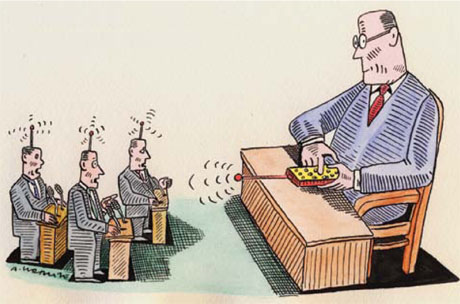
Unfortunately, we’ve accumulated three additional, unofficial branches of government, and devolved so far from our Founder’s vision that we may no longer have either a republic or a democracy, but an oligarchy (i.e. a form of government where power is held by small group).

What are the three “unofficial” branches that the oligarchs use to wield power?  The donor branch, the media branch, and the education branch; all run by the so-called “elites.”

I’ve written before about the “elites” that steer this country, and you’ve probably read or heard others speak of them without really explaining the composition of the group.

Who are the elites in the United States (international elites are another subject)? They are people at the head of the three legitimate branches and the three “shadow” branches of government. In influential order:

The President of the United States: Head of State. Head of Government. Chief Executive Officer of the Executive Branch and Commander in Chief of the military. The incumbent holds possibly the most influential position in the world; certainly whoever occupies the Oval Office wields the most diplomatic influence backed by the most extraordinary military.

The donor class – the folks who provide significant funds to politicians, PACs, and campaigns and are owed favors and quid pro quos. Think George Soros, the Koch brothers, corporate lobbyists, and the like. If we could dig deep enough, we might also find drug lords and other organized crime dons in this class.

The rest of the elected politicians at the Federal level: the 535 members of Congress (the House of Representatives and the Senate), plus the vice president.

Next come political appointees: ambassadors, cabinet secretaries and other cabinet-level executives, federal judges, and military combatant commanders and the Joint Chiefs of Staff – and the emeriti of these positons – e.g. Henry Kissinger.

There is some overlap between the politicians above and the influencers in their networks. These are their fellow Ivy-League and service-academy alumni, corporate and institutional boards, bank chairmen, media moguls, etc.

Perhaps at the bottom rung of the elites are the folks who try to influence us more directly. This group is largely composed of the academic and think-tank intelligentsia and “on-air talent” in the mainstream media.

Perhaps not really elite, but still somewhat culpable for the direction of our country: The entrenched bureaucrats just below the political appointee level. They provide institutional continuity across multiple administrations – and they are largely not accountable. Not because they don’t “report” to anyone, but because it’s so damn hard to fire someone in the Federal government, and because they can just outlast the appointed bosses that can fire them.

Altogether, I estimate that there are perhaps as many as 300,000 to as few as 30,000 people running our country of 300,000,000+ people.  What would you call a form of government where perhaps 1/1000th to 1/10,000th of the population holds almost all of the power?

Most Illogical

download

By Mike Cronin

We are often presented with the terms “logic,” “reason,” “critical thinking,” and “common sense.” They are often touted as valuable skills or traits in our society.  But are they really so appreciated?

You are likely to find enough differing definitions of those terms to keep you busy reading for a while, but there is a common thread.

I think Ayn Rand described logic quite eloquently as the art of “non-contradictory identification,” and common sense as the “unselfconscious” use of logic. Critical thinking and reasoning have broader connotations, but generally include, or go hand-in-hand with, logic and common sense.

There are formal courses on logic and critical thinking, but it’s hit-or-miss whether you encounter them outside of philosophy electives at a college or university or at law school.  By way of one example: my own formal education has included familiarization with debate (taught as a segment of sixth-grade English), and I went to a high school that prided itself on producing critical thinkers. I’ve earned bachelor’s and master’s degrees. Yet, to my recollection, not one of those sources presented a formal course of instruction on logic or critical thinking. Why?

I suspect that many of you can report a similar gap in your own formal education. Could it be that our educational institutions, and the governments and/or religions that run them, don’t want to produce an abundance of critical thinkers because graduates so equipped might then apply their reasoning skills against some of the irrational curricula or insane policies emitted by learning institutions or their political and financial overlords?

Consider:  In its current guise, the Department of Education, with an annual budget in the tens of billions, was signed into existence by President Carter in 1979. It’s stated mission is to “…promote student achievement and preparation for global competitiveness by fostering educational excellence and ensuring equal access.”

Has it accomplished that mission?  It certainly “promotes” student achievement.  Cranking out a single inspirational poster can “check the box” on that mediocre and vague aspiration. It has also made progress on the “equal access” portion – you would be hard-pressed to find someone in this country who has no access to some form of publicly-funded K-12 education. But it has failed utterly at preparing students for global competitiveness!   US scores in literacy, numeracy, and problem solving skills are now near the bottom for industrialized countries.  Perhaps the mission statement of the Department of Education has little alignment to its true purpose.

Don’t think I’m being paranoid here.  No less a luminary than Woodrow Wilson, then President of Princeton University (and later to become President of the United States) revealed the elite’s view of the purpose of public education when, in 1909, he said: “We want one class of persons to have a liberal education, and we want another class of persons, a very much larger class of necessity in every society, to forgo the privilege of a liberal education and fit themselves to perform specific difficult manual tasks.” Note again that he said those words before he was elected President of the United States, so this idea did not overly detract from his elect-ability.

Nowadays, the elite’s plan seems to be to indoctrinate everyone with as much liberal education as they can absorb! Of course, the meaning of liberal has -ahem- been drifting left somewhat since Wilson illuminated the raison d’etre of public schools.

Might not the alumni of schools and universities that failed to teach courses on critical thinking or reasoning skills logically conclude they have been cheated?

The Battle Begins. How Will you Fare?

trump-clinton

By Mike Cronin

Barring a “black swan” event, the race for president is down to Trump vs. Clinton.  Who will you vote for, and why?  Will you even vote?  Will your vote matter?

There are so many marginal factors that can shape an election, but there are some basic election fundamentals that seldom get explained.

First: From 1932 to 2012, the average voter turnout has never been higher than 63% or less than 49%.  That means on average only a little over half of the eligible population votes in any given presidential election.  Of the half that votes, roughly 32% are dyed-in-the-wool liberal Democrats and will always vote for the Democrat candidate.  Roughly another 22% of the half that votes is comprised of hard-core conservative Republicans who will always vote for the Republican candidate.  These groups are the “base” for a given candidate/party.  Once you exclude the 54% of voters that are going to automatically vote D or R in any given election, the real battle takes place over the remaining half of the half of Americans who are going to vote. Expressed another way: Presidential elections hinge on the lever pulls of slightly less than 25% of the adult population!

It gets better.  Where those 25% reside is crucial.  If a majority of them reside in states that are overwhelmingly likely to vote a certain way, their votes aren’t going to mean very much.  Conversely, if the bulk of those independent voters reside in states that could go either way (the so-called battleground states), their votes could wield enormous influence!

Are you one of the independents or third party members who vote but don’t blindly punch holes for any party’s candidate (or against the other party’s!)?  Where do you live?  Will your vote count?

If you are, how will you make your decision? Party loyalty isn’t your thing, so what does it for you?  Unfortunately, some will waste their votes on frivolous criteria such as the looks, race, or gender of the candidate, or on candidate’s oratorical prowess.

To do justice to our system and not waste my vote, I’ve developed a small list of criteria that I can rate each candidate against using a survey technique called a Likert scale.  Here it is:

Rate each candidate on how you believe they would:

Honor the Oath of Office and abide by the Constitution & the laws of the land Fail Marginal Mediocre Good Exemplary
Appoint Supreme Court Justices that will uphold the Constitution Fail Marginal Mediocre Good Exemplary
Command the armed forces and employ military force only to counter serious threats to the United States Fail Marginal Mediocre Good Exemplary
Act with integrity & honesty, and demonstrate character Fail Marginal Mediocre Good Exemplary
Govern transparently Fail Marginal Mediocre Good Exemplary
Reduce dysfunction and corruption in the Executive Branch Fail Marginal Mediocre Good Exemplary
Work to reign in government spending, promote capitalism and demonize socialism Fail Marginal Mediocre Good Exemplary
Work to audit, and possibly end, the Federal Reserve Fail Marginal Mediocre Good Exemplary
Work to end, or at least lessen and simplify, the income tax Fail Marginal Mediocre Good Exemplary
Overhaul the immigration system to allow maximum freedom to enter and remain in the country  consistent with preventing criminals, terrorists, and other bad actors in and without yielding an automatic electoral advantage to any party Fail Marginal Mediocre Good Exemplary

Obviously, you might prefer different criteria than what I’ve settled on, but whatever thoughtful criteria you select can still work.  Once you establish your criteria and rate each candidate, score them thus: 1 point for each Fail, 2 points for each Marginal, 3 points for each Mediocre, 4 points for each Good, and 5 points for each Exemplary. Total up the scores and vote for the candidate that earns the highest marks.

Still, there is at least one other major contextual factor that is seldom examined during presidential elections: Congress.  We can elect a president based on the most cogent criteria, but if he or she must deal with a Congress skewed to the opposing party, it is likely they will face high resistance to carrying out their plans or their mandate.  Even if he or she gets to work with a same-party Congress, your candidate could still find it hard to make headway if, like Donald Trump, they come from outside the beltway political establishment.

There is a simple (not easy!) fix to that: Help your presidential candidate get a sympathetic, same-party Congress to work with!


Blanket Guilt or Precision-Guided Accountability?

quote-i-don-t-believe-in-collective-guilt-the-children-of-killers-are-not-killers-but-children-elie-wiesel-107-25-38

By Mike Cronin

Q. What do all of the following have in common?

A. You might be tempted to answer racism or bigotry, but that doesn’t cover the last item. The correct answer is that in all of the above examples, an entire group is being held accountable for the supposed sin of an individual or individuals. It is a hallmark of collectivism.

Consider: The sniper who killed the Dallas police officers on Thursday was seeking revenge for the deaths of some black men who had been shot by some white police officers in other states.  In other words, in his mind, since some white police officers in other locations had killed black men, all white officers were racists. The sniper committed the very same crime he believed the white officers had committed:  he held a group responsible for the actions of a few, or of one.  He tried, convicted, sentenced, and shot the Dallas police officers for crimes they didn’t commit, or for the non-crime of being white.

Mr. Trump’s proposal to ban Muslims is less combative, but it still stems from a collectivist mentality: If some Muslims are coming here to do us harm, then we can reduce the potential for such acts by banning ALL Muslims from entering the country. There is certain soundness to the logic here: If no Muslims can enter, it must follow that the jihadist sub-set of Muslims can’t enter.  Nonetheless, setting aside the difficulties in enforcing such a policy, the idea goes against the principles of individual liberty: it applies a sanction to an entire group for potential crimes yet to be committed by some members of that group.

Consider:  If you take the Bible literally, then you believe God created Adam, the first human.  Adam was tempted by Eve (who was herself tempted by the serpent) to eat the forbidden fruit from the tree of knowledge.  Human souls have been tarnished by this “original sin” ever since. Put another way: Humanity is being held to account for a supposed sin we could do nothing about, because it happened thousands of years before any of our births. In essence, we have been born convicted of a crime we didn’t commit and commanded to atone for it or suffer eternal damnation.

The problem is that collectivism belongs to our infancy. Our country was founded on the principles of individual liberty and personal responsibility, but they conflict with the collectivist principles at the root of most religious doctrines, so there has been a constant duality in American culture.  For example: During World War Two, The US Government rounded up US citizens of Japanese ethnicity and “interned” them in concentration camps for the sin of merely having common ancestry with an enemy; yet after the war, our government largely did not hold the Japanese people accountable for the brutality of their vanquished rulers.  Instead, General MacArthur’s occupation forces went after the actual individuals who led the Empire.

It is all too human to project our fear, or anger, or hatred, or resentment over the sins or crimes committed by an individual onto a group, yet there is no justification for doing so. Humans have been doing this since we were stone-age primitives trying to protect our “turf” from rival clans. It takes some enlightenment to dial down our naked aggression and apply accountability with precision.  It is a thing we must learn if we are to advance as a species.

Storm Warning: Orlando

06132016_Orlando_Shooting_Police_Response

By Mike Cronin

There are many aspects to the tragedy in Orlando that defy reason, but we may yet be able to put many of the chaotic elements into context and derive some small degree of understanding.

Keep in mind the following as you watch the news and listen to the pundits and demagogues:

As we’ve discussed elsewhere, the news networks’ primary job is to sell advertising. They will dwell on every aspect of this story as long as they can in order to keep you coming back to watch commercials find out the latest breaking wrinkle.

The anti-gun fanatics will exploit our fears in order to advance their agenda to ban ___ (take your pick of anything gun or gun-related).  They’ll be sure to shout that this was the worst shooting in US history.  That might be true if you discount several massacres of Native Americans and the Civil War; I don’t know.

Pro-gun zealots will exploit the fear that the left is coming to take our freedom. They will jump up and down to expose every error the anti-gunners make about the specific gun used, how it was obtained, and about how it is already illegal to have a firearm inside a place that serves alcohol in Florida, so gun bans demonstrably don’t work.

Strident religious groups will be in a hurry to tell us that what happened in Orlando was God’s punishment for the sinful behavior of the club’s clientele.  In fact, one such group, ISIS, took credit for the attack!

Let’s try to unscrew ourselves from the ceiling a bit and put some more context to this storm:

Was it the worst mass-shooting in US history?   Ever hear of Bear River (~250 dead), Sand Creek (up to 163 dead), or Wounded Knee (150 dead)? They were but three of dozens of massacres of Native Americans committed in the 1800s.  How about the various battles of the Civil War (~600,000 dead)? (Granted, some might say those events don’t count because they weren’t “crimes” or terrorist attacks; instead, they were (directly or indirectly) government operations. I think that not only do they count, they exemplify the very reason we must not give up the right to keep and bear arms!)

Was it the worst terrorist attack on US soil? No; that was 9/11. (~3000 dead).

Surely it was the worst domestic terrorist attack?  Nope. That dubious title goes to the Oklahoma City bombing. (168 dead)

Nor was Orlando the worst nightclub attack; that distinction belongs to the “Happy Land” club arson fire in the Bronx in 1990 (87 dead).

It does look like Orlando might actually be the worst attack on the LBGT community; though there was an attack nearly as bad in 1973: 32 were killed at the “Upstairs Club” arson attack in New Orleans.

To like-minded folk that believe the second amendment is under attack and should not be infringed upon any further:  Yes, the anti-gunners will shamelessly exploit mass shootings.  We don’t need to follow their example and squawk and honk at each inaccuracy or inane statement made while the tape is still around the crime scene and the blood is still on the floor.  Those rounds are largely wasted.  Save them for the letters to the editor and to your politicians.  Let the anti-gunners make their mistakes in the heat of the moment.

As for the religious condemnation: If you believe Jesus was the son of God, then ask yourself: what would Jesus do?  Would he kill homosexuals?  Would he add salt to their wounds after such a tragedy by saying they were killed because they were sinful? Most especially, would he do that just to get attention? If he wouldn’t do those things, it might be wise to follow his example.

If you are a radical Muslim jihadist, I know that nothing I write here will sway you in any way. Even so, I must say it. If you purport to be a devout member of the so-called religion of “peace,” what is peaceful about slaughtering people whose behavior you don’t approve of, either here or in Syria, or Iraq, or the rest of the world where Islam holds sway?

If ISIS was indeed ultimately behind this attack, what have you gained? All you have accomplished is to show your clients and constituents that one jihadi with a gun and a lot of ammo can kill a lot of unarmed people.  And….what? Is this supposed to terrify us? We are not terrified. Is it supposed to gain you recruits?  You’ve caused just as many, or more, to deplore your cause.

We live in an era with instant news and constant competition for our attention. We are in the middle of one of the most contentious election cycles in recent memory. We are in a shooting conflict with ISIS. The Orlando massacre served as a catalyst to energize a storm of bloviating. We can let it die down a bit so we can hear ourselves think before making hasty conclusions.

Is it a Conspiracy? Who Gains?

5d-tinfoil-hat-

By Mike Cronin

As we saw last week, Occam’s razor is one tool for helping us avoid falling into the trap of believing in every conspiracy theory that comes along.  Another way to evaluate conspiracy theories for credibility is by asking the simple question: Who stands to gain?  In 1998, when Hillary Clinton was First Lady, she alleged that there was a “vast right-wing conspiracy” to besmirch her husband over the Monica Lewisnky scandal.  The political right certainly made every attempt to tarnish her husband for his indiscretion, but that was not a conspiracy, it was simply opposition politics. The right stood to gain by impeaching the president, but it didn’t take any secret cabal to put together a smear campaign; each individual pundit and politician was able to drum up outrage on his own! On the other hand, Mrs. Clinton stood to gain if she could rally support by painting herself as the embattled victim fighting for truth and dignity, so she let fly with the allegation, and it became one of the most often-cited Hillary quotes.  When the president from one party provides his opposition with the ingredients of a scandal, OF COURSE the opposition will take advantage of the opportunity!  That’s not a conspiracy, it’s an axiom!

Like the “vast conspiracy” against the Clintons, sometimes the activity of a conspiracy theory is credible, but the motives and/or competence ascribed to the perpetrators are dubious: The political right is fond of alleging that the left controls the education system and is intentionally dumbing down our kids through Common Core, campus speech codes, revisionist history curricula, etc.  As with the right’s non-conspiratorial opposition to the Clintons, the state of our education system need not be attributed to a conspiracy of the left. Instead, the state of our education system is the accumulated results of long-term government control.  OF COURSE a government-controlled education system is going to promote and advance a pro-government agenda! That’s not a conspiracy, it’s an axiom!

Let’s look at another example:

Some allege that the wars in Iraq (Desert Storm in 1991, Iraqi Freedom beginning in 2003) were all about oil. It is easy to fan that flame, as Dick Chenney (President Bush Sr’s Secretary of Defense, and Bush Jr’s Vice President) was the CEO of Haliburton (a huge company that provides all manner of services to the oil industry) in between the Bushes presidencies. In the sense that the Bush administrations conspired to go to war in order to gain personal control of Iraqi oil, the answer is doubtful, as Iraqi oil remains under Iraqi control. However, there is a more credible context under which “oil” can be held as the reason for the wars: Saddam Hussein took over Kuwait and threatened to invade Saudi Arabia (his forces actually did cross the border at Najaf). That meant he held a significant portion of the world’s oil reserves (and therefore the lifeblood of international commerce) at risk. OF COURSE the Iraq Wars were about oil! That’s not a conspiracy, it’s an axiom…but not the same one some conspiracy theorists would have us believe.

Often, though, the conspiracy theories are just ludicrous. From the 1990s onward, the term “black helicopters” has picked up the connotation among believers that nefarious forces under the auspices of the United Nations patrol the US and engage in clandestine activities designed to bring about a “New World Order.”  IF such forces exist, and IF they used helicopters for transportation, it is highly unlikely they would adopt a “signature” that would defeat their efforts to remain hidden.

“Chemtrails” is another ridiculous theory. Supposedly, “they” are using jet airliners to spray mysterious chemical agents across the nation for unknown purposes.  The evidence: Contrails. Occam’s razor leaves us no guesswork here: The simplest explanation for contrails is that they are CONTRAILS, not weaponized chemical clouds. Who stands to gain?  The charlatans selling “reports” on chemtrails.

Probably one of the looniest has to be the flat earthers.  Yes, there are still people out there who believe the world is flat.  In order to swallow that pill, you have to ignore or evade absolutely proven scientific facts. For example, you have to believe that every photo and bit of video from orbit showing the curvature of the earth has been faked. That would require that all space programs across the globe have conspired to tell the same lie to billions of people since the USSR launched Sputnik in 1957. The real conspiracy here is the one being perpetrated by the theorists themselves in furthering this drivel.

“What is more likely, a complicated scenario that requires tortured logic to arrive at, or the simple explanation?” “Who stands to benefit, the alleged conspirators, or the person alleging the conspiracy?” When you examine a conspiracy theory and ask a few simple questions, OF COURSE you’ll get a much better sense of the theorists’ credibility!

It’s a Conspiracy!

Paranoid Android

By Mike Cronin

Last week I wrote about critical thinking.  This week I thought we might look at an area that is ripe for its practical application: Conspiracy theories.

Some people believe the 9/11 attacks were perpetrated by our own government in order to provide the Bush administration a pretext to go to war. Others believe the Apollo moon landings were faked.  Conspiracy theories abound: Aliens at Area 51. JFK’s murder. Chemtrails. Black helicopters. The list keeps growing.

How do we get at the truth? Sometimes we can’t. While the truth may be discoverable, the means of discovery are not always available at the time the conspiracy theory is popular, nor is discovery always worth the price to find out even if the means are available.

On the other hand, we have thinking tools to help us decide whether a given conspiracy theory is plausible. These allow us to dismiss the implausible theories.  One of these tools is called Occam’s razor.  In a nutshell, Occam’s razor says that there is seldom any need to consider complicated answers when simple ones will do.

Let’s take the case of UFOs at Area 51.  The theory generally postulates that aliens crashed on earth near Roswell, New Mexico in 1947 and the US government is holding their bodies and recovered spacecraft at Area 51.  In order to believe that, you have to accept:

  1. Out of all the possible places the aliens could visit in our galaxy, the aliens came here.
  2. The aliens have faster-than-light travel (which our science believes to be impossible) or they can hibernate for hundreds or thousands of years. Either way their technology is fantastically beyond ours.
  3. Their fantastic technological advantage both failed them utterly (because they crashed) and succeeded spectacularly (because their bodies and spaceship survived the crash roughly intact.)
  4. Out of all of the possible places they could have crashed, they wound up hitting rural New Mexico.
  5. Our government bureaucrats have been savvy enough to keep the real truth secret all of this time.

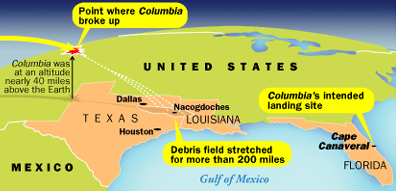
It might be possible…but the “evidence” to support the theory to date amounts to not much more than fuzzy pictures and unverifiable “eye-witness” testimony, while the holes in the theory are powerful. For example: Remember the space shuttle Columbia disaster?  If the aliens’ spacecraft made it through reentry intact, there would have been a huge crater at the impact location like the one near Winslow, Arizona:

16772

If it broke up during reentry, there would have been debris scattered for hundreds or thousands of miles along the descent path:

search_map-med

Let’s apply Occam’s razor: It is far more likely that there was never an alien spacecraft crash in 1947 or any other year. Most likely, whatever the government recovered in New Mexico in 1947 was man-made and that whatever goes on at Area 51 now is wholly human activity devoid of alien influence. Why believe that?  Because there is no evidence beyond the circumstantial that intelligent extra-terrestrials have visited earth.

Why does there always seem to be a slate of such conspiracy theories “active” at any given time?   Because conspiracy theories are fun and profitable!  There is no shortage of people who will “investigate” such mysteries and sell their findings in the form of books and special reports. There are others who make and market souvenirs. If the theory gains enough of a following, there will be entire TV shows dedicated to “solving” (i.e. perpetuating) the myth or even movies that popularize various explanations. (For example: there was a movie called Capricorn One that gave credence to the idea that the government could fake a maned Mars landing – which no doubt fueled the Apollo conspiracy). It’s all meant to keep the gravy train on track.

The conspiracy theory-industrial complex is mostly harmless when understood for what it is.  For example: Like most people, I can enjoy a sci-fi mega-flick like Independence Day or its forthcoming sequel Resurgence (which romanticize the idea of aliens at Area 51). However, for me to enjoy such movies, I have to suspend my disbelief (i.e. “ignore” my faculty for critical thinking).

On the other hand, there is a dark side to the conspiracy market. It manifests in at least two ways:

  1. There are an abundance of Americans whose education neglected to cover critical thinking. They cannot “suspend their disbelief” because they don’t have any!
  2. A viable market for conspiracy theories is also fertile ground for politicians to play upon people’s fears: “The whole aim of practical politics is to keep the populace alarmed (and hence clamorous to be led to safety) by an endless series of hobgoblins, most of them imaginary.” (H.L. Mencken)

A Matter of Perspective

XocKd

By Mike Cronin

No doubt you know that the sun rises in the east and sets in the west once every 24 hours.  It has done so for billions of years and will continue to do so for billions more.

Fact: The sun rises and sets about 16 times per day.

Fact: The sun rises and sets once every two weeks.

Fact: The sun doesn’t rise or set at all.

All of these facts are true.  How can that be?

Each is true from a certain perspective – and false from other perspectives.  The first is true from the perspective of people on the earth’s surface.  The second is true from the perspective of an astronaut onboard the International Space Station.  The third is true from the perspective of an astronaut on the surface of the moon.  The last is true from the perspective of the sun itself.

Perhaps you’ve heard it said that in so-and-so’s world, XYZ is quite different than in your world. Maybe you were taught to think of Western Europe, the US, the British Commonwealth, and Japan as the “first” world, and places like Haiti, Somalia, and Afghanistan as examples of the “third” world. Yet we all live on the same planet, so how can we be living in different worlds?

The first, second, and third worlds aren’t really separate worlds; they just appear that way from certain perspectives.  Sometimes using such metaphors can be useful in helping us frame our understanding of the actual world; sometimes the metaphors become euphemisms and are used to evade harsh truths.

For example: Haiti is the poorest, least-developed country in the western hemisphere.  It occupies part of an island called Hispaniola; the remainder of the island is taken up by the Dominican Republic. Compared to Haiti, the Dominican Republic is doing well. Some folks who call Haiti a failed state and a third-world country may be setting a scene or weaving a narrative (i.e. depicting things from a certain perspective) in order to ask you for donations to help the poor souls that live there.

Such people may mean well, but the solution to Haiti’s troubles probably depends on understanding things from a more difficult perspective.

Consider this: The 2010 earthquake that struck Port-au-Prince (Haiti’s capital) was followed less than a month later by an even more powerful earthquake in Chile.  Both earthquakes caused about the same amount of destruction in terms of the value of the property destroyed, yet the death tolls were staggeringly different.  In the Haiti quake, nearly a quarter of a million people lost their lives.  In the Chilean quake, the death toll was three orders of magnitude smaller. (A little over 500 people died).

Why was there such a vast difference between the two? How can a more powerful earthquake cause far less loss of life, but the same amount of property damage?

In Chile, there are building codes, insurance, robust first response capabilities, adequate hospitals, and property rights. In Haiti there are not. The property damage was the same from the perspective of cost, but vastly different from the perspective of number of buildings destroyed.  In Haiti, a good portion of the buildings in Port-au-Prince collapsed outright, including the president’s palace.  In Chile, many buildings suffered damage that will be expensive to fix…but far fewer buildings actually collapsed – because most were built to code to withstand earthquakes.

haiti palace

The Haitian presidential palace after the 2010 earthquake.

Why did Chile have those benefits and not Haiti?  Because for most of its history, Chile has given at least some recognition to the concept of individual and property rights.  Chileans had incentive to achieve and build and protect their investment.  Haiti, though its existence as a nation is essentially the result of a slave rebellion, never really adopted the concepts of individual freedom or property rights.  It has been ruled by a series of thugs, some worse than others, who would simply take what they wanted.

The harsh truth in the more difficult perspective: Sending aid to Haiti may help some Haitians stave off the reaper a little longer, but no amount of aid can help the Haitians adopt a philosophy of recognizing and respecting rights.

Understanding that a difference in perspective can be trivial (as in the case of knowing astronauts see 16 sunrises per “day”) or pivotal (as in the case of sending aid to Haiti), and how differing perspectives might be compared or judged against each other, is a critical skill to develop – one many of our elected leaders have failed to acquire.

Are You Principled or Ruled?

By Mike Cronin

“If you want to be ruled, follow the rules. If you want to be principled, follow principles.”  I don’t know who said those words, but they are profound.  An admired man or woman is often said to be “of principle.”  If you think about heroes, famous statesmen, positive historical figures, leading thinkers, or other notable people, you will seldom, if ever, find that such figures are admired for following the rules.  So what is the difference, and why is one better than the other?

A rule dictates from external authority; a principle guides from reason.  Rules demand: You must (or must not) take such and such an action, or possess some item, or allow some condition. The primary consideration of the rule-follower is for first-order effects only:  to avoid suffering the imposed consequences for disobedience.  Rules often fail to allow for context or circumstances.  Indeed, governments often thoughtlessly pile up so many rules that it becomes impossible to know or follow them all. It’s even likely that as rules multiply, we will be simultaneously  obligated and prohibited from doing some action!

Principles consider second- and thirdorder effects:  “If I do ___, then someone else’s rights might be violated.  If I allow some condition, someone else might be harmed. I don’t want my own rights violated or to be harmed by poor conditions, so I will not perpetuate those things myself.” The deeper consideration of the principled person is for the maintenance of civilized society and the consequences to his or her own integrity and character for a given act or omission. Principles can be adapted to circumstances, and they are not produced by dictators, monarchs, presidents, or legislatures.

By no means does this suggest one should disobey rules on a whim.  Some rules exist for a legitimate purpose – indeed, they are based on constructive principles.  For example: laws that prohibit the initiation of force against others generally derive from a just principle, and ought to be obeyed, whereas laws that demand the initiation of force against others are probably unjust.

Obeying rules set by others doesn’t take any thought.  Deriving your own principles or incorporating principles learned from others into your life requires some deeper consideration for the consequences of your actions (or lack of same). Adhering to principles require the exercise of judgement. Adhering to principles sometimes means proudly accepting the consequences of breaking the rules – Dr. Martin Luther King exemplified this during his civil rights movement in the 1960s.

Consider this: Some Germans who followed the rules obeyed their masters and slaughtered six million Jews during the Nazi reign. Some British colonists who followed principles disobeyed the rules, rebelled against their ruler, and gave birth to the United States.

Do you want to give up your heritage as a human being and revert to animal status?  Be an obedient, unthinking rule follower.  If you want to perpetuate civilization, think for yourself – especially about the ramifications of your actions (or omissions). Adopt or derive the best principles you can, then live by them!

The Death of Income Taxes

no_irs

By  Mike Cronin

Imagine three of your neighbors come to you and tell you that as a group you are all going to vote on raising $10,000 for a playground. You’re don’t have kids, or they are grown and living on their own, so you vote no.  The other three all have kids, so they vote yes…and demand that you pay your “fair” share or they will beat you up.  They also decide that the more money you have, the more you have to pay.  Since you kids have moved out, you have more disposable income than any of them, so your “fair” share turns out to be half of the cost, or $5000, while each of their fair shares turn out to be about 1/6th of the cost, or about $1666 each. The three neighbors enter your house, find your safe, demand you open it, then they take $5000 from you.  They also demand that you assemble paper work that proves you don’t actually owe even more than the $5000, and give it to them by mid-April. You decide that it’s better to pay the $5000 and show proof that you don’t have to pay even more than to get beat up, so you spend several hours digging through your banking documents, and submit your financial “proof” that you paid enough.

The above scenario is a microcosm of how our tax system works today. The majority voted to take the property of the minority and use it to pay for something the minority didn’t ask for and doesn’t need or want. Our current system is confiscatory, that is, your money is confiscated from you. Worse, as your income goes up, so does the percentage the government (i.e. your neighbors) takes from you.

There are few ways you have of influencing the amount that’s taken from you: You can hide money at the risk of getting beat up by your neighbors and having even more money stolen (i.e. income tax evasion); you can make less money so you have to pay less (lowering your income – at the expense of your quality of life); you might find ways to protect some of your money for now in exchange for paying later (like certain retirement plans); and you might try finding different neighbors who will promise (but fail) to steal less of your money (i.e. elect a different set of politicians). Regardless of whatever trick you use to make the taxes a little less painful, you take it for granted that such a parasitical system is a permanent fixture of life.

It wasn’t always like this, and it doesn’t have to stay this way. The modern income tax didn’t become a constant monkey on the backs of Americans until 1913.  Imagine that: from 1776 until 1913, with a few exceptions, our government managed to function without stealing money from us.  It can be that way again.

What if instead of coercing you to pay for a playground (or any other bit of government) you don’t want, your three neighbors find enough like-minded folks to form a corporation, pitch in some seed money to buy or lease land, get the playground built, then they charge a small access fee to use it? No one forces anyone else or intrudes on their financial life. Government involvement is reduced to providing an enforcement tool for the contracts between the playground company and the builders, and providing routine police protection and emergency response. Government stays small, because it isn’t involved in building facilities or providing services that can and should be offered competitively in the private sector.  Your burden is tiny – your sales taxes pay for contract enforcement, emergency response, and the courts.

This method of raising funds for government is called a consumption tax.  You only pay for what you use, and only for how much of it you use. No one steals your money, and you don’t have to prove anything to anyone about your finances.

There have been various proposals for such a system.  The most comprehensive that I’ve seen is called “The Fair Tax.”  You can learn about it here: https://www.youtube.com/watch?v=DsqjW3_5Lhw

The Fair Tax is not perfect, and it has no shortage of critics.  Most of those critics would lose something if the Fair Tax were enacted.  IRS employees would no longer be required. Tax preparation businesses would become obsolete.  If our tax system wasn’t confiscatory and hideously complicated, there would be no reason for that entire industry to exist. Politicians would lose a lot of power under such a scheme. Regardless, the Fair Tax is a system that does not punish productivity or operate via the threat of force, so it is by default better than what we have now!