When Everything is a Crisis, Nothing is a Crisis

248769_318723208232720_678404428_n

By Mike Cronin

Dear politicians, intellectuals, pressure-group leaders, and media mouths,

All day every day you bombard us with crisis after crisis. Drugs. Guns. War. Climate. Celebrity drama. International tensions. Rape culture. Income inequality. Racism. Sexism. Immigration. Political correctness. The list goes on ad-nauseam. Most are real issues that need reasoned efforts to solve or mitigate, but you spin them into crises, then you anoint yourselves as experts and saviors that can save us – if only we turn over our rights, our money, or our reason (or all three!) to you.

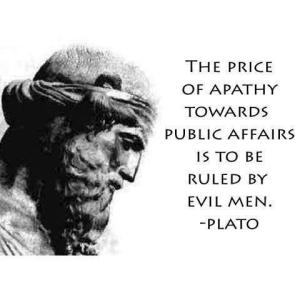
We understand that at some level you have to market and advertise your issue, your ideals, your narrative.  On the other hand, you need to understand that at some point we will succumb to crisis fatigue and stop caring about your cherry-picked and manicured emergencies.  We will become apathetic.  Most of you don’t want that; you want your pet cause to be solved or cured. But some of you do want an apathetic populace.  An apathetic populace is ripe for manipulation by a charismatic tyrant.

If you are one of the public figures I opened this letter to, and you genuinely want your problem solved, dial down the urgency settings on your rhetoric or you will defeat yourself!

If you are a tyrant in waiting:  know that your tactic is exposed.  You are not fooling anyone.

That is all.

Some Thoughts on Mass Shootings

download

By Mike Cronin

In my last post, I tried to moderate the gun debate by debunking the myths that 1.) Shootings and violence are on the rise; 2. The police can and must protect you; and 3). The 2nd Amendment does not protect an individual’s right keep and bear arms.

A sharp-eyed commenter pointed out that I was largely silent on the sub-issue of mass shootings, so I thought I’d have a go at trying to cut through some of the alarmism* emanating from the media and gauge how bad the problem really is. Let’s take a look:

According to Mass Shooting Tracker, there were 363 mass shootings in 2013, 339 in 2014, and 353 in 2015 as of Dec 6.  Mass Shooting Tracker doesn’t articulate their criteria for what exactly a mass shooting is, though they do state that their mission is “providing unbiased, raw statistics, all with verified sourcing to inform society of the number of Mass Shootings that occur in the United States each year, no matter the cause or intent of the toll of victims.”

Nearly one mass shooting per day sounds horrific, right?  But the folks at Pew research recently published an article that shows that gun homicides have been going down since the 90s.

But wait! In June of this year, President Obama recently started “that this type of mass violence does not happen in other advanced countries. It doesn’t happen in other places with this kind of frequency.”

And this Wall Street Journal article screams that the US leads the world in mass shootings.

So what gives?  Gun homicide has been going down, yet mass shootings are an almost daily occurrence?

We certainly have gun violence and mass shooting in this country; there is no denying that.  But is the problem really a crisis spiraling out of control?  Are we really the worst place among developing nations, or have we run across a vast case of weasel-ese?

chluke “What we’ve got here is a failure to communicate.”

We are being fed a tangled web of facts and data woven to further an agenda by spinners adept at using truth to lie or mislead or to “shape a narrative.”

My own agenda is to try to help people understand the world through the use of reason and rationality.  I am biased in favor of freedom, individual rights and liberty, free markets, and capitalism.  I took an oath to support and defend the Constitution of the United States.  Once I did that wearing a uniform, now I’m trying to do it in part with this blog.  To that end, when I cite references or statistics or other data, you can bet I tried to find sources or data that support my point…but I also will tell you that.

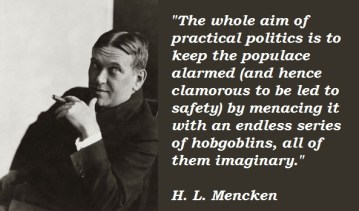
The leading adversaries in the gun control/gun rights debate do the same thing, except that they are much less likely to tell you their bias or agenda like I just did. The people who want more gun control, or even full confiscation, know that they are up against the 2nd Amendment.  They will use, or misuse, every statistical trick, fact, and rhetorical tactic in a way that makes gun violence in America seem as bad as possible.
mencken

Conversely, there are people who would have us believe that the entire mass media is hell-bent on eradicating guns from America, or that Liberals just don’t get the concept that making something illegal won’t make it go away. They will also use, or misuse, sources and data to back up their positions.

Here are  a couple of tricks spin-meisters like to use:

Use absolute numbers vs rates to make a comparison between populations. The Wall Street Journal article does this.  It claims the US leads the world in mass shootings.  They are using absolute data to back that claim.  It is a fact that the US has more mass shootings than any other developed nation…but that is not the whole story. The US has more people and more guns than the rest of the developed countries, so of course we will have more mass shootings and more deaths, in absolute terms.  But do we have the highest death rate from mass shootings?  Nope.  We’re somewhere in the upper- middle. So which country is the worst? Would you believe it is statistically more likely that someone in Norway (?!) will die in a mass shooting than in any other developed country? That makes President Obama’s June assertion incorrect. Mass shootings do happen in some other developed countries with as much or more frequency per capita than in the US.

Omit context:  How many of the mass shootings in the US are justified self-defense (i.e. not a crime)?  We are not told.  How many are being committed by perpetrators with weapons that are already illegal to possess? We are not told. How many perpetrators were in the country illegally? How many were crazies off their meds who should not even be in public unsupervised? We are not told. How many happened at places where it was already illegal to have a gun at all (i.e. so-called “gun-free zones”)? We are not told. How many were attacks by terrorists? We are not told.  It is factual, but misleading, to merely count up incidents and report them without providing any context.

Another way to omit context: Make a crisis out of some aspect of a problem that supports your point, while ignoring or evading that the larger problem is within normal bounds. Mass shootings are but a subset of shootings, which are but a subset of violence, which is but a subset of causes of death.

Is there some other cause of death that is more of a problem than mass shootings? If so, why isn’t it getting as much attention?

In fact, there are several. The top ten causes are various diseases, accidents, and suicide. The homicide rate is roughly only half the suicide rate. Sadly, Heart attacks, cancer, accidents, diabetes, and suicide are not very newsworthy in and of themselves, but a killing spree is high drama.

So is the mass shooting problem as bad as we are led to believe? I’ve given you a peek behind the curtain, but you’ll have to decide that for yourself.

*Here is a mild example of the kind of alarmism I am referring to:  The Mass Shooting Tracker data listed above clearly indicate there are very nearly enough mass shootings (according to their unstated definition of mass shooting) to equal one per day over the last three years.  A PBS article citing this very same source ran with the headline “More than one mass shooting happens per day in the U.S., data shows.” Call me guilty of splitting hairs, but claiming a source indicates “more than one per day” when the data show “nearly one per day” is either sloppy exaggeration, ignorance of the length of a year, or irresponsible sensationalism.

Moderating the Chain-Reaction Gun Debate

guns

By Mike Cronin

The recent shootings in Paris, San Bernardino, and Colorado Springs have brought out the usual heated debate over guns and gun control.  Perhaps we can moderate the chain-reaction with a bit of reason by dispelling a few myths:

Myth: Gun violence is exploding in America. Mass shootings are up, and more people than ever are being killed by guns.

Fact 1: Not true. It’s very hard to find source material on this issue that is reasonably free from bias – either liberal or conservative.  The least-biased source I found, Pew Research, shows that “National rates of gun homicide and other violent gun crimes are strikingly lower now than during their peak in the mid-1990s, paralleling a general decline in violent crime, according to a Pew Research Center analysis of government data.

Fact 2: Even if we set aside any policy or philosophical agenda on the part of the media, consider that news organization select stories based on several factors of “newsworthiness.”  “Mass shootings” fit several of these criteria.  They are sensational stories. It is good business to hype sensational stories; ergo killing sprees get lots of coverage…and perpetuate a sense of dread or crisis.   It’s just not as sexy to report that “no one was shot today” when an armed citizen deterred a gunman from committing a violent act.

Myth: Why do you need a gun when you can just call the police?

Fact: The average number of police officers in cities with 50,000 or more residents is 17 cops per 10,000 people.  When you account for shift work, days off, and detectives, supervisors, and special teams (like SWAT), one quarter or less of those 17 will be uniform-wearing officers “on the street” available to respond at any given time.  You might be able to call the police, but it’s very unlikely they will arrive in time to get between you and whatever or whoever is threatening you.

Myth: The police have to protect me.

Fact: No they don’t.  They are obligated to protect society as a whole via the deterrent value of investigating crimes and arresting criminals, not protecting you as an individual.  Don’t take my word for it; the Supreme Court has maintained this position over several cases dating to at least 1981, including Castle Rock v. Gonzales and Warren v. District of Columbia.

Myth: The Second Amendment was about arming the militia, not the average citizen.

Fact:  The Supreme Court ruled in D.C. v. Heller that the 2nd Amendment affirms the individual right to keep and bear arms.  The founders themselves made clear in their writings independent of the Constitution and Bill of Rights that the people must not be prevented from owning and bearing firearms. Consider these few examples from some of the most prominent founders:

“Firearms stand next in importance to the constitution itself. They are the American people’s liberty teeth and keystone under independence … from the hour the Pilgrims landed to the present day, events, occurences  (sic) and tendencies prove that to ensure peace security and happiness, the rifle and pistol are equally indispensable … the very atmosphere of firearms anywhere restrains evil interference — they deserve a place of honor with all that’s good.” -George Washington

“The supposed quietude of a good man allures the ruffian; while on the other hand arms, like laws, discourage and keep the invader and plunderer in awe, and preserve order in the world as property. The same balance would be preserved were all the world destitute of arms, for all would be alike; but since some will not, others dare not lay them aside … Horrid mischief would ensue were the law-abiding deprived of the use of them.” -Thomas Paine

“The great object is that every man be armed.” and “Everyone who is able may have a gun.” -Patrick Henry

“Those who hammer their guns into plowshares will plow for those who do not.” -Thomas Jefferson

“The constitutions of most of our States assert that all power is inherent in the people; that … it is their right and duty to be at all times armed; … ” –Thomas Jefferson

“The best we can help for concerning the people at large is that they be properly armed.” -Alexander Hamilton

The bottom line: 1. Gun violence, though dreadful, is not as bad as you are lead to believe. 2. You are responsible for your own self-defense, not the police!  3. The right of the individual to own a firearm is absolutely what the founders intended to protect, and what the Supreme Court has upheld, in the 2nd Amendment.

Disagree?  let’s hear it!

“Franksgiving:” The First Black Friday?

pilgrims-P

Excerpted from History.com’s “History of Thanksgiving:

“In 1817, New York became the first of several states to officially adopt an annual Thanksgiving holiday; each celebrated it on a different day, however, and the American South remained largely unfamiliar with the tradition. In 1827, the noted magazine editor and prolific writer Sarah Josepha Hale—author, among countless other things, of the nursery rhyme “Mary Had a Little Lamb”—launched a campaign to establish Thanksgiving as a national holiday. For 36 years, she published numerous editorials and sent scores of letters to governors, senators, presidents and other politicians. Abraham Lincoln finally heeded her request in 1863, at the height of the Civil War, in a proclamation entreating all Americans to ask God to “commend to his tender care all those who have become widows, orphans, mourners or sufferers in the lamentable civil strife” and to “heal the wounds of the nation.” He scheduled Thanksgiving for the final Thursday in November, and it was celebrated on that day every year until 1939, when Franklin D. Roosevelt moved the holiday up a week in an attempt to spur retail sales during the Great Depression. (Emphasis added.) Roosevelt’s plan, known derisively as Franksgiving, was met with passionate opposition, and in 1941 the president reluctantly signed a bill making Thanksgiving the fourth Thursday in November.”

Three Random Thoughts

1908247_619961594719227_928068838_n

By Mike Cronin

I have been holding my criticism of Common Core until I could see for myself how it is being applied to my own children’s education.  It isn’t all that special.  My son is learning multiplication.  He recently asked for my help.  The problem he was working on required him to describe various tools he could use to solve it, such as grids, counters, and number lines.  One tool conspicuously missing from the “kit:” multiplication tables!  How “common” can Common Core be if it eschews the near-universal “tools” taught to previous generations?

The Supreme Court recently ruled in favor of gay marriage, essentially granting the right to homosexuals nationwide to wed and enjoy the same legal advantages as heterosexuals, such as designating the spouse as beneficiary for insurance.  In my opinion, homosexuals were seeking the wrong remedy to the wrong injury.  The injury is that for far too long, government has held sway over who could be married to whom, in direct contravention of the concepts of free association and individual rights. It would have been much more proper to argue that the remedy would be for government, at any level, to exercise no purview over the relationships of competent, consenting adults, except in terms of contract enforcement. The quest for nationally-legalized gay marriage was successful…at reinforcing the assumption of a power by the government it was not endowed to by the Constitution.

I recently heard an atheist offer a quip to the effect that if  Creationism (AKA Intelligent Design, or I.D.) becomes a required “theory” to be taught in public school, Evolution should then be a required subject to be preached in church.  I thought that was a neat bit of rhetorical art.  However, as with gay marriage, it would be the wrong remedy for the wrong injury.  The problem isn’t that Creationism/I.D. are religious beliefs disguised as scientific theory, and would therefor constitute a violation of the separation of church and state.  The problem is that we have massive federal interference and oversight (disguised as “support”) for public schools, which ought to be solely the domain of the states. (This may come as a surprise, but there is no power enumerated in the Constitution that gives the federal government any purview over education. The word “education” does not even appear in the Constitution proper.)  Remission of federal control over education would not eliminate the argument over separation of church and state, or of Evolution vs. Creationism/I.D. But it would localize the problem. The states, counties, and school districts would be freer to experiment with curriculum design, and if a family objected to the local curriculum, whether it included Creationism/I.D. or not, they would have more power to influence change or a greater likelihood of finding a curriculum to their liking in a different school system.  And they might have a little more money in their pockets.

Disagree with my reasoning?  Let’s hear it!

Independence Day?

Tattered-American-Flag-Distress

By Mike Cronin

Six months ago, Military Times reported that morale in the military is waning.  The article sums up the reasons thusly: “Today’s service members say they feel underpaid, under-equipped and under-appreciated.” Of course, feeling underpaid and overworked would sap anyone’s morale, but that last bit, feeling underappreciated, is key.

Today is supposed to be about celebrating our independence and our freedoms.  While we certainly capitalized on the gift of independence from Britain our founders bestowed on us, we are regressing on the freedom front.

Everywhere you turn, there is a law or rule or tax that does nothing to protect our rights.  Protecting individual rights is the only proper purpose of a government meant to function under the consent of the governed. Instead, we are shackled with millions of pages of petty proscriptions and ruinous regulations. Instead we are creating a dependent class.

Service men and women joined to protect those freedoms, not to watch them erode.

On top of that, our military has been commanded to fight wars with a proverbial hand tied behind its back (Vietnam, Iraq II, Afghanistan) against enemies we don’t care to name (War on Terror, War on Drugs); “led” by politicians who haven’t served and don’t respect the Constitution and the rule of law.

Worse, our military has been commanded by our elected politicians to fight wars at the cost lives, and cut spending at the same time, while being prohibited from employing the most direct methods of saving those funds (e.g.. base closures). Closing bases costs jobs, and thus votes, to those self-same politicians. Thus, the life of the service member fighting abroad means less than the job of the base employee working at home.  How’s that for a morale killer?

The bureaucrats in the Pentagon are left with the alternative of achieving spending cuts by cutting pay, benefits, and/or people, and “consolidating” services…while we are still at war!

By all means, celebrate Independence Day today.  We remain an independent and sovereign nation. But think twice when you are told we celebrate our freedom today, because that freedom is eroding, and our service members know it.


Got Reason?

By Mike Cronin

It’s hard to know what to believe these days.  The mainstream media cares about ratings more than veracity or depth, so there’s always an undertone of urgency to the news.  Likewise, pundits are out to sell books, increase circulation of their columns, and keep their names on the air, so they make a living off of controversy.  Worst of all, sophisticated ideologues are adept at hijacking issues or movements and turning them to their own purposes.

How can we filter this constant stream of misinformation and disinformation and get to something resembling the truth?

We could do worse than to try using reasoned thought.   Here are a two examples:

The controversy:  Vaccines.  On the one hand, people argue that vaccines are safe and effective, and that not getting vaccinated puts not only the unvaccinated person at risk of contracting various diseases, but the vaccinated as well.  On the other hand, people argue that vaccines are not nearly as safe as they are touted to be, and they can cause more harm than the disease they are meant to protect us from.

A dose of reason:  Vaccines have proven highly effective (but not perfect) at greatly curtailing diseases such as Polio, Mumps, Measles, Small Pox, Typhoid, and Rubella.  Very few people, (but not zero) suffer any ill effects from receiving FDA-approved vaccines (unproven, or experimental vaccines, are a subject for another post).  A mercury-based preservative called thimerosal is used in some vaccines, but it was phased out of vaccinations meant for children beginning in 1999.  A sampling of anti-vaccine literature would have us believe thimerosal and other substances in vaccines can cause autism or other ill effects. There is no hard proof of this.

Bottom line: On balance, vaccines are an overall benefit, though they are imperfect. We should not disregard the good just because it is not perfect, especially if “good” is the best we have. The extreme low risk of side effects compared to the very real risk of contracting a disease suggest that it is generally safer to get vaccinated than to refuse to do so – but do your homework.

The controversy: Climate Change.  I have remarked on this in previous posts, so I will not go into it deeply here other than to sum up:  The climate may be changing, and human activity, especially carbon emissions, may be the main contributor, but that is far from proven.   To paraphrase Carl Sagan: if you intend to prove an extraordinary claim, you must exhibit extraordinary evidence.  You cannot do that when:

  1. Your change your theory to fit the times, but not the facts (the fear was global cooling in the 70s, then it became global warming in the 90s, now it’s “climate change”)
  2. You change your facts to fit your theory (Climategate)
  3. You vilify critics as heretics (aka “deniers”) instead of countering their arguments
  4. You use muddied language (e.g. “Consensus: 97% of climate scientists agree”). That’s the same as saying “the scientists that agree, agree. Those who don’t, disagree.” In other words, there is no consensus among climate scientists!
  5. Your organizing body is political, not scientific (IPCC)
  6. The “solutions” you propose penalize carbon-emitting activities in developed countries and allows the same activities in undeveloped countries – as if the climate recognizes borders or economics (e.g. Kyoto Protocol)

A reasoned view: Human-caused climate change may be real, but the “science” used to prove that is far from “settled,” and the implied catastrophe is far from certain. In fact, climate science is driven far more by politics and funding than by the desire to know the objective truth.

Bottom line: Take dire warnings of climate catastrophe with a grain of salt and don’t feel guilty for enjoying your modern standard of living, but don’t grossly pollute through sheer neglect or wanton disregard for the environment.


Quantitative Easing or Quantitative Fleecing?

By Mike Cronin

Q: You’ve heard the talking heads talk about quantitative easing, so what the heck is it?

A: Put in the most basic terms, quantitative easing, or QE, is weasel-ese for the Federal Reserve (aka “the Fed”) attempting to stimulate consumption by making up money out of nothing and injecting it into the economy.

Q: What’s wrong with that?

A: Multiple things:

  1. The Constitution gives the government the power to print and coin money. That is one of the functions of the Dept of the Treasury.  The Constitutionality of the government making monetary policy (i.e. manipulating interest rates or “stimulating” the economy) has been debated since the time of Jefferson and Hamilton.  The powers enumerated to the government in the Constitution manifestly do not include allowing it to charter a central bank (which is what the Federal Reserve is), but Congress created one anyway with the passage of the Tenth Amendment in 1913.
  2. The “money” that the Federal Reserve puts into the economy is created out of thin air. The process is convoluted, but the net effect is that the Fed accomplishes QE by changing the balance in the accounts it is “depositing” the money into, i.e. creating electronic “money” out of thin air. The theory is that by giving banks more money (quantitative) to lend at low rates (easing), more businesses will borrow that money and put it to work, which will in turn generate more commerce.  In other words, the economy will have been “stimulated.”  The problem is, after the financial crises in 2007-2009, banks are only lending money to those with top-tier credit ratings.  A great deal of the money that is meant to stimulate commerce has instead stimulated stock trading.  That’s why we can have record stock prices even as the rest of the economy (especially on the employment side) is unspectacular.
  3. Since the value of a thing, including money, is directly related to its relative scarcity, adding hundreds of billions, or even trillions of dollars into electronic circulation reduces, or debases, the value of our already existing money. If the money isn’t worth as much as it used to be, but the value of the things we buy hasn’t changed, the price will have to go up. That’s price inflation.  If your income rises with prices, inflation may not be alarming, but how often do you get a raise just because your money loses value?

Q: If I’m not going to make more money at work, making money in the stock market isn’t so bad, is it?

A: In and of itself, making money on stocks is not bad.  The problem is that there shouldn’t be any QE and there shouldn’t be a central bank!

In reality, instead of stimulating the economy, QE amounts to a second, insidious way to tax you.  The first way is income and capital gains taxes. They are painful, but at least they are overt and articulated in law.  The second is in currency debasement (the deliberate erosion of the buying power of the dollar to increase the amount of dollars moving in the system) by the unelected, unaccountable, and opaque Federal Reserve.  It is not nearly as overt, but it takes value from you just the same.

UFOs: Fact AND Fantasy

10290701_10153038770176605_4125244323639896682_n

By Mike Cronin

Do I “believe” in UFOs?  I absolutely believe people have seen objects or phenomena in the sky that they couldn’t identify, so yes, I believe that unidentified flying objects exist in the most literal sense. I enjoy science fiction and space opera fantasy, and I believe earth can’t be the only planet in the universe with sentient life.  Do I believe any of the UFOs people have seen here on earth are alien spacecraft?  No. As Carl Sagan once remarked: “extraordinary claims require extraordinary evidence.”

My belief that other sentient creatures must exist is not evidence of anything. For spacecraft to come here from another solar system would mean either the alien operators found a way around the speed of light, or they spent centuries, or even millenia, to travel here. Either would fit the very definition of extraordinary.

So far, the body of evidence indicating UFOs are extraterrestrial spacecraft is not only not extraordinary, it is completely underwhelming. Fuzzy pictures, suspect “eye witness” accounts, and dramatized “documentaries” do comprise strong evidence – of our own credulity.

Weasel Words: Constitutional Rights

civil rights_header

By Mike Cronin

Have you noticed that the weasels telling us we have “rights” to a job, or an education, or healthcare – all things that can only be given to some at the expense of others, are quite often the same people that are trying to eliminate our inalienable rights? (You know – the rights the Founders tried to protect with the Declaration of Independence, the Constitution, and the Bill of Rights?  The ones that don’t depend on taking time, money, or goods away from anyone?)

Consider: If you have a right to a job, then an employer is compelled by law to give some of his property, namely the position, to you. If you have a right to an education, the government has to first take money from your friends and neighbors to pay for it.  If you have a right to healthcare, then you have a license to demand time and effort from doctors, nurses, technicians, and pharmacists, and a warrant to seize medicines or medical equipment away from those who made them. If you have a right to not be offended, then you have the power to muzzle the free expression of others.

On the other hand, the rights the founders designed our government to protect do not require us to take away anything from our neighbors; they simply require that we leave each other alone.  They don’t preclude us helping others voluntarily; the don’t preclude private entities from influencing our charitable behavior; but they do not permit the government to use its coercive power to dictate whether or how our neighbors’ “generosity” is to be extracted and distributed.

When the weasels take from the most productive in order to give it to the least productive in the name of benevolence, the result is not universal prosperity, it is universal resentment.  The productive resent having the fruit of their labor confiscated (via income tax withholding, for example), and the recipients resent the productive for being able to “make it.”  Nobody prospers except the politicians, cronies, and bureaucrats doing the taking.

The weasels will use every rhetorical trick to convince us that we have Constitutional rights to this, that, or the other thing.  There is no such thing as a Constitutional right, because the Constitution doesn’t grant us our rights.  The Constitution isn’t the law we are supposed to obey; it’s the law the government is supposed to obey.  It doesn’t give us our rights; its purpose is to protect our rights from the government!