Social Justice: Still a Weasel Word

download

By Mike Cronin

Some time ago, I wrote about the squishy-ness of the term “Social Justice.” It still rankles.

In addition to this blog, I frequently answer questions on a forum called Quora.  Therein, I recently had a debate with a fellow over “social justice” in general, and whether whites should pay reparations to blacks to atone for slavery/Jim Crow/Segregation specifically.

I’ll state right up front: Reparations are a bad idea, and no, I don’t hate blacks.

As I’ve mentioned elsewhere, I believe in individual liberty, limited, rights-protecting government, and Capitalism.  I am also a bit of a skeptic, mildly contrarian, and I tend to prefer rational responses over emotional ones.  I don’t waste energy on hatred, I don’t see any race as superior or inferior to any other race, and I generally deal with people as individuals vice members of some group. It also means I think of justice and injustice in terms of individual action and consequence.

This brings us back to Reparations.  I can’t support the idea because, regardless of how blacks were oppressed or injured by slavery (or later on Jim Crow laws and Segregation), the people who were slaves have been dead for generations – just as the people who held them as slaves have been dead for generations. Treating blacks as a race of sub-humans then was a morally repugnant act committed by more than a few whites, most especially the relatively few whites who actually owned slaves.  But not every white person was an oppressor then, nor were all slave owners white, nor was every black person a slave.

In my mind, government-sponsored racial discrimination based on benign prejudice is just as noxious as discrimination inspired by malicious prejudice.” – Clarence Thomas

Indeed, social justice warriors seeking to impose reparations on whites always seem to ignore or forget that 360,000 Union soldiers, mostly white by far, died in the service of reuniting the country and limiting the spread of slavery to the west.  The Union Army and Navy killed 260,000 Confederates, again mostly whites, who were trying to keep the South, which was wholly dependent on slavery, independent.  Let’s make that point a little more succinct: Whites trying to reunite the country and limit, if not outright eliminate, slavery fought and killed other whites – by the hundreds of thousands, to do it. Between the end of the butchery of the Civil War and Dr. Martin Luther King’s civil eloquence, most blacks (but not all) were still treated poorly by many whites (but not all). Black incomes and living conditions took an overall upward trend.

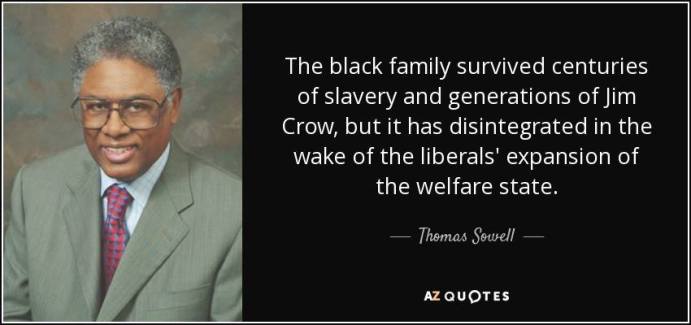
Then came the War on Poverty.  Welfare. An insidious form of wealth transfer. Take money from those who earned it, and give it to those who didn’t.  It put many blacks (and others) right back into bondage – into the slavery of perpetual dependence.  Reparations is a smoke screen word to do more of the same.
15940362_1630282206988368_7273752908148723957_n

During the exchange, I attempted several different ways to make the case that the historical injustice done to the blacks who were slaves and the subsequent victims of post-bellum hatred and discrimination can never be corrected – because the victims and victimizers are long gone.  No one alive today can be responsible for transgressions committed generations in the past – because they weren’t even alive, much less involved, in committing the transgressions.  Thinking that one race is responsible for, and must atone for, the plight of another race is every bit as racist a notion as thinking that one race is superior to another.  It is a large step down the path to perpetual grievance and resentment that plagues much of the rest of the world.

I maintain that “social justice” is a weasel word.  Seeking “social justice” in the form of unjust “wealth transfers” and reparations can never correct the uncorrectable sins of the past.  Real justice can prevail when everyone stops attributing the traits, or actions, or intelligence, or habits, or crimes, etc. of individuals to all the members of a race, or tribe, or nation, or ethnic group, or gender, etc. and starts treating individuals as individuals.

Despite my denunciation of social justice and my espousing of individualism, my interlocutor kept pressing me for details of my plan to bring social justice to blacks today.  We were both using English words, but he was speaking weasel-ese.


Globalism vs. Trumpism

9yedzw-1

By Mike Cronin

A common thread in the alarms raised by the election of Donald Trump is the concern that his brand of nationalism/populism will turn the US isolationist, or worse, into a fascist dictatorship. Why are globalists, themselves no friends of individualism, alarmed at such a prospect?  It might help to understand more about the complexities of globalism/globalization.

According to http://www.globalization101.org/what-is-globalization/;

“Globalization is a process of interaction and integration among the people, companies, and governments of different nations, a process driven by international trade and investment and aided by information technology. This process has effects on the environment, on culture, on political systems, on economic development and prosperity, and on human physical well-being in societies around the world….

…Globalization is deeply controversial, however. Proponents of globalization argue that it allows poor countries and their citizens to develop economically and raise their standards of living, while opponents of globalization claim that the creation of an unfettered international free market has benefited multinational corporations in the Western world at the expense of local enterprises, local cultures, and common people. Resistance to globalization has therefore taken shape both at a popular and at a governmental level as people and governments try to manage the flow of capital, labor, goods, and ideas that constitute the current wave of globalization.”

Don’t get me wrong.  There is nothing inherently wrong with globalization per se.  In fact, taken at face value, it is probably a net benefit to humanity. Think about the spread of modern medicine and information technology, for example.  I think unfettered international free markets would be a great thing.  I have often presented my bias for free-market capitalism.  My bias has no border.  Unfortunately, the only unfettered free markets that exist today are the “black” markets for illicit goods, and unfortunately, human trafficking.  The rest of the global market is beset by trade imbalances, currency manipulation, defaults, sovereign debt crises, bailouts, and other “fetters.”

Given that explanation, the shape of the globalist critique against Mr. Trump (and the recent “Brexit” vote) begins to emerge.  Among the proponents of globalism are those who have been unethically enriched by manipulating matters at the diplomatic, international finance, and CEO levels.  Many of the proponents of globalism are not proponents of an unfettered free market. They seek to establish and/or perpetuate imbalances that they can profit from.  These are not productive people; they are more like vultures or parasites. These are the globalists who fear that Donald Trump’s administration, a Republican majority Congress, and a conservative Supreme Court will upend the existing “globalist” order – the globalists who have the most wealth and power to lose.

And that is why we must also examine nationalism.  The elite manipulators of international intercourse may be parasitical; but that does not make their concern over a rise in Trump-branded nationalism baseless.  Extreme nationalism has led to dark places before. Consider the word “Nazi.” It’s a German abbreviation for Nationalsozialist, i.e. “Nationalist Socialist,” hence the anti-Trump crowds’ easy conflation of Trump’s “America First” populism with fascist nationalism.

Will Mr. Trump’s brand of nationalism lead to that same dark place?  Did we just elect a tyrant-in-waiting?  Time will tell.  If Trump does become a dictator, I wonder: will the lachrymose legions lamenting Hillary’s loss begin to see the wisdom of the Second Amendment?

Ten Observations on Election 2016

hillary-clinton-supporters-cry-over-election-loss

By Mike Cronin

Donald Trump’s victory certainly stirred up a lot of clamor and noise this week.  Let’s see if we can herd some of the cats:

  1. Democracy has failed. The people chose Hillary Clinton by 200,000 votes, but the electoral victory went to Trump. Our “democracy” cannot fail if we don’t have one, which is in fact the case. We were given a federalist republic under the rule of law. We use democratic processes for some decisions to give the people a voice, but we are not supposed to have a system of straight-up majority rule. As to the electoral vote: It remains to be seen whether any electors will “go rogue” and vote against their “pledge” on Dec 19th, but it has happened before (as recently as 2004).  Of course, it’s never been by enough margin to change the outcome of an election.  In this case, at least 38 would have to be “faithless electors” to get Clinton to 270.
  2. Trump hates immigrants. He hates Mexicans. He hates Muslims. He’s racist.  We’ll, he might. Only he knows for sure.  However, he is married to an immigrant and he has people from all walks of life working for him.  He certainly doesn’t think people should be here illegally, which is not the same thing as hating the people who are or the people who want to be.
  3. Trump is a misogynist sexual predator. His caught-on-camera crudities certainly lend themselves to this narrative. There’s little actual evidence and no credible accusers that demonstrate he hates all women or has assaulted any of them, but Trump’s verbal vulgarity in this area is one of the most troubling things about him. Still, while Trump has been caught speaking like a sexual predator might; Hillary Clinton continues to aid and abet one.
  4. Trump is going to destroy all of the progress progressives have made over the last eight years. Possibly, but presidents seldom accomplish their full agendas.  Yes, Trump will have a Republican-majority Congress, but it won’t be a super-majority, and the Republican establishment doesn’t like him.  Trump bills himself as a deal maker.  He’ll have to be to get his agenda anywhere.
  5. Trump is going to elevate nationalism over globalism. Both are euphemisms for collectivism; only the boundaries are different. Neither is as good for individuals as unfettered free market capitalism.  There might possibly be temporary beneficial effects for Americans in the shift, especially if our troops come home and small businesses can thrive again.
  6. Trump is an idiot/outsider/politically inexperienced. He certainly does not articulate himself with Obama’s grace, but he is no dummy. In fact, he’s likely quite adept at persuasion (see items five and six on this list). He is certainly gifted at getting free publicity (or at least notoriety) from the very mass-media that hates him. Also, his lack of political experience, i.e. his NOT being a career politician or D.C. insider, is one of the fundamentals that led him to get elected.
  7. What happened with the polls? They consistently gave Clinton the edge! Bottom line: garbage in/garbage out.  The pollsters drew their samples from the same body of “likely voters” they always used, and in some cases “oversampled” Democrats.  The former was neglectful and led to the Democrats believing in their own invulnerability; the latter was a nefarious attempt to convince would-be Trump voters to stay home on Election Day. Once exposed, the revelation likely caused the exact opposite effect. Either way, the pollsters failed to obtain accuracy because they could not, or would not, sample validly.  
  8. FBI Director Comey’s shenanigans (i.e. his announcements regarding the on-again/off-again investigation into Clinton’s email debacle vis-à-vis Huma Abedin’s laptop) comprised the quintessential October Surprise, and it hurt Clinton. It certainly didn’t help, but it’s much more likely that Clinton’s shenanigans hurt Clinton.
  9. Why were Clinton and Trump our candidates? What secret weapon did they employ that none of their competitors had? 30-plus years of universal name recognition.
  10. What does it mean that Republicans gained more seats in Congress, strengthening their majority? They didn’t get a super majority, so there are a few (rare) actions they would have to earn Democratic support for in order to act: Impeaching the president and overriding his vetoes are two such cases. 2. Republicans will get to shape the Supreme Court for the next generation. 3. Republicans now have an opportunity to reverse much of the Democrats’ work over the last eight years. Whether they will actually do so, or get complacent and/or get caught up with internal divisions remains to be seen.

Rigorous Red or Bogus Blue? Part I

0d8621c

By Mike Cronin

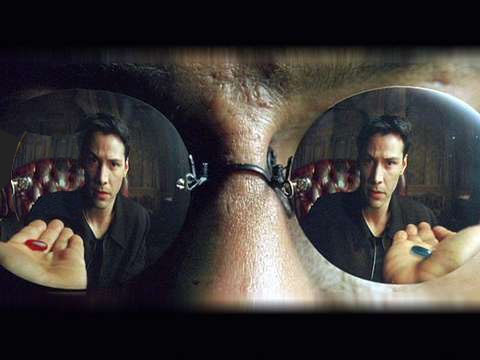
In the 1999 movie “The Matrix,” the future is presented as a dystopia where the vast majority of human beings are caged in pods that capture their body heat to energize a vast, governing machine intelligence.  In order to keep people in such a state, the machines created a virtual reality and plugged the brains of the human “batteries” directly into it – this constructed reality is the eponymous Matrix.

There are a few human rebels who escaped the machines, fighting an almost hopeless battle against them. These rebels are able to plug themselves back into the Matrix with full awareness of its virtual nature, and work to free the rare human “battery” who has begun to suspect the Matrix is not reality.  In the process of freeing such a mind, the leader of the extraction team confronts the skeptical person within the Matrix, hints at the truth, then offers the candidate two pills, one red, the other blue.  If the candidate takes the blue pill, he will remain trapped in the Matrix.  If he takes the red, he will be unplugged, rescued from his pod, and shown the true nature of reality.

There are some people today who believe we are living in a Matrix.  I don’t subscribe to that at all, but I do believe nearly all of our society’s ills can be attributed to a conflict between two philosophical meta-traditions, with schools of thought that promote collectivism & altruism on one side; and the philosophies of  individualism & reason on the other.  The traditions of collectivism & altruism have some Matrix-like qualities.

“Children who know how to think for themselves spoil the harmony of the collective society which is coming where everyone is interdependent.” ― John Dewy, hero of progressive education.

Like the machines in the Matrix, the elite of these traditions would prefer their subjects remain ignorant of the true nature of things, i.e. to take the metaphorical blue pill.  Creating critical thinkers is not a goal for the education of the masses in systems dependent on these models; nor is it a priority for the media to expose truths that contradict the narratives of the anointed elite.  But unlike the “batteries” of the Matrix, We the People are not trapped in energy-sucking pods. Metaphorical red pills can be found.

“We want one class of persons to have a liberal education, and we want another class of persons, a very much larger class of necessity in every society, to forgo the privilege of a liberal education and fit themselves to perform specific difficult manual tasks.” ― Woodrow Wilson, 28th President of the United States

Promoters and adherents of philosophies of individualism and reason are, like the rebels in the Matrix movies, very much a minority who see things much closer to the way they truly are. A thinking, reasoning mind is valued among such rebels, skeptics, and extremists, but represents a threat to the purveyors of the blue pill.

“To fill the young of the species with knowledge and awaken their intelligence… Nothing could be further from the truth. The aim… is simply to reduce as many individuals as possible to the same level, to breed and train a standardized citizenry, to put down dissent and originality. That is its aim in the United States… and that is its aim everywhere else.” – H.L. Mencken, journalist and author

The conflict between “blue” and “red” thinking has been with us since humans first started using tools to make tools – probably as far back as the invention of the wheel.  Blue thinking started with superstitions and pagan religions.  It has always had the advantage of being easier to sell and easier to believe in, so it has always flourished in some form or fashion, while red thinking has always required intellectual rigor, which meant it was not preferred by people looking for the path of least resistance. In fact, ours was the first nation to be founded on the principles of individual liberty and capitalism – i.e. The United States of America is the original red state!

5 Ways to Fight Hobgoblins

panic-button

By Mike Cronin

I often refer to H.L. Mencken’s “hobgoblins” quote: “The whole aim of practical politics is to keep the populace alarmed (and hence clamorous to be led to safety) by menacing it with an endless series of hobgoblins, all of them imaginary.” We see this every day, often with the enthusiastic pot-stirring of the main stream media.

Take today’s headlines, for example.  Rising tensions with Russia over the imbroglio in Syria. Hurricane Matthew. Gold prices. Stock prices. Jobs growth. Giving up control of the internet.  Hillary’s scandals. Trump’s crudities.  Duterte’s bombast. NFL ratings. Crazy clown sightings.

How is all of that really important? How can we ignore the hobgoblins and glean the “ground truth?”

A few rules of thumb can be useful:

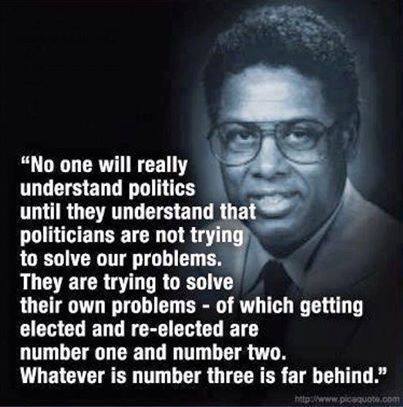
  1. Always keep Mencken’s quote in mind, together with Thomas Sowell’s observation:1931497_10156430011180515_9052930332313088412_n
  2. Get your news from a variety of sources. Journalism has evolved, or more precisely, de-volved, in the face of 24/7 cable news cycles, citizen-chroniclers, and the web.  According to the authors of Blur, the old media’s apex occurred at about the time of the Three Mile Island incident in 1979. CNN came online shortly after in 1980, and the 24/7 news cycle was born. The term spin as euphemism for truth-shaping entered the lexicon at about the same time. Consumers have had to contend with an ever more clamorous, ratings-driven media ever since. Every outlet is biased, but some do a better job of admitting what their bias is (my own, for example, is for individualism, reason, and laissez-faire capitalism) and/or mitigating for it (this reporter, for example, does a commendable job on reporting from Washington D.C. without interjecting his ideology). Alternately, check out the US news from a foreign source, such as BBC, Al Jazeera, or Xinhua.  They are biased as well, but perhaps not about the same things we are. It can be enlightening.
  3. Once the main-stream media have added unique theme music to a particular story, it’s not breaking news anymore. They are trying to turn it into a cash-cow and milk it for ratings.
  4. Most mainstream media operations lean left/liberal/progressive/Democrat, while Drudge, Breitbart, and Fox News (at least until the recent departure of Roger Ailes) tilt right/conservative/Republican – but what if both of those factions are two sides of the same coin? In order to see liberals and conservatives as opposites, you are supposed to accept a left-right political spectrum model with socialism on one end and fascism on the other. To the subjugated souls living under either, there is no practical difference. As the saying goes: All models are wrong, some models are useful.  A left-right / liberal-conservative model keeps you scared of the hobgoblins.  What if we look through a different lens? What if we put individual liberty on one end, and absolute tyranny on the other?  I contend that on such a model, “liberal” and “conservative” establishment politicians are continuously dragging us closer to the tyranny cliff, with only the flavor of tyranny at issue. Using a better model might get us closer to “ground truth.”  Who will lead us to liberty or drag us to tyranny?
  5. One kind of real hobgoblins we must watch for: luminaries with enough wattage to force the public eye to “look away.” Such wattage could come in the form of personal charm or charisma, whereby the figure is judged by their reputation instead of earning a reputation based on considered judgement (e.g. President Obama’s anticipatory Nobel Peace Prize), or via “wagging the dog” (e.g. President Johnson’s incandescent “Gulf of Tonkin” lie).


The Battle Begins. How Will you Fare?

trump-clinton

By Mike Cronin

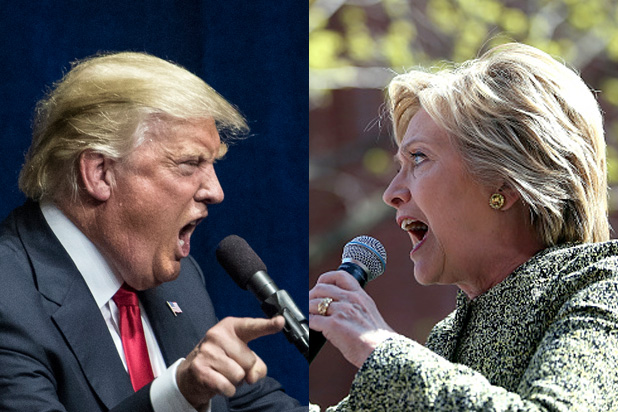
Barring a “black swan” event, the race for president is down to Trump vs. Clinton.  Who will you vote for, and why?  Will you even vote?  Will your vote matter?

There are so many marginal factors that can shape an election, but there are some basic election fundamentals that seldom get explained.

First: From 1932 to 2012, the average voter turnout has never been higher than 63% or less than 49%.  That means on average only a little over half of the eligible population votes in any given presidential election.  Of the half that votes, roughly 32% are dyed-in-the-wool liberal Democrats and will always vote for the Democrat candidate.  Roughly another 22% of the half that votes is comprised of hard-core conservative Republicans who will always vote for the Republican candidate.  These groups are the “base” for a given candidate/party.  Once you exclude the 54% of voters that are going to automatically vote D or R in any given election, the real battle takes place over the remaining half of the half of Americans who are going to vote. Expressed another way: Presidential elections hinge on the lever pulls of slightly less than 25% of the adult population!

It gets better.  Where those 25% reside is crucial.  If a majority of them reside in states that are overwhelmingly likely to vote a certain way, their votes aren’t going to mean very much.  Conversely, if the bulk of those independent voters reside in states that could go either way (the so-called battleground states), their votes could wield enormous influence!

Are you one of the independents or third party members who vote but don’t blindly punch holes for any party’s candidate (or against the other party’s!)?  Where do you live?  Will your vote count?

If you are, how will you make your decision? Party loyalty isn’t your thing, so what does it for you?  Unfortunately, some will waste their votes on frivolous criteria such as the looks, race, or gender of the candidate, or on candidate’s oratorical prowess.

To do justice to our system and not waste my vote, I’ve developed a small list of criteria that I can rate each candidate against using a survey technique called a Likert scale.  Here it is:

Rate each candidate on how you believe they would:

Honor the Oath of Office and abide by the Constitution & the laws of the land Fail Marginal Mediocre Good Exemplary
Appoint Supreme Court Justices that will uphold the Constitution Fail Marginal Mediocre Good Exemplary
Command the armed forces and employ military force only to counter serious threats to the United States Fail Marginal Mediocre Good Exemplary
Act with integrity & honesty, and demonstrate character Fail Marginal Mediocre Good Exemplary
Govern transparently Fail Marginal Mediocre Good Exemplary
Reduce dysfunction and corruption in the Executive Branch Fail Marginal Mediocre Good Exemplary
Work to reign in government spending, promote capitalism and demonize socialism Fail Marginal Mediocre Good Exemplary
Work to audit, and possibly end, the Federal Reserve Fail Marginal Mediocre Good Exemplary
Work to end, or at least lessen and simplify, the income tax Fail Marginal Mediocre Good Exemplary
Overhaul the immigration system to allow maximum freedom to enter and remain in the country  consistent with preventing criminals, terrorists, and other bad actors in and without yielding an automatic electoral advantage to any party Fail Marginal Mediocre Good Exemplary

Obviously, you might prefer different criteria than what I’ve settled on, but whatever thoughtful criteria you select can still work.  Once you establish your criteria and rate each candidate, score them thus: 1 point for each Fail, 2 points for each Marginal, 3 points for each Mediocre, 4 points for each Good, and 5 points for each Exemplary. Total up the scores and vote for the candidate that earns the highest marks.

Still, there is at least one other major contextual factor that is seldom examined during presidential elections: Congress.  We can elect a president based on the most cogent criteria, but if he or she must deal with a Congress skewed to the opposing party, it is likely they will face high resistance to carrying out their plans or their mandate.  Even if he or she gets to work with a same-party Congress, your candidate could still find it hard to make headway if, like Donald Trump, they come from outside the beltway political establishment.

There is a simple (not easy!) fix to that: Help your presidential candidate get a sympathetic, same-party Congress to work with!


Tweets, Taxes, and the Pursuit of Happiness

68808176

By Mike Cronin

Socialists of all stripes decry capitalism, but cannot achieve their vision of a classless, egalitarian society without first stealing the wealth created by capitalists! Case in point:

Mayte Lara, an illegal immigrant, created a brouhaha on Twitter by describing how she bragged during her Valedictory speech about being “undocumented” and yet still achieved a “full ride” scholarship to the University of Texas.  Why?  Federal law does not prohibit states from providing in-state tuition to “undocumented students.”  Why should there be an uproar?  I mean, it’s not as if Texas taxpayers will have their hard-earned money taken from them via the coercive power of government in order to pay for Ms. Lara’s college education at the expense of whatever they might do with it themselves, is it?  It couldn’t be that the price of a UT education is going up in part because there is no such thing as “free” tuition, could it?

This isn’t about race or hatred of illegal immigrants.  We could change our laws to reform the immigration system to make it easier to be in this country legally.  It’s the dysfunction, the absurdity, the gall of having laws on the books that are enforced at virtual gun point (i.e. tax compliance) while facilitating the wholesale abandonment of other laws (immigration) in order to expand the welfare state and the vast pool of voters dependent on government.

As a human being, Mayte Lara has as much right as anyone to seek out the best life she can find for herself.  We might even refer to such a right as “the pursuit of happiness.” Doesn’t that phrase have a familiar ring?  You might have read it before in a modest historical document.  But the right to pursue happiness is not the same thing as being given the privilege to be made happy at other’s expense.  Ms. Lara has no right to the wealth, time, or property others have produced.  Yet (perhaps without realizing it), she flaunted the fact that she was given a license from government to dispose of the wealth, time, and property of others (in the form of her tax-payer funded education).

Taking wealth from the citizens you are supposed to protect, and giving it to illegal immigrants you are supposed to deport.  Absurd!

In a related note, the Democratic National Committee is putting a wall around its convention site.  A Secret Service agent said the wall was for security purposes. Really? You mean it’s not meant to be a canvas for taggers?  It’s for security? From what, Bernie Sanders supporters? Thanks for the enlightenment, Agent Obvious!

Aren’t the Democrats supposed to be the party of inclusion and multiculturalism? They are certainly against the idea of putting a wall along our border with Mexico. If there were such a wall, future Democratic voters like Ms. Lara would have a much harder time getting into the US!

(I am also against a border wall, by the way, but for a different reason.  I think the best way to fix immigration is to make it easier to be here legally under a variety statuses and in a way that doesn’t automatically confer a voter pool to one party and a tax burden to everyone.)

On Critical Thinking

THINKER_side_columns

By Mike Cronin

A lot of people talk about critical thinking, but I seldom ever see any explanation of what critical thinking is.  Left to our own devices, we might reasonably assume that critical thinking means being critical.  That is partially right.  Certainly people who practice critical thinking are often critical of others, but that is not the essence of the term.

To me, critical thinking means examining my own thoughts on an issue for errors in logic or reasoning before verbalizing them. It means basing my positions on a foundation of rational thought. It means recognizing bias, especially my own.

I’ve written before about bias.  When you read a news article or watch a news piece, the reporters and networks pretend they have no bias, but that is absurd.  Everyone has a bias – it is inevitable, because even the wisest among us cannot see things from every and all perspectives.  The difference between my blog and some others is that I tell you right up front what my bias is.  I am pro-freedom, pro-capitalism, pro-individualism, and pro-reason.  I am against socialism and any other form of collectivism. My biases are not a result of my upbringing.  If anything, my biases are in opposition to the trends and positions espoused to me in school, church, and to some degree, the military.

Logic is another key ingredient of critical thinking.  Ayn Rand described logic as the art of correct identification.  That sounds simple, but it has deep consequences.  It is easy for a child to recognize a lemon as a lemon, but it might be a bit harder for the child to understand that the lemon can never be anything other a lemon.  It can only do or behave as a lemon.  A person might squeeze it to get the juice, or grate it to get the pith, but a lemon cannot become a bird and fly away.

Wishful thinking and other logical errors are the source of much conflict and dysfunction in the world. An example:  The current brouhaha over gender identity.  We are either born with male anatomy or female anatomy (occasions of true androgyny are exceedingly rare). “Identifying” as the opposite gender from what one’s anatomy dictates (no pun intended) is logically erroneous.  One might align their conflicted desires to reality via surgery and drugs, but until those procedures are complete, one is “male” or “female” according to one’s anatomy.

At the heart of many arguments and conflicts over logic are premises.  There is no shortage of pundits, educators, and other influential people that use well-crafted logical arguments that stem from bad premises.  Take “equality” for example.  We might hear that the difference between conservatives and liberals is that conservatives want people to be treated as equal under the law, while liberals want everyone to have equal outcomes.  The first premise rests on the idea that no one is more valuable as a human being than anyone else.  It creates the conditions whereby a poor person can raise themselves up from poverty on their own hard work and merit. It is essentially correct, but hard to enforce, because the rich and well connected can sometimes buy better legal representation than the poor. The second premise rests on the idea that it’s not fair for one person to have more than another, so wealth must be redistributed.  It gives no attention to the concepts that wealth belongs to whomever created it, or that individuals have any responsibility for their own situation.  It is a bad premise, because it ignores the fact that life is not and cannot be fair, and it ignores all of the evidence of human history:  Humans cannot rise above animalism without individual effort to devise technology or apply the technology to raising the standard of living.

Are you a critical thinker?

Random Absurdities, Pt. 2.


sisyphus

By Mike Cronin

It’s OK to kill our (human) enemies, but we dare not name them.  On the other hand, we have no compunction about conducting war against all sorts of things that aren’t enemies: Terrorism is a tactic used by our aforementioned unnamed enemy, but terrorism itself is not an enemy. Drugs are a commodity sold by enemies taking advantage of the risk/reward conditions our drug laws create, but drugs themselves are not an enemy. Poverty is a condition often perpetuated by people who refuse to accept that they are responsible for the choices they make.  Poverty is not an enemy, but the “War on Poverty” often treats the most productive among us as foes.

The “Occupy Wall Street” types who made a stink a few years ago railing against capitalism were often seen wearing name-brand clothing, drinking coffee from famous-brand cafes, and calling and texting each other on smart phones.  How can one accept an anti-capitalist argument from spokes-dudes wading up to their necks in the products, goods, and services created at the hands of some of our most effective capitalists?

Scientifically speaking, anything with a carbon molecule is organic. Virtually all of the food items we eat, with the exception of water, salt, and trace minerals, are organic in the most factual sense possible: they contain carbon atoms and molecules in the structures of carbohydrates and proteins.   The idea that a vegetable or box of cookies or a can of soda might not be legally “organic” when they are factually “organic” is a semantic absurdity fostered by the pipsqueaks of panic.

Ditto for “genetically modified organisms” (GMOs).  Virtually every domesticated food plant and animal produced and consumed today is a result of genetic modification that has been going on since the dawn of agriculture.  Here again, the pipsqueaks are pandering to fear.  It makes no difference to your body if a tomato or grape or a chicken was modified over many generations in the field or one generation in a test tube.  You are going to eat the stuff, draw energy from it, and eliminate it, not blend it into your genetic code. Eating “Franken-food” will not cause you to turn into a shambling mutant!

I am reliably informed that airline pilots for most of the big domestic airlines (American, United, Delta) are paid by the hour, from the time the jet is pushed back from the gate at the departure airport until the door is opened at the arrival airport.  Is it not absurd to incentivize your highest-paid hourly employees to NOT be efficient in an industry with such low profit margins that attention to efficiency is essential for financial success?

The concept of “white privilege” has been instigated as a way to induce guilt in white people for (supposedly) causing, or at least not having to suffer, the woes (real or imagined) of every other demographic. It is a racist concept, and it absurd.  It is racist because it attributes advantage to whites solely on the basis of their skin color.  It ignores the fact that there are many non-white people who attain as many, or more, rewards and advantages in their lives than most whites.  It is absurd when applied to Americans because all of us in the US enjoy far more “privilege” (in the form of better living conditions, more freedom, and more opportunities for some, and sadly, also in the form of government handouts for others) than most people in most countries around the world.  The constant stream of immigrants pouring into this country (legally and illegally) aren’t coming here seeking to be oppressed by the man!

We are supposed to take it for granted that income inequality is a bad thing and accept all kinds of wealth redistribution schemes to help resolve it.  There is never any allowance for the possibility that income inequality might be a direct result of ingenuity inequality or effort inequality. That would mean that people are responsible for their own achievements (or lack thereof).  We can’t have that – it would be absurd!

A Capital Idea: an “-ism” for Freedom

By Mike Cronin

Last week, I offered the view that adopting socialism is a recipe for disaster. Most of the political “-isms” (socialism, communism, fascism, imperialism, etc.)  “-chies” and “-cracies” (monarchy, anarchy, theocracy, democracy, plutocracy, oligarchy, etc.) sound different on paper, but they all have two things in common: the rule of one human or few humans over the rest, and the absence of individual freedom.

There is an alternative.  Our founders gave us a Constitutional republic which enshrined the rule of law and individual liberty.  The essential element of freedom is property rights, including self-ownership.  The political-economic system that arises where freedom reigns is called capitalism.  It has never been fully embraced by any country.  Our own country perhaps came the closest, which greatly contributed to the vast economic achievements and ever-increasing prosperity we came to expect as Americans.

Yet our failure to fully adopt it has had a profound effect on our history. The institution of slavery was a direct affront to the concept of freedom, and it convulsed our country from its beginnings through the Civil War and beyond. I’ve written elsewhere of slavery and unjust war as two of the four major dysfunctions that have afflicted our country.

Want some examples of how capitalism is better than socialism?

The Ukraine is a geographic bread basket, similar in productive potential to the US Midwest; yet the Union of Soviet Socialist Republics (of which Ukraine was once one of the socialist republics) had to import grain from us during the height of the cold war. Why couldn’t they produce and distribute enough to feed themselves?

Virtually every labor saving and communications device and other technological advancement since the Dark Ages was invented or perfected in the US or another semi-capitalistic country. (E.g. the electric light bulb, the car, the airplane, the microwave oven, the TV, VCR, and DVD, the laser, vaccines, etc.). Have you ever considered buying a car designed and manufactured by an Iranian or North Korean company?  Does such a thing even exist? Why aren’t such things invented in dictatorships and socialist utopias?

In most cases, landlocked nations are doomed to economic mediocrity or worse. (Examples: Afghanistan, Mongolia, and Bolivia). But a few, such as Switzerland and Lichtenstein, are incredibly well off.  What separates them? The ones that are well off have a much higher degree of individual freedom and capitalism than the others.

China was once every bit the communist leviathan that the Soviet Union was.  Why didn’t China go the same way the USSR did? Conversely, why is the US going through a decline?

China is ascending to the same degree it has adopted limited capitalistic market reforms. Our country is declining to the same degree we adopt the socialist dysfunctions that destroyed the Soviets and continues to hamper the Chinese. Imagine the productive energy that could be unleashed if 1.4 billion people enjoyed a fully free existence!

Despite the vast body of historical evidence that capitalism works and socialism doesn’t, capitalism has been given a bad name.  Individual freedom requires individual responsibility for one’s own actions and living with the consequences of one’s choices.  For that reason, capitalism will always be a hard sell compared to the free goodies and cradle-to-grave care promised by the heralds of the other “-isms.” On top of that, where capitalism has some influence, prosperity follows. Prosperous people are easy for envy-baiters to blame in order to gain an audience…and power. In virtually every human system of organization other than capitalism, anyone with wealth could only attain it by taking a bigger share of “the pie” than everyone else. Capitalism is unprecedented – it allows the productive to enlarge the pie!  But the envy mongers can’t or won’t see that.  They say capitalism fosters greed.  There’s no denying that greedy people exist,  and some of them advance quite far under semi-capitalistic economies, but socialism is absolutely powered by greed and envy!

It is easy for the prophets of utopia to blame capitalism for the sins of the other systems. The latest example is the appellation “crony” capitalism.  The proper term for companies using influence, connections, and campaign donations to get laws passed that stifle their competition is “corporatism.”  Using the coercive power of government to stifle your competition when you can’t win competitively through offering better value is not capitalism at all, though it has some capitalistic trappings (namely the privately-owned nature of the corporation).

The really ironic thing about the other “-isms?”  They need the productivity of capitalism.  A greedy socialist can’t “redistribute” wealth from the productive to the parasitic if there isn’t any wealth to start with.  He must decry capitalism even as he robs the capitalistic in order to buy votes from those he has bamboozled.