Infotainment?

tesla-model-s-2

By Mike Cronin

Most of my blog posts have been, I hope, informative, perhaps even instructive. However, I have to admit they probably are not very entertaining. Time to lighten up a little.

Medicine and law love to use exclusive language. Lots of Greek and Latin words.  The military, being full of hyper-competitive types, had to go one better, and develop an entire language using jargon and acronyms and the occasional bit of “poetic vulgarity.”  I mean, why use a simple term like “car bomb” when a multi-syllabic mouthful like “VBIED” (vehicle-born improvised explosive device) will do?

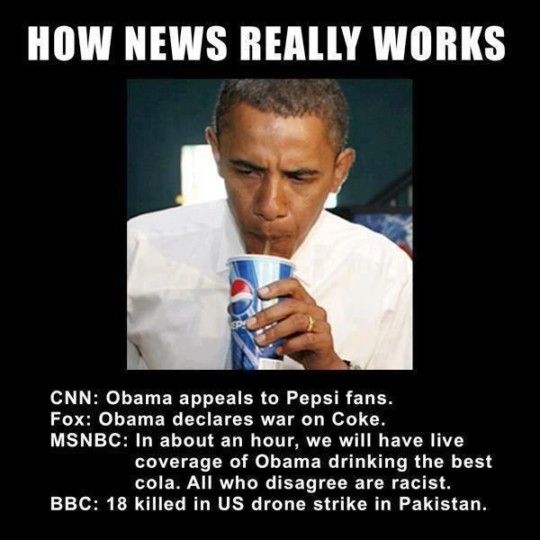
All news is fake; some news is useful:
94c041dd3a0d6d0223e0b45e5e65991b

I got called up for jury duty. When my group showed up at the appointed place and time, clerks showed us a propaganda video explaining how jury service was a civic duty because we have all enjoy a right to a trial by jury.  A little cheesy, but valid.  Then the video tried to pump up our patriotism by showing waving flags and national landmarks while the narrator gushed that jury service was crucial to our democracy. Since we don’t have a democracy, and since jury duty can be required or not of citizens under almost any form of government, I had to wonder who put together and/or approved the video, and whether they deserved a trial by jury for inflicting that pious excrement on us!

While commuting, I sometimes see a pink Jeep on my route.  Said Jeep has a custom license plate that says: “PINK JEEP.”  Thank you, Captain Obvious.

Sometimes my office has to assess whether an engagement mission between the USAF and a foreign air force has had the effect of building a partner relationship.  It is extremely difficult.  How does one detect “love-trons,” let alone “count” them?

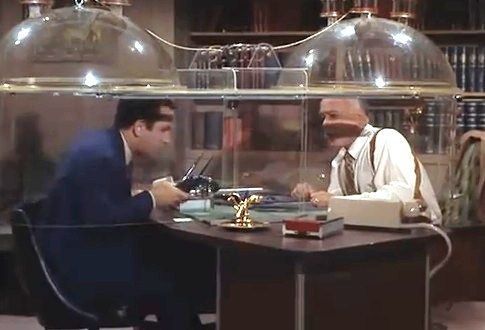
The 1960s TV show Get Smart, a spoof of James Bond movies and the secret agent genre in general, was prophetic in its portrayal of absurd spy gadgets that were meant to keep conversations secure, but actually hindered the agents using them while making the goings-on clearly understandable to any bystander.  The “Cone of Silence” was one such ludicrous device. When lowered over the heads of agents, they could not hear each other clearly, but anyone not under the cone could hear the agents perfectly well.  The modern security environment on government computers is sadly reminiscent of such shenanigans. It is becoming increasingly difficult for users to actually communicate and collaborate using the communications and collaborations tools meant for the purpose. Hopefully it is not as easy for those who wish us ill to get our information as it was for the opposition on Get Smart!
9f55b0d9f86c986aed24aae0b814d4ab


Not so Random Matter?

hqdefault

By Mike Cronin

I started out thinking I had several disparate items for this week’s post, but they all seemed to tie together:

It’s science-project season at my son’s school.  He brought home an information/instruction packet.  He had to get a parent to sign the first page – which is a letter to parents explaining that the kid has to do the science work on his own, but parents can help with the non-process portions of the project (e.g. helping the kid get materials) etc., etc. On the reverse of the first page is a progress tracker.  The kid has to get his parents to sign each time he hits a milestone on the project.  My son got dinged on the first milestone because I didn’t sign it.   The first milestone is to have a parent sign the letter to parents.  Yes, that’s right: The purveyors of the science project’s hand-out material failed to notice they are requiring a parent sign the back of a form in order to certify that the parent signed the front of the form…and they make the kid take the hit if the parent doesn’t jump through the hoop.  On a science project. You know, Science?  The subject where they teach kids logic, critical thinking, precision, peer review, attention to detail, right? Little things like that.

Speaking of science, I work in a small office with five other people. All five are scientists and/or engineers. Our office serves as a kind of internal think-tank. We do quantitative and qualitative analysis, among other things. I am the only one in the office who does not have a degree in science, technology, engineering, or math (STEM).  My colleagues can run rings around me on any kind of math-based reasoning or problems.  On the other hand, I usually get the better of them when it comes to verbal expression.  I like to tease them that they are all experts at qualitative reasoning, while I am the quality. At any rate, our work sometimes involves (mathematical) models and simulations. Someone in the field once quipped that “all models are wrong, but some models are useful.”

Given the public’s current fascination with the phenomena of “fake news,” I think an adaptation of the “models” aphorism is apropos as a guidepost for judging the efficacy of anything in the media: “All news is fake, but some news is useful.” Two cases in point:

Some right-wing media sources are reporting that Christiana Figueres, Executive Secretary of U.N.’s Framework Convention on Climate Change, as much as revealed that the UN’s plans to combat climate change are really a set of blinders to hide the real agenda: the destruction of capitalism. While the UN is no friend of capitalism, context matters, as does the thing that is not being said.  Figueres undeniably advocates for the alteration of the global economy when she says:

“This is the first time in the history of mankind that we are setting ourselves the task of intentionally, within a defined period of time, to change the economic development model that has been reigning for at least 150 years, since the Industrial Revolution,”

Note that she stops short of stating that the current global economic development model that must be changed is capitalism (it isn’t, by the way – it’s a mix of capitalism and controls), or describing what model should obtain.  I would not be surprised to learn that Figueres is indeed anti-capitalist, nor would I be surprised to learn that UN efforts to combat global warming are indeed a smokescreen to hide the destruction of capitalism, but Figueres’s statements fall short of being a smoking gun – more like an eyebrow-raiser. The subject bears watching.

Meanwhile, on the left side of the fake news spectrum, we have the New York Times’ headlines for Friday’s attack at the Louvre in Paris by a “lone wolf” Islamic jihadist. Their first headline read: “Louvre Museum Evacuated after French Soldier Opens Fire.” At best, this headline leads you to believe the incident revolved around the actions of a French soldier. At worst, it leads you to believe a French soldier went nuts and started shooting up the Louvre.  A few hours later, the headline had changed to read: “Assailant Near Louvre Is Shot by French Soldier” Again, the French soldier’s actions seem to be the focus.  As mentioned previously, context matters, and what is not being said matters. What the vaunted New York Times neglected, or purposely refused to highlight in their headlines, was that a man shouting “allahu ackbar!” (i.e. “God is great” in Arabic) and wielding knives attacked some French soldiers and was shot by one of them in response.

It would not do to depart from The Narrative by highlighting yet another attack by a Muslim against Western targets, even as the militant arm of the “tolerant” left is convulsing over President Trumps’ recent “anti-Muslim” immigration restrictions, now would it? Instead, the “Newspaper of Record” felt it must mislead readers with deceptive headlines. I’m not suggesting the Times should have gone with “Islamo-Fascist Nut-Job Takes Knives to a Gun Fight in Paris; Wins Darwin Award Nomination,” but something like “Assailant Shouting in Arabic Shot by Soldier At Louvre” might have hit the right balance between not jumping to conclusions about the attacker’s religion, intentions, and connections, and the response of the soldiers.  All news is fake, some news is useful.

Social Justice: Still a Weasel Word

download

By Mike Cronin

Some time ago, I wrote about the squishy-ness of the term “Social Justice.” It still rankles.

In addition to this blog, I frequently answer questions on a forum called Quora.  Therein, I recently had a debate with a fellow over “social justice” in general, and whether whites should pay reparations to blacks to atone for slavery/Jim Crow/Segregation specifically.

I’ll state right up front: Reparations are a bad idea, and no, I don’t hate blacks.

As I’ve mentioned elsewhere, I believe in individual liberty, limited, rights-protecting government, and Capitalism.  I am also a bit of a skeptic, mildly contrarian, and I tend to prefer rational responses over emotional ones.  I don’t waste energy on hatred, I don’t see any race as superior or inferior to any other race, and I generally deal with people as individuals vice members of some group. It also means I think of justice and injustice in terms of individual action and consequence.

This brings us back to Reparations.  I can’t support the idea because, regardless of how blacks were oppressed or injured by slavery (or later on Jim Crow laws and Segregation), the people who were slaves have been dead for generations – just as the people who held them as slaves have been dead for generations. Treating blacks as a race of sub-humans then was a morally repugnant act committed by more than a few whites, most especially the relatively few whites who actually owned slaves.  But not every white person was an oppressor then, nor were all slave owners white, nor was every black person a slave.

In my mind, government-sponsored racial discrimination based on benign prejudice is just as noxious as discrimination inspired by malicious prejudice.” – Clarence Thomas

Indeed, social justice warriors seeking to impose reparations on whites always seem to ignore or forget that 360,000 Union soldiers, mostly white by far, died in the service of reuniting the country and limiting the spread of slavery to the west.  The Union Army and Navy killed 260,000 Confederates, again mostly whites, who were trying to keep the South, which was wholly dependent on slavery, independent.  Let’s make that point a little more succinct: Whites trying to reunite the country and limit, if not outright eliminate, slavery fought and killed other whites – by the hundreds of thousands, to do it. Between the end of the butchery of the Civil War and Dr. Martin Luther King’s civil eloquence, most blacks (but not all) were still treated poorly by many whites (but not all). Black incomes and living conditions took an overall upward trend.

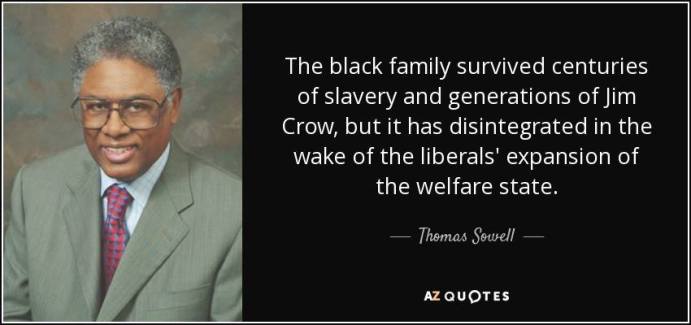
Then came the War on Poverty.  Welfare. An insidious form of wealth transfer. Take money from those who earned it, and give it to those who didn’t.  It put many blacks (and others) right back into bondage – into the slavery of perpetual dependence.  Reparations is a smoke screen word to do more of the same.

15940362_1630282206988368_7273752908148723957_n

During the exchange, I attempted several different ways to make the case that the historical injustice done to the blacks who were slaves and the subsequent victims of post-bellum hatred and discrimination can never be corrected – because the victims and victimizers are long gone.  No one alive today can be responsible for transgressions committed generations in the past – because they weren’t even alive, much less involved, in committing the transgressions.  Thinking that one race is responsible for, and must atone for, the plight of another race is every bit as racist a notion as thinking that one race is superior to another.  It is a large step down the path to perpetual grievance and resentment that plagues much of the rest of the world.

I maintain that “social justice” is a weasel word.  Seeking “social justice” in the form of unjust “wealth transfers” and reparations can never correct the uncorrectable sins of the past.  Real justice can prevail when everyone stops attributing the traits, or actions, or intelligence, or habits, or crimes, etc. of individuals to all the members of a race, or tribe, or nation, or ethnic group, or gender, etc. and starts treating individuals as individuals.

Despite my denunciation of social justice and my espousing of individualism, my interlocutor kept pressing me for details of my plan to bring social justice to blacks today.  We were both using English words, but he was speaking weasel-ese.


Know Your Narratives

quote-if-you-tell-a-lie-big-enough-and-keep-repeating-it-people-will-eventually-come-to-believe-joseph-goebbels-83-20-28

By Mike Cronin

Last week I offered three tips for Filtering the Feed.  I thought I’d end 2016 with one more tip:

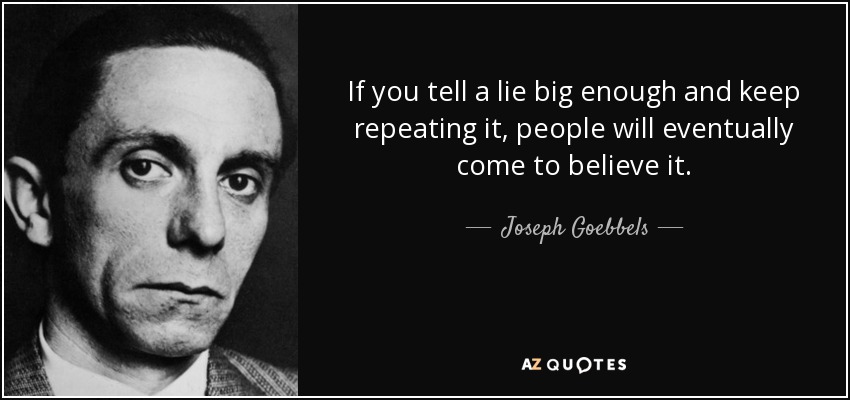
Understand “The Narrative(s).” As mentioned in tip one last week, the news is almost always fake to one degree or another.  One of the driving factors in most main-stream media outlets is maintaining a certain narrative. But the mass media are not the only purveyors of “the narrative.”  In dictionary terms, a narrative is simply a story.  In the sense of modern ideological competition, narratives are essentially the story that is supposed to be happening.  This striving to present the world to the rest of us in a certain way is especially favored by liberals / progressives, but conservatives are not immune to doing so either.  The liberals have elevated maintaining “The Narrative” to an art form, as they control most of the machinery for advancing their version of it: Entertainment, Academia, Education, and Mass Media.  Here are some of its major hallmarks:

  1. Your membership in a group defined by your skin color, ethnic heritage, income, or other attribute is more important than your individual identity.
  2. Ergo, whites are oppressors, or at least privileged, especially white heterosexual men. White men can be held to account for virtually any unfavorable outcome experienced by virtually any other group. In extreme instances, simply being white is racist, while any form of bias, discrimination, or exclusionary behavior directed against whites by other groups cannot, by definition, be racist.
  3. Human beings are destroying the planet
  4. Wealth is distributed unfairly and must be redistributed
  5. Guns are evil
  6. Abortion is a sacred right
  7. Marijuana should be legal
  8. Gays should have the right to marry
  9. Everyone has the right to free speech…unless it’s offensive to anyone except white males or Christians – then it should be doubly illegal.
  10. Everyone has a right to education, health care, food, etc.
  11. It wasn’t Hillary’s fault
  12. Everyone is equal, so everyone should have equal outcomes (except white males – see above)
  13. We should have pure democracy
  14. Big Government is the solution to all of our problems

While liberals have practically “weaponized” narrative advancement, conservatives have their own version of a narrative, which generally espouses opposite positions from the liberal orthodoxy, but not 100%:

  1. Your membership in a group defined by your skin color, ethnic heritage, income, or other attribute is perhaps as important as your individual identity.
  2. Some whites were oppressors while other whites defeated them during the Civil War. Later on, there will still some whites that were oppressors, while others stood with Dr. King in the 60s. Whites don’t have a lock on being oppressors, nor do non-whites have a lock on being the oppressed, as the relatives of the 6 million Jews killed during the Holocaust, or of the Cambodians killed by Pol Pot, or of the Russians killed by Stalin, or the Chinese killed by Mao can attest.
  3. Global warming is a hoax. Human beings might be destroying the planet – you’ll need to prove it without cooking the books and without resorting to calling skeptics “deniers” as if they are heretics.
  4. Wealth is distributed unfairly and must be redistributed…just not by nearly as much as our liberal colleague want.
  5. Guns are a God-given right
  6. Abortion is murder
  7. Drug use is evil
  8. The government must protect the sanctity of marriage as being between one man and one woman
  9. Everyone has the right to free speech…unless it’s flag burning, oh, and you need to say the Pledge of Allegiance.
  10. Everyone has the right to seek out education, health care, food, etc.
  11. It WAS Hillary’s fault
  12. Everyone deserves equal treatment under the law
  13. We are supposed to have a republic
  14. Big Government is the cause of most of our problems…but we’ll let it grow…just more slowly than our liberal colleagues.

There is an alternative to the combating narratives. Call it the moderate, or libertarian, or independent view.  It would probably make more sense to more people than either of the others, except that it has far weaker advancement machinery. I happen to ascribe to this view:

  1. Your membership in a group defined by your skin color, ethnic heritage, income, or other attribute is irrelevant compared to your individual identity.
  2. Some individuals do oppressive things against others. In a rights-respecting country, you can’t rationally hold an entire group accountable for the sins of an individual member of that group, especially if those sins were committed before any of the current members of that group were born.
  3. Human beings might be contributing to climate change, which is, and always has been, a natural phenomenon. We’ll be better off adapting to it than disrupting society with draconian, rights-destroying measures to try and stop it.
  4. Wealth is created by productive people, not distributed. No one has a right to the fruit of someone else’s labor. Coerced charity is theft, but voluntary charity is just fine.
  5. Guns are a protected right because self-defense is a right, to include defending oneself from common criminals, or uncommon criminals, such as tyrannical government.
  6. A woman has the right to do what she will with her own body…but killing a human being is murder. When does a fetus become an individual human being? Before that point, abortion is merely a medical procedure; after that point, killing the baby is murder.
  7. The government should have no say about what intoxicants competent, consenting adults put into their own bodies – but such use cannot mitigate acts committed while voluntarily intoxicated.
  8. The government should have no say in the relationships between competent, consenting adults, except as regards fraud and contract enforcement.
  9. Everyone has the right to free speech…especially if it’s offensive, but not if it takes away something someone else had a right to. Conversely, no one has a right to make others provide a platform, venue, or to make anyone else listen.
  10. The only rights that are proper can’t involve taking anything from anyone else…in violation of their rights!
  11. It WAS Hillary’s fault
  12. Everyone deserves equal treatment under the law
  13. We are supposed to have a republic
  14. Government has a singular purpose: the protection of our rights. When it does anything else, it ends up violating our rights and making the problem it was supposed to correct even worse.

Three Tips for Filtering the Feed

louie-psihoyosinforevolution-e1447273790627

By Mike Cronin

Last year I wrote about the war on Christmas. This year the election of Donald Trump has overshadowed the usual brouhaha over nativity scenes at City Hall. So this year I thought I’d go with something a little more practical. The guiding purpose of this blog is to make sense out of the vast array or “manufactured truth” that we are constantly bombarded with. Here are a few tips and tricks to deal with it every day:

201016msm

  1. Consume news skeptically: the first thing you need to remember about the news media is that their first concern is to sell advertising. Their second concern is often to reinforce a narrative or advance an ideological or even partisan agenda. Running in third place is actually informing you about the new events of the day. There has been much ado recently about fake news. Given the first and second criteria just outlined, almost all the news is fake to one degree or another. When there is some crisis happening, such as 9/11, and the news “breaks in” to tell us about the event as it’s happening, they haven’t had much time to adapt it to their preferred narrative. In those cases we are usually getting real news, even if some of the details are inaccurate while the debris is still falling or the smoke is still rising. As soon as one of these stories acquires its own theme music, it’s no longer breaking news. At that point you must start taking it with a grain of salt. In reality, the best way to glean something of the truth may be to examine headlines from multiple news sources, to include some foreign outlets such as the Economist, BBC, and perhaps even Al Jazeera or Xinhua.  Even so, while those sources may tell you what’s happening and why, they seldom articulate what it means and what will likely happen because of it. Personally, I like to scan the news headlines, but I also like to read intelligence. One of my favorite sources is StratFor; a private “intelligence” firm that uses the lens of geopolitics to explain the world.

geopolitics

  1. Geopolitics, as you might have guessed, is not just about geography or politics, but about how geography enables or constrains political and/or economic action between nations and other actors. For example: The United States is largely regarded to have the largest economy and the most powerful military, and we are generally thought of as being the world’s only superpower. But it is not only our military might or our form of government that has led us to this condition. The United States is this way in part because of where it’s at and what it has. The most striking example of this is our river and coastal waterway system. “The Greater Mississippi Basin together with the Intracoastal Waterway has more kilometers of navigable internal waterways than the rest of the world combined. The American Midwest is both overlaid by this waterway and is the world’s largest contiguous piece of farmland. The U.S. Atlantic Coast possesses more major ports than the rest of the Western Hemisphere combined. Two vast oceans insulated the United States from Asian and European powers, deserts separate the United States from Mexico to the south, while lakes and forests separate the population centers in Canada from those in the United States. The United States has capital, food surpluses and physical insulation in excess of every other country in the world by an exceedingly large margin.” (From StratFor’s “The Geopolitics of the United States.”) Give these advantages, it would have been a shock if the US had not become an economic powerhouse! By way of contrast, consider the difficulties faced by a landlocked country. Afghanistan, for example, is estimated to have over $1 trillion worth of natural resources in the form of valuable ores and minerals. Yet owing to the difficulty of getting to and from Afghanistan and navigating within its borders, and the fractured nature of its tribal society, Afghanistan has never realized its economic potential, and is unlikely to do so in the foreseeable future. Where the United States has abundance of access, Afghanistan has a dearth. Geography has dealt a difficult hand to landlocked countries, but there is at least one way to overcome that difficulty: adopt a Western form of governance that recognizes individual rights and promotes liberty. Switzerland is the epitome of a country that can overcome geographic isolation by staying neutral in the conflicts of its neighbors and giving its people freedom.
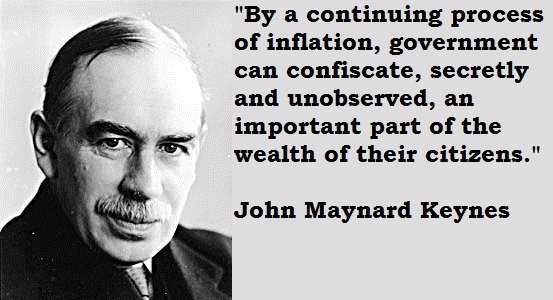
  1. Like most, I’ve had geography classes, and classes on US. Government, but I never had a “geopolitics” class per se in my formal education. Our schools are set up to teach material as discreet subjects, but our brains are not set up that way. We learn and make memories by association. Another example might be economics. The word economics conjures up thoughts of central banks, such as the Federal Reserve, changing interest rates and conducting “quantitative easing.” Those elements of economics were among the set popularized by John Maynard Keynes, and “Keynesian Economics holds sway among the vast majority of economists today.  9i7jfxdepbiuxmllhv6wxoykazrjmeynuapn20ngnu0But in a broader sense, economics is the study of human activity. This goes hand in glove with geopolitics, as does history. Come to think of it, so does psychology. What if there was a way of learning economics (and other subjects) in a way that more closely mimics the way the human brain learns? Under such a rubric, there would be far fewer barriers between what we think of as the traditional subjects. Such a field exists.  It’s called “praxeology.” In short, praxeology is the study of volitional human action, and it is a basis for the Austrian school of economic thought.  We can borrow the concept to help us understand the world without trying to become economists ourselves.

Using these three tools (skeptical news consumption, understanding how geography can enable or constrain political and economic action, and removing the artificial barriers between “subjects,” and examining human action holistically), we can better learn to Filter the Feed.

Conventional Wisdom?

36180739

By Mike Cronin

A million people can’t be wrong.  Oh, yes they can.  Look no farther than religion. There are dozens, if not hundreds in existence now, and there have been thousands throughout history.  Each believes that all the others are wrong.  They certainly can’t all be right. Don’t go there?  OK, how about: Environmentalists vs. global warming “deniers,” the medical community vs “anti-vaxers,”or “the moon landings were fake” crowd vs NASA?”   Would you believe there are still people who think the earth is flat?

If it ain’t broke, don’t fix it.  As an adage for leaving things alone that are working well enough and focusing on genuine problems, this is not bad advice.  However, when it morphs into an attitude it becomes counter-productive.  If humans all held this attitude, we’d still be sleeping in caves, picking lice off our neighbors, and dying of old age or tooth decay in our twenties and thirties.

It’s a free country.  Not as free as it’s supposed to be.  Want to open or run a business?  Get a license, or two, or ten.  Comply with state and local compensation and workmen’s comp laws. Pay estimated taxes every quarter. Want to drill a well or build an addition on your own property?  Do you have the water and mineral rights?  Got a permit? Have you thought about homeschooling your kids?  Again: do you have the right permits?  Are you following the prescribed curriculum? On and on: permits, regulations, licenses, red tape.

The police will protect me.  They don’t have to.  They have to protect society as a whole, not you as an individual. If the police had to protect all of us individually, each of us individuals would have to be a police officer.

Teachers deserve more money. The good ones do. The mediocre ones don’t.  The bad ones should be fired.  Regardless, school districts have no economically compelling reason to pay more.  It’s a simple case of supply and demand.  The overall supply of trained teachers and freshly-minted teaching candidates is roughly double the demand.

Pro athletes don’t deserve million-dollar salaries.  Then stop paying them. Once again, supply and demand is at work.  Professional-caliber athletes are exceedingly rare and highly sought-after, so they command dream-come-true salaries.  If you refuse to buy sports packages on cable, stop buying fan gear, and stop going to games, the teams will lose money and athlete salaries will drop.

We’re fighting a war on __(drugs, poverty, terrorism, obesity, etc…) No, we are not.  Wars are fought against enemies, not chemicals, circumstances, tactics, or conditions.  Generating a “war-fighting” mindset is a tactic used by people who want you to give up some of your freedom in exchange for a little more security – which they can’t really provide.

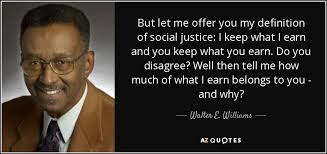
Not wanting to pay your fair share of taxes is greedy.  1. How much is a “fair share?”  Who gets to decide? 2.  If I am “greedy” solely for wanting to keep what I earn, what word applies to those who think they have even more right to take my money than I have to keep it?

I have a Constitutional right to__.  Nope.  The Constitution protects our rights by establishing a limited government; it does not grant rights.  It seems like a subtle distinction, but it is the thing that made the fledgling United States of America unique in the history of the world:  the first nation established based on the principle of limited, rights-protecting government established in the service of a free people.

Electric cars don’t emit carbon dioxide.  Not directly, but indirectly, the power plant that produced the electricity to charge the car’s batteries most likely did (unless it was nuclear)…and the industrial activity used to mine the ores and smelt the metals to make the batteries themselves sure did.

Recycling is good for the environment. Really? How much energy is saved when you have to produce double the number of plastic bins and operate twice the number of fuel-guzzling, traffic-congesting big trucks to service them? What about the recycling plant itself?

Everyone hates Congress. Then why do Congress members have such high re-election rates over time?  Apparently, we love our own Senators and Representatives and only hate the rest of Congress.

RIGOROUS RED OR BOGUS BLUE, PT III

87971b3eb353cf89fdefdd9941bb76bb

By Mike Cronin

The focus of the last two posts was on the “blue pill” as it regards our “progressive” education system.  I have written several previous posts dealing with political prescriptions for “blue pill” thinking.  The imagery and tone of those pieces and this one may lead you to assumes I am associating all things “blue pill” with liberal/Democrat/ “blue state” politics, and red pill rigor with Republican/conservative/”red state” politics.

You would only be partially right.  Our education and media elite are certainly dominated by those who would prefer a tame, conditioned electorate, but that desire is not exclusive to the panoply of progressive poohbahs.  There is no shortage of conservatives/traditionalists that would like to impose their own brand of “blue pill” virtuality upon us using the existing, Prussian-model school system.  The pill would be “branded” quite differently, of course: Teaching of creationism/intelligent design as science and mandatory recitation of the pledge of allegiance (a loyalty oath) by children too young to understand the concept of total commitment are two ways that come readily to mind.

“In our secular society, school has become the replacement for church, and like church it requires that its teachings must be taken on faith.” ― John Taylor Gatto

So what can be done?  Ultimately, a “red pill” solution would entail the separation of school and state, in the same way and for the same reasons we have separation of church and state.

Whoa! How can you say such a thing, Cronin?!  If we don’t have public education, we’ll have a bunch of uneducated kids running around that can’t think critically, getting into mischief and gangs and criminal conduct! We won’t be competitive in the global market!

How would that be different than what we have now?

Believe it or not, before the imposition of public schooling, and especially the Department of Education, the literacy rate in this country was actually higher than it is now across many demographic groups. (Admittedly, that is a tough comparison to accept. It requires that one omit slaves from the calculation, for instance, as the first public schools appeared while slavery was still legal; teaching slaves to read was often prohibited.)

I ask you: If a thing can be done privately, what business does the government have doing it?

But if we don’t have public education, won’t the private education system be just as much of a “blue pill?”

Unlikely. The key ingredients missing from education in a system monopolized by government are competition and choice. In a competitive education market, schools would have to meet their customers’ expectations or go out of business.  Good teachers would be highly sought after and well compensated.  Bad teachers could be fired. Government is force. Government performs exceedingly well where force is the required tool to solve a problem.  At best, government achieves a desultory mediocrity at everything else it does. Is force the correct tool to use to educate our children?

We are indoctrinated by a school system designed to mass-produce workers and consumers, “informed” by a mass media machine that continuously keeps us alarmed, and led by politicians whose only concern is getting elected or re-elected.  How could anything be wrong?

The Philosophy of Invincible Ignorance

ignorance3

By Mike Cronin

I once heard an anecdote about a female engineering student who spoke up in the classroom and opined that 50% of engineers should be women.  The professor requested that the student take a look at the class make up. (It was overwhelmingly male.) The professor then observed that before 50% of engineers could be women, 50% of engineering students would have to be women.

A quick web search indicates science, engineering, technology, and math (STEM) are still largely male-dominated fields of work…and college study, with engineering being extremely so – to the tune of roughly 80% male to 20% female. (There was no accounting for any “alternately gendered” engineers/students.)

I don’t know how to get more females into STEM programs, or even if gender parity in STEM is a must-do, but I do know that destroying scientific rigor is not the answer.

Apparently, that is a misogynist attitude on my part.  According to a study by Laura Parson of the University of North Dakota, STEM course syllabi (and by extension all of STEM) alienate women because of the way they are worded. Her study was undertaken through the lens of “poststructuralist feminist thought.” For those of us uninitiated in the arcana of ivory-tower academician-speak,   “Poststructuralism ‘rejects objectivity and the notions of an absolute truth and single reality.’” Ahh, now that explains a few things.

Under such a system of thought, you can do or say anything you want, because in your subjective reality you’ve decided it’s OK.  That kind of junk philosophy may be the foundation (or the excuse) for the pervasiveness of what the late William F. Buckley, Jr. called “invincible ignorance.”  Imagine a world underpinned by such mental guidance: People could do whatever they felt like and get away with it…as long as they were of the anointed class approved by the elite, who could do or say whatever they felt like in their own little realities.

I mean, under such a regime you could have a central bank pump funny money into the big investment banks and the stock market even as the rest of the government taxes the bejesus out of the people’s real earnings and accumulated wealth, and call it “economic stimulus” or “quantitative easing.” Or you could have members of the elite who think the laws don’t apply to them, or that when they are caught breaking the laws, claim they made a “mistake” and not even get charged with a crime, let alone tried or convicted. Or you could wage endless wars against conditions and actions like obesity, poverty, drugs, and terrorism instead of naming your enemies and destroying them.  Or wealth could be distributed and redistributed, instead of earned and taken. Or the Supreme Court could call the Constitution a “living document” and interpret it to mean anything they liked, vice what it actually says.

I wonder how soon it will be before travelers will have to fly in an airplane designed by an engineer who went to the “Laura Parson School of Subjective Sciences and Mathematics,” who “felt” her math was correct under her own alternative understanding of the laws of physics?


Most Illogical

download

By Mike Cronin

We are often presented with the terms “logic,” “reason,” “critical thinking,” and “common sense.” They are often touted as valuable skills or traits in our society.  But are they really so appreciated?

You are likely to find enough differing definitions of those terms to keep you busy reading for a while, but there is a common thread.

I think Ayn Rand described logic quite eloquently as the art of “non-contradictory identification,” and common sense as the “unselfconscious” use of logic. Critical thinking and reasoning have broader connotations, but generally include, or go hand-in-hand with, logic and common sense.

There are formal courses on logic and critical thinking, but it’s hit-or-miss whether you encounter them outside of philosophy electives at a college or university or at law school.  By way of one example: my own formal education has included familiarization with debate (taught as a segment of sixth-grade English), and I went to a high school that prided itself on producing critical thinkers. I’ve earned bachelor’s and master’s degrees. Yet, to my recollection, not one of those sources presented a formal course of instruction on logic or critical thinking. Why?

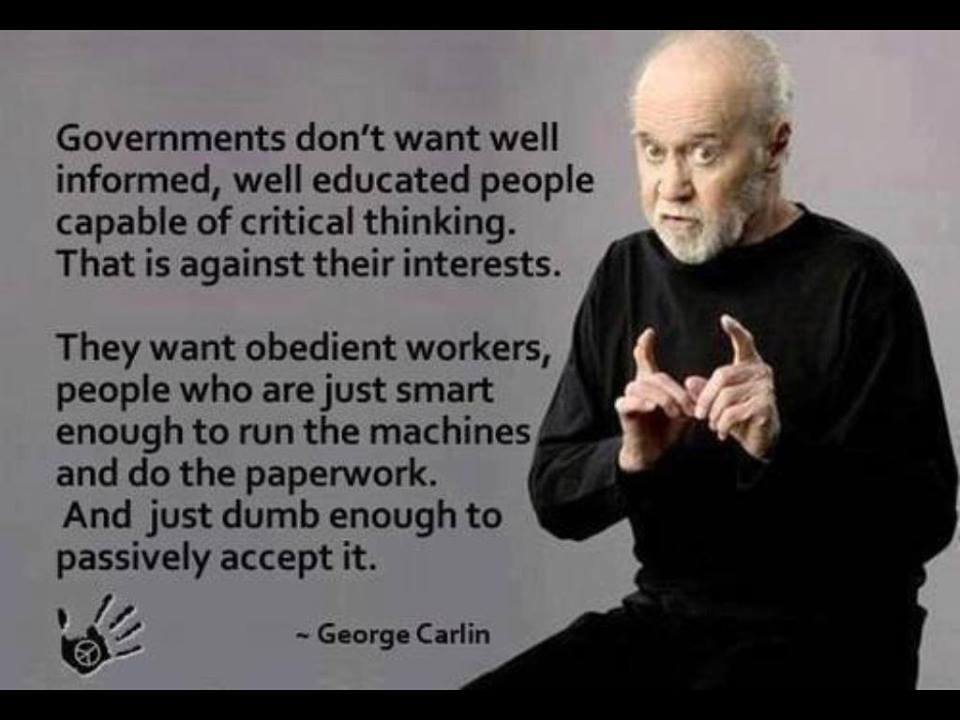
I suspect that many of you can report a similar gap in your own formal education. Could it be that our educational institutions, and the governments and/or religions that run them, don’t want to produce an abundance of critical thinkers because graduates so equipped might then apply their reasoning skills against some of the irrational curricula or insane policies emitted by learning institutions or their political and financial overlords?

Consider:  In its current guise, the Department of Education, with an annual budget in the tens of billions, was signed into existence by President Carter in 1979. It’s stated mission is to “…promote student achievement and preparation for global competitiveness by fostering educational excellence and ensuring equal access.”

Has it accomplished that mission?  It certainly “promotes” student achievement.  Cranking out a single inspirational poster can “check the box” on that mediocre and vague aspiration. It has also made progress on the “equal access” portion – you would be hard-pressed to find someone in this country who has no access to some form of publicly-funded K-12 education. But it has failed utterly at preparing students for global competitiveness!   US scores in literacy, numeracy, and problem solving skills are now near the bottom for industrialized countries.  Perhaps the mission statement of the Department of Education has little alignment to its true purpose.

Don’t think I’m being paranoid here.  No less a luminary than Woodrow Wilson, then President of Princeton University (and later to become President of the United States) revealed the elite’s view of the purpose of public education when, in 1909, he said: “We want one class of persons to have a liberal education, and we want another class of persons, a very much larger class of necessity in every society, to forgo the privilege of a liberal education and fit themselves to perform specific difficult manual tasks.” Note again that he said those words before he was elected President of the United States, so this idea did not overly detract from his elect-ability.

Nowadays, the elite’s plan seems to be to indoctrinate everyone with as much liberal education as they can absorb! Of course, the meaning of liberal has -ahem- been drifting left somewhat since Wilson illuminated the raison d’etre of public schools.

Might not the alumni of schools and universities that failed to teach courses on critical thinking or reasoning skills logically conclude they have been cheated?

It’s a Conspiracy!

Paranoid Android

By Mike Cronin

Last week I wrote about critical thinking.  This week I thought we might look at an area that is ripe for its practical application: Conspiracy theories.

Some people believe the 9/11 attacks were perpetrated by our own government in order to provide the Bush administration a pretext to go to war. Others believe the Apollo moon landings were faked.  Conspiracy theories abound: Aliens at Area 51. JFK’s murder. Chemtrails. Black helicopters. The list keeps growing.

How do we get at the truth? Sometimes we can’t. While the truth may be discoverable, the means of discovery are not always available at the time the conspiracy theory is popular, nor is discovery always worth the price to find out even if the means are available.

On the other hand, we have thinking tools to help us decide whether a given conspiracy theory is plausible. These allow us to dismiss the implausible theories.  One of these tools is called Occam’s razor.  In a nutshell, Occam’s razor says that there is seldom any need to consider complicated answers when simple ones will do.

Let’s take the case of UFOs at Area 51.  The theory generally postulates that aliens crashed on earth near Roswell, New Mexico in 1947 and the US government is holding their bodies and recovered spacecraft at Area 51.  In order to believe that, you have to accept:

  1. Out of all the possible places the aliens could visit in our galaxy, the aliens came here.
  2. The aliens have faster-than-light travel (which our science believes to be impossible) or they can hibernate for hundreds or thousands of years. Either way their technology is fantastically beyond ours.
  3. Their fantastic technological advantage both failed them utterly (because they crashed) and succeeded spectacularly (because their bodies and spaceship survived the crash roughly intact.)
  4. Out of all of the possible places they could have crashed, they wound up hitting rural New Mexico.
  5. Our government bureaucrats have been savvy enough to keep the real truth secret all of this time.

It might be possible…but the “evidence” to support the theory to date amounts to not much more than fuzzy pictures and unverifiable “eye-witness” testimony, while the holes in the theory are powerful. For example: Remember the space shuttle Columbia disaster?  If the aliens’ spacecraft made it through reentry intact, there would have been a huge crater at the impact location like the one near Winslow, Arizona:

16772

If it broke up during reentry, there would have been debris scattered for hundreds or thousands of miles along the descent path:

search_map-med

Let’s apply Occam’s razor: It is far more likely that there was never an alien spacecraft crash in 1947 or any other year. Most likely, whatever the government recovered in New Mexico in 1947 was man-made and that whatever goes on at Area 51 now is wholly human activity devoid of alien influence. Why believe that?  Because there is no evidence beyond the circumstantial that intelligent extra-terrestrials have visited earth.

Why does there always seem to be a slate of such conspiracy theories “active” at any given time?   Because conspiracy theories are fun and profitable!  There is no shortage of people who will “investigate” such mysteries and sell their findings in the form of books and special reports. There are others who make and market souvenirs. If the theory gains enough of a following, there will be entire TV shows dedicated to “solving” (i.e. perpetuating) the myth or even movies that popularize various explanations. (For example: there was a movie called Capricorn One that gave credence to the idea that the government could fake a maned Mars landing – which no doubt fueled the Apollo conspiracy). It’s all meant to keep the gravy train on track.

The conspiracy theory-industrial complex is mostly harmless when understood for what it is.  For example: Like most people, I can enjoy a sci-fi mega-flick like Independence Day or its forthcoming sequel Resurgence (which romanticize the idea of aliens at Area 51). However, for me to enjoy such movies, I have to suspend my disbelief (i.e. “ignore” my faculty for critical thinking).

On the other hand, there is a dark side to the conspiracy market. It manifests in at least two ways:

  1. There are an abundance of Americans whose education neglected to cover critical thinking. They cannot “suspend their disbelief” because they don’t have any!
  2. A viable market for conspiracy theories is also fertile ground for politicians to play upon people’s fears: “The whole aim of practical politics is to keep the populace alarmed (and hence clamorous to be led to safety) by an endless series of hobgoblins, most of them imaginary.” (H.L. Mencken)