Ten Observations on Election 2016

hillary-clinton-supporters-cry-over-election-loss

By Mike Cronin

Donald Trump’s victory certainly stirred up a lot of clamor and noise this week.  Let’s see if we can herd some of the cats:

  1. Democracy has failed. The people chose Hillary Clinton by 200,000 votes, but the electoral victory went to Trump. Our “democracy” cannot fail if we don’t have one, which is in fact the case. We were given a federalist republic under the rule of law. We use democratic processes for some decisions to give the people a voice, but we are not supposed to have a system of straight-up majority rule. As to the electoral vote: It remains to be seen whether any electors will “go rogue” and vote against their “pledge” on Dec 19th, but it has happened before (as recently as 2004).  Of course, it’s never been by enough margin to change the outcome of an election.  In this case, at least 38 would have to be “faithless electors” to get Clinton to 270.
  2. Trump hates immigrants. He hates Mexicans. He hates Muslims. He’s racist.  We’ll, he might. Only he knows for sure.  However, he is married to an immigrant and he has people from all walks of life working for him.  He certainly doesn’t think people should be here illegally, which is not the same thing as hating the people who are or the people who want to be.
  3. Trump is a misogynist sexual predator. His caught-on-camera crudities certainly lend themselves to this narrative. There’s little actual evidence and no credible accusers that demonstrate he hates all women or has assaulted any of them, but Trump’s verbal vulgarity in this area is one of the most troubling things about him. Still, while Trump has been caught speaking like a sexual predator might; Hillary Clinton continues to aid and abet one.
  4. Trump is going to destroy all of the progress progressives have made over the last eight years. Possibly, but presidents seldom accomplish their full agendas.  Yes, Trump will have a Republican-majority Congress, but it won’t be a super-majority, and the Republican establishment doesn’t like him.  Trump bills himself as a deal maker.  He’ll have to be to get his agenda anywhere.
  5. Trump is going to elevate nationalism over globalism. Both are euphemisms for collectivism; only the boundaries are different. Neither is as good for individuals as unfettered free market capitalism.  There might possibly be temporary beneficial effects for Americans in the shift, especially if our troops come home and small businesses can thrive again.
  6. Trump is an idiot/outsider/politically inexperienced. He certainly does not articulate himself with Obama’s grace, but he is no dummy. In fact, he’s likely quite adept at persuasion (see items five and six on this list). He is certainly gifted at getting free publicity (or at least notoriety) from the very mass-media that hates him. Also, his lack of political experience, i.e. his NOT being a career politician or D.C. insider, is one of the fundamentals that led him to get elected.
  7. What happened with the polls? They consistently gave Clinton the edge! Bottom line: garbage in/garbage out.  The pollsters drew their samples from the same body of “likely voters” they always used, and in some cases “oversampled” Democrats.  The former was neglectful and led to the Democrats believing in their own invulnerability; the latter was a nefarious attempt to convince would-be Trump voters to stay home on Election Day. Once exposed, the revelation likely caused the exact opposite effect. Either way, the pollsters failed to obtain accuracy because they could not, or would not, sample validly.  
  8. FBI Director Comey’s shenanigans (i.e. his announcements regarding the on-again/off-again investigation into Clinton’s email debacle vis-à-vis Huma Abedin’s laptop) comprised the quintessential October Surprise, and it hurt Clinton. It certainly didn’t help, but it’s much more likely that Clinton’s shenanigans hurt Clinton.
  9. Why were Clinton and Trump our candidates? What secret weapon did they employ that none of their competitors had? 30-plus years of universal name recognition.
  10. What does it mean that Republicans gained more seats in Congress, strengthening their majority? They didn’t get a super majority, so there are a few (rare) actions they would have to earn Democratic support for in order to act: Impeaching the president and overriding his vetoes are two such cases. 2. Republicans will get to shape the Supreme Court for the next generation. 3. Republicans now have an opportunity to reverse much of the Democrats’ work over the last eight years. Whether they will actually do so, or get complacent and/or get caught up with internal divisions remains to be seen.

Rigorous Red or Bogus Blue? Part I

0d8621c

By Mike Cronin

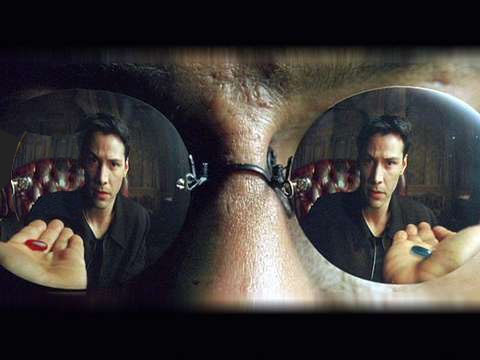
In the 1999 movie “The Matrix,” the future is presented as a dystopia where the vast majority of human beings are caged in pods that capture their body heat to energize a vast, governing machine intelligence.  In order to keep people in such a state, the machines created a virtual reality and plugged the brains of the human “batteries” directly into it – this constructed reality is the eponymous Matrix.

There are a few human rebels who escaped the machines, fighting an almost hopeless battle against them. These rebels are able to plug themselves back into the Matrix with full awareness of its virtual nature, and work to free the rare human “battery” who has begun to suspect the Matrix is not reality.  In the process of freeing such a mind, the leader of the extraction team confronts the skeptical person within the Matrix, hints at the truth, then offers the candidate two pills, one red, the other blue.  If the candidate takes the blue pill, he will remain trapped in the Matrix.  If he takes the red, he will be unplugged, rescued from his pod, and shown the true nature of reality.

There are some people today who believe we are living in a Matrix.  I don’t subscribe to that at all, but I do believe nearly all of our society’s ills can be attributed to a conflict between two philosophical meta-traditions, with schools of thought that promote collectivism & altruism on one side; and the philosophies of  individualism & reason on the other.  The traditions of collectivism & altruism have some Matrix-like qualities.

“Children who know how to think for themselves spoil the harmony of the collective society which is coming where everyone is interdependent.” ― John Dewy, hero of progressive education.

Like the machines in the Matrix, the elite of these traditions would prefer their subjects remain ignorant of the true nature of things, i.e. to take the metaphorical blue pill.  Creating critical thinkers is not a goal for the education of the masses in systems dependent on these models; nor is it a priority for the media to expose truths that contradict the narratives of the anointed elite.  But unlike the “batteries” of the Matrix, We the People are not trapped in energy-sucking pods. Metaphorical red pills can be found.

“We want one class of persons to have a liberal education, and we want another class of persons, a very much larger class of necessity in every society, to forgo the privilege of a liberal education and fit themselves to perform specific difficult manual tasks.” ― Woodrow Wilson, 28th President of the United States

Promoters and adherents of philosophies of individualism and reason are, like the rebels in the Matrix movies, very much a minority who see things much closer to the way they truly are. A thinking, reasoning mind is valued among such rebels, skeptics, and extremists, but represents a threat to the purveyors of the blue pill.

“To fill the young of the species with knowledge and awaken their intelligence… Nothing could be further from the truth. The aim… is simply to reduce as many individuals as possible to the same level, to breed and train a standardized citizenry, to put down dissent and originality. That is its aim in the United States… and that is its aim everywhere else.” – H.L. Mencken, journalist and author

The conflict between “blue” and “red” thinking has been with us since humans first started using tools to make tools – probably as far back as the invention of the wheel.  Blue thinking started with superstitions and pagan religions.  It has always had the advantage of being easier to sell and easier to believe in, so it has always flourished in some form or fashion, while red thinking has always required intellectual rigor, which meant it was not preferred by people looking for the path of least resistance. In fact, ours was the first nation to be founded on the principles of individual liberty and capitalism – i.e. The United States of America is the original red state!

Blanket Guilt or Precision-Guided Accountability?

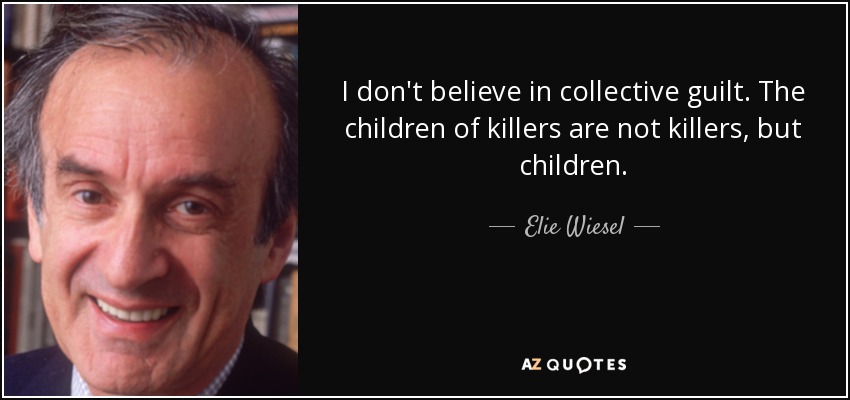
quote-i-don-t-believe-in-collective-guilt-the-children-of-killers-are-not-killers-but-children-elie-wiesel-107-25-38

By Mike Cronin

Q. What do all of the following have in common?

A. You might be tempted to answer racism or bigotry, but that doesn’t cover the last item. The correct answer is that in all of the above examples, an entire group is being held accountable for the supposed sin of an individual or individuals. It is a hallmark of collectivism.

Consider: The sniper who killed the Dallas police officers on Thursday was seeking revenge for the deaths of some black men who had been shot by some white police officers in other states.  In other words, in his mind, since some white police officers in other locations had killed black men, all white officers were racists. The sniper committed the very same crime he believed the white officers had committed:  he held a group responsible for the actions of a few, or of one.  He tried, convicted, sentenced, and shot the Dallas police officers for crimes they didn’t commit, or for the non-crime of being white.

Mr. Trump’s proposal to ban Muslims is less combative, but it still stems from a collectivist mentality: If some Muslims are coming here to do us harm, then we can reduce the potential for such acts by banning ALL Muslims from entering the country. There is certain soundness to the logic here: If no Muslims can enter, it must follow that the jihadist sub-set of Muslims can’t enter.  Nonetheless, setting aside the difficulties in enforcing such a policy, the idea goes against the principles of individual liberty: it applies a sanction to an entire group for potential crimes yet to be committed by some members of that group.

Consider:  If you take the Bible literally, then you believe God created Adam, the first human.  Adam was tempted by Eve (who was herself tempted by the serpent) to eat the forbidden fruit from the tree of knowledge.  Human souls have been tarnished by this “original sin” ever since. Put another way: Humanity is being held to account for a supposed sin we could do nothing about, because it happened thousands of years before any of our births. In essence, we have been born convicted of a crime we didn’t commit and commanded to atone for it or suffer eternal damnation.

The problem is that collectivism belongs to our infancy. Our country was founded on the principles of individual liberty and personal responsibility, but they conflict with the collectivist principles at the root of most religious doctrines, so there has been a constant duality in American culture.  For example: During World War Two, The US Government rounded up US citizens of Japanese ethnicity and “interned” them in concentration camps for the sin of merely having common ancestry with an enemy; yet after the war, our government largely did not hold the Japanese people accountable for the brutality of their vanquished rulers.  Instead, General MacArthur’s occupation forces went after the actual individuals who led the Empire.

It is all too human to project our fear, or anger, or hatred, or resentment over the sins or crimes committed by an individual onto a group, yet there is no justification for doing so. Humans have been doing this since we were stone-age primitives trying to protect our “turf” from rival clans. It takes some enlightenment to dial down our naked aggression and apply accountability with precision.  It is a thing we must learn if we are to advance as a species.

On Critical Thinking

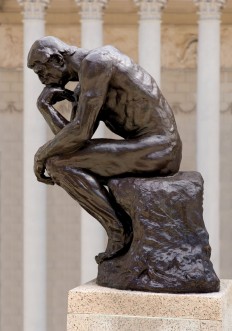
THINKER_side_columns

By Mike Cronin

A lot of people talk about critical thinking, but I seldom ever see any explanation of what critical thinking is.  Left to our own devices, we might reasonably assume that critical thinking means being critical.  That is partially right.  Certainly people who practice critical thinking are often critical of others, but that is not the essence of the term.

To me, critical thinking means examining my own thoughts on an issue for errors in logic or reasoning before verbalizing them. It means basing my positions on a foundation of rational thought. It means recognizing bias, especially my own.

I’ve written before about bias.  When you read a news article or watch a news piece, the reporters and networks pretend they have no bias, but that is absurd.  Everyone has a bias – it is inevitable, because even the wisest among us cannot see things from every and all perspectives.  The difference between my blog and some others is that I tell you right up front what my bias is.  I am pro-freedom, pro-capitalism, pro-individualism, and pro-reason.  I am against socialism and any other form of collectivism. My biases are not a result of my upbringing.  If anything, my biases are in opposition to the trends and positions espoused to me in school, church, and to some degree, the military.

Logic is another key ingredient of critical thinking.  Ayn Rand described logic as the art of correct identification.  That sounds simple, but it has deep consequences.  It is easy for a child to recognize a lemon as a lemon, but it might be a bit harder for the child to understand that the lemon can never be anything other a lemon.  It can only do or behave as a lemon.  A person might squeeze it to get the juice, or grate it to get the pith, but a lemon cannot become a bird and fly away.

Wishful thinking and other logical errors are the source of much conflict and dysfunction in the world. An example:  The current brouhaha over gender identity.  We are either born with male anatomy or female anatomy (occasions of true androgyny are exceedingly rare). “Identifying” as the opposite gender from what one’s anatomy dictates (no pun intended) is logically erroneous.  One might align their conflicted desires to reality via surgery and drugs, but until those procedures are complete, one is “male” or “female” according to one’s anatomy.

At the heart of many arguments and conflicts over logic are premises.  There is no shortage of pundits, educators, and other influential people that use well-crafted logical arguments that stem from bad premises.  Take “equality” for example.  We might hear that the difference between conservatives and liberals is that conservatives want people to be treated as equal under the law, while liberals want everyone to have equal outcomes.  The first premise rests on the idea that no one is more valuable as a human being than anyone else.  It creates the conditions whereby a poor person can raise themselves up from poverty on their own hard work and merit. It is essentially correct, but hard to enforce, because the rich and well connected can sometimes buy better legal representation than the poor. The second premise rests on the idea that it’s not fair for one person to have more than another, so wealth must be redistributed.  It gives no attention to the concepts that wealth belongs to whomever created it, or that individuals have any responsibility for their own situation.  It is a bad premise, because it ignores the fact that life is not and cannot be fair, and it ignores all of the evidence of human history:  Humans cannot rise above animalism without individual effort to devise technology or apply the technology to raising the standard of living.

Are you a critical thinker?

Discrimination: Weasel Word?

dis1

By Mike Cronin

Why is it that advertisements for luxury goods often appeal to those with “discriminating tastes,” yet it is widely regarded as wrong to discriminate against people on the basis of their genetic makeup, physical abilities, or group affiliations? How can it be good to discriminate in one instance, but not the other? I submit it is because the word discrimination has two opposing meanings; one of which is weasel-ease.

Dictionary.com gives four definitions for discrimination.  The first two seem to be almost completely contradictory to each other. The first, i.e. “an act or instance of discriminating, or of making a distinction,” alludes to judgment. It is the meaning that applies in the case of advertisers appealing to the supposed keen discernment of well-heeled consumers.  The second definition, “treatment or consideration of, or making a distinction in favor of or against, a person or thing based on the group, class, or category to which that person or thing belongs rather than on individual merit…” is the kind of discrimination that gets folks into legal and moral trouble.

Here’s the rub: a person who takes such action for or against another solely on account of race, creed, gender, etc., is actually indiscriminately applying their prejudices or stereotypes against their victims. They are in fact failing to discriminate based on individual merit. That’s the exact opposite of the primary definition of discrimination, and it is the essence of collectivism. “Discrimination” has entered the weasel lexicon.