A Crazy Idea

bright-idea-different-individual-group-society-community

By Mike Cronin

In the 1600s, pilgrims came to this land to escape religious persecution. Other colonists soon followed. In the late 1700s, the thriving 13 colonies decided to throw off the yoke of their far-off ruler. In the 1860s, we fought a war over slavery.  (Some will tell you the war was about state’s rights, but the “rights” being fought over were the right to secede from the Union in order to continue the practice of slavery.) About a half-century later, women won the right to vote. Nearly another half century after that, we had the civil rights and equal rights movements.  At some point, other groups saw that these early movements were largely successful in gaining for their members the recognition that they deserved the same rights as anyone else. But then new groups started seeking privileges disguised as rights.

For instance: the gay marriage movement.  This movement sought (and is still seeking) the privilege for one person to be able to marry another person of the same gender. The movement postulates that since heterosexuals have a “right” to marry, homosexuals deserve no less. Advocates of this arrangement are right that homosexuals ought to have the same rights as heterosexuals; but they err by seeking parity with heterosexuals in being permitted to marry by the government. If marriage (or domestic partnership), or any other kind of association is indeed a right, then the movement should be demanding the elimination of government intrusion (except for the function of contract enforcement) in the domestic arrangements of competent, consenting adults. (Freedom-loving heterosexuals ought to consider advocating for the same thing!)

Now we live in a time with a constantly-increasing number of movements and causes seeking special privileges for smaller and smaller groups of people.  The latest examples: Trans-gendered folks seeking the “right” to use whichever public restrooms are appropriate to the gender they “identify” with.  College kids demanding “safe spaces” where they can be free from challenging ideas espoused by disagreeable people. Illegal immigrants demanding in-state tuition rates and voting rights. Minimum-skilled fast-food workers demanding higher pay than junior military members (who have months of technical training) make. Able-bodied yet jobless people demanding food stamps.

Before you know it, every single individual in this country will get the crazy idea that they deserve equal rights for themselves.  Some will demand free speech, others will want to own a gun, and many would like to have the right to be free from unreasonable search and seizure.  Some might even want to be free to associate with whomever they’d like.

Folks might get the fantastical notion that a genuine individual right cannot require or obligate anything of anyone else other than that we leave each other alone and honor our voluntary commitments.

Some thought leaders and other prominent people might even get together and decide to craft a document that would enshrine these ideas.  They might imagine that the best way to organize a government would be around the concept that its sole purpose is to protect the rights of free individuals, and that such freedom is the best way yet devised by humans to deliver the greatest good to the greatest number.

I wonder what it would take to produce such a document and put it into force. Could such a society ever flourish? What would we call such a place?

 

A Matter of Perspective

XocKd

By Mike Cronin

No doubt you know that the sun rises in the east and sets in the west once every 24 hours.  It has done so for billions of years and will continue to do so for billions more.

Fact: The sun rises and sets about 16 times per day.

Fact: The sun rises and sets once every two weeks.

Fact: The sun doesn’t rise or set at all.

All of these facts are true.  How can that be?

Each is true from a certain perspective – and false from other perspectives.  The first is true from the perspective of people on the earth’s surface.  The second is true from the perspective of an astronaut onboard the International Space Station.  The third is true from the perspective of an astronaut on the surface of the moon.  The last is true from the perspective of the sun itself.

Perhaps you’ve heard it said that in so-and-so’s world, XYZ is quite different than in your world. Maybe you were taught to think of Western Europe, the US, the British Commonwealth, and Japan as the “first” world, and places like Haiti, Somalia, and Afghanistan as examples of the “third” world. Yet we all live on the same planet, so how can we be living in different worlds?

The first, second, and third worlds aren’t really separate worlds; they just appear that way from certain perspectives.  Sometimes using such metaphors can be useful in helping us frame our understanding of the actual world; sometimes the metaphors become euphemisms and are used to evade harsh truths.

For example: Haiti is the poorest, least-developed country in the western hemisphere.  It occupies part of an island called Hispaniola; the remainder of the island is taken up by the Dominican Republic. Compared to Haiti, the Dominican Republic is doing well. Some folks who call Haiti a failed state and a third-world country may be setting a scene or weaving a narrative (i.e. depicting things from a certain perspective) in order to ask you for donations to help the poor souls that live there.

Such people may mean well, but the solution to Haiti’s troubles probably depends on understanding things from a more difficult perspective.

Consider this: The 2010 earthquake that struck Port-au-Prince (Haiti’s capital) was followed less than a month later by an even more powerful earthquake in Chile.  Both earthquakes caused about the same amount of destruction in terms of the value of the property destroyed, yet the death tolls were staggeringly different.  In the Haiti quake, nearly a quarter of a million people lost their lives.  In the Chilean quake, the death toll was three orders of magnitude smaller. (A little over 500 people died).

Why was there such a vast difference between the two? How can a more powerful earthquake cause far less loss of life, but the same amount of property damage?

In Chile, there are building codes, insurance, robust first response capabilities, adequate hospitals, and property rights. In Haiti there are not. The property damage was the same from the perspective of cost, but vastly different from the perspective of number of buildings destroyed.  In Haiti, a good portion of the buildings in Port-au-Prince collapsed outright, including the president’s palace.  In Chile, many buildings suffered damage that will be expensive to fix…but far fewer buildings actually collapsed – because most were built to code to withstand earthquakes.

haiti palace

The Haitian presidential palace after the 2010 earthquake.

Why did Chile have those benefits and not Haiti?  Because for most of its history, Chile has given at least some recognition to the concept of individual and property rights.  Chileans had incentive to achieve and build and protect their investment.  Haiti, though its existence as a nation is essentially the result of a slave rebellion, never really adopted the concepts of individual freedom or property rights.  It has been ruled by a series of thugs, some worse than others, who would simply take what they wanted.

The harsh truth in the more difficult perspective: Sending aid to Haiti may help some Haitians stave off the reaper a little longer, but no amount of aid can help the Haitians adopt a philosophy of recognizing and respecting rights.

Understanding that a difference in perspective can be trivial (as in the case of knowing astronauts see 16 sunrises per “day”) or pivotal (as in the case of sending aid to Haiti), and how differing perspectives might be compared or judged against each other, is a critical skill to develop – one many of our elected leaders have failed to acquire.

Are You Principled or Ruled?

By Mike Cronin

“If you want to be ruled, follow the rules. If you want to be principled, follow principles.”  I don’t know who said those words, but they are profound.  An admired man or woman is often said to be “of principle.”  If you think about heroes, famous statesmen, positive historical figures, leading thinkers, or other notable people, you will seldom, if ever, find that such figures are admired for following the rules.  So what is the difference, and why is one better than the other?

A rule dictates from external authority; a principle guides from reason.  Rules demand: You must (or must not) take such and such an action, or possess some item, or allow some condition. The primary consideration of the rule-follower is for first-order effects only:  to avoid suffering the imposed consequences for disobedience.  Rules often fail to allow for context or circumstances.  Indeed, governments often thoughtlessly pile up so many rules that it becomes impossible to know or follow them all. It’s even likely that as rules multiply, we will be simultaneously  obligated and prohibited from doing some action!

Principles consider second- and thirdorder effects:  “If I do ___, then someone else’s rights might be violated.  If I allow some condition, someone else might be harmed. I don’t want my own rights violated or to be harmed by poor conditions, so I will not perpetuate those things myself.” The deeper consideration of the principled person is for the maintenance of civilized society and the consequences to his or her own integrity and character for a given act or omission. Principles can be adapted to circumstances, and they are not produced by dictators, monarchs, presidents, or legislatures.

By no means does this suggest one should disobey rules on a whim.  Some rules exist for a legitimate purpose – indeed, they are based on constructive principles.  For example: laws that prohibit the initiation of force against others generally derive from a just principle, and ought to be obeyed, whereas laws that demand the initiation of force against others are probably unjust.

Obeying rules set by others doesn’t take any thought.  Deriving your own principles or incorporating principles learned from others into your life requires some deeper consideration for the consequences of your actions (or lack of same). Adhering to principles require the exercise of judgement. Adhering to principles sometimes means proudly accepting the consequences of breaking the rules – Dr. Martin Luther King exemplified this during his civil rights movement in the 1960s.

Consider this: Some Germans who followed the rules obeyed their masters and slaughtered six million Jews during the Nazi reign. Some British colonists who followed principles disobeyed the rules, rebelled against their ruler, and gave birth to the United States.

Do you want to give up your heritage as a human being and revert to animal status?  Be an obedient, unthinking rule follower.  If you want to perpetuate civilization, think for yourself – especially about the ramifications of your actions (or omissions). Adopt or derive the best principles you can, then live by them!

Socialism Seems Free, but You WILL Pay for it!

By Mike Cronin

No doubt you’ve heard the word socialism being bandied about a lot lately. Democratic presidential candidate Bernie Sanders is an avowed socialist. A recent poll shows that 36% of millenials favor socialism.  And whys shouldn’t they? Free education!  Free healthcare!  Subsidized housing, food, & utilities! Socialism sounds really good. But it isn’t.

It might help if we have a common understanding of what socialism really is.

Simply, socialism is a political/economic theory where all property is owned “by the people.” What could be better than a place where all property is shared and nothing is owned?  That’s the theory.  In practice, It results in the state asserting primacy in all aspects of life and individuals having few, if any, rights. It is a form of collectivism – which means the group, or collective, is prioritized over the individual. Bee hives, ant colonies, and human “communes” are collectives. Under any form of collectivism, the majority can do away with the rights (and often lives) of the minority (of which the individual is the most basic element).

Collectivism/socialism comes in various forms, such as communism, which the Union of Soviet SOCIALIST Republics (USSR) subscribed to, and “Nationalsozialismus” (the German term for National SOCIALISM, from which the term “Nazi” is derived).  Some might argue that the Nazis were in fact fascist, not socialist.  Fascism was also the system of socialism that Mussolini oversaw in Italy. (The term fascism derives from the Latin term “fasces,” a bundle of sticks with an axe protruding from it. Fasces was the Roman symbol of power.)

Some political scientists argue that communism is on the political left, while fascism is on the right, as depicted in this graphic:

I argue that the only practical difference between communist variety of socialism practiced in Soviet Russia and the fascist-flavored socialism animating Nazi Germany and Italy was that the fascists gave lip service to the idea of private property rights – as long as the property was used at the direction of the state.   There were no private property rights at all in the Soviet Union.

Whether people have no property rights at all, or have the “right” to own property in service to the state, is a distinction without a difference. Both systems had charismatic, murderous dictators in charge. Both systems had secret police, concentration camps, and mass murders. Both systems failed to create wealth; they could only steal it or destroy it. There was no freedom in either system.

Thus, a more accurate depiction of communism and fascism on the right-left political model would be to put them both on the left under socialism, with freedom and capitalism on the right.  The diagram below is closer to the truth:

Consider that every country that has adopted any form of socialism has been degraded or destroyed in direct proportion to the degree of socialism it enacted. Nazi Germany. The Soviet Union. North Korea. Cuba. Venezuela.

China and Vietnam were once in the same boat, but both have attained some limited reversal from the crushing oppression the others experienced through adoption of limited free-market economic reforms. But make no mistake, the Chinese and Vietnamese people are not free.

Consider Karl Marx’s famous aphorism: “From each, according to his ability; to each according to his needs.” It sound so wonderful, but it glosses over the essential question: Who decides what your gifts and needs are? (Newsflash – it sure isn’t going to be you!) “From each, according to his ability” means that the state will extract every bit of use out of you that it can, and your desires are irrelevant.  “To each, according to his needs” means that the state, not you, will determine what you need, and you will be lucky to get it.

So how bad is socialism?  At it’s best, socialism creates resentment and dependency; at its worst the people living under socialist governments are slaves – the ones who survived mass murder.


When Everything is a Crisis, Nothing is a Crisis

248769_318723208232720_678404428_n

By Mike Cronin

Dear politicians, intellectuals, pressure-group leaders, and media mouths,

All day every day you bombard us with crisis after crisis. Drugs. Guns. War. Climate. Celebrity drama. International tensions. Rape culture. Income inequality. Racism. Sexism. Immigration. Political correctness. The list goes on ad-nauseam. Most are real issues that need reasoned efforts to solve or mitigate, but you spin them into crises, then you anoint yourselves as experts and saviors that can save us – if only we turn over our rights, our money, or our reason (or all three!) to you.

We understand that at some level you have to market and advertise your issue, your ideals, your narrative.  On the other hand, you need to understand that at some point we will succumb to crisis fatigue and stop caring about your cherry-picked and manicured emergencies.  We will become apathetic.  Most of you don’t want that; you want your pet cause to be solved or cured. But some of you do want an apathetic populace.  An apathetic populace is ripe for manipulation by a charismatic tyrant.

If you are one of the public figures I opened this letter to, and you genuinely want your problem solved, dial down the urgency settings on your rhetoric or you will defeat yourself!

If you are a tyrant in waiting:  know that your tactic is exposed.  You are not fooling anyone.

That is all.

Weasel Words: Constitutional Rights

civil rights_header

By Mike Cronin

Have you noticed that the weasels telling us we have “rights” to a job, or an education, or healthcare – all things that can only be given to some at the expense of others, are quite often the same people that are trying to eliminate our inalienable rights? (You know – the rights the Founders tried to protect with the Declaration of Independence, the Constitution, and the Bill of Rights?  The ones that don’t depend on taking time, money, or goods away from anyone?)

Consider: If you have a right to a job, then an employer is compelled by law to give some of his property, namely the position, to you. If you have a right to an education, the government has to first take money from your friends and neighbors to pay for it.  If you have a right to healthcare, then you have a license to demand time and effort from doctors, nurses, technicians, and pharmacists, and a warrant to seize medicines or medical equipment away from those who made them. If you have a right to not be offended, then you have the power to muzzle the free expression of others.

On the other hand, the rights the founders designed our government to protect do not require us to take away anything from our neighbors; they simply require that we leave each other alone.  They don’t preclude us helping others voluntarily; the don’t preclude private entities from influencing our charitable behavior; but they do not permit the government to use its coercive power to dictate whether or how our neighbors’ “generosity” is to be extracted and distributed.

When the weasels take from the most productive in order to give it to the least productive in the name of benevolence, the result is not universal prosperity, it is universal resentment.  The productive resent having the fruit of their labor confiscated (via income tax withholding, for example), and the recipients resent the productive for being able to “make it.”  Nobody prospers except the politicians, cronies, and bureaucrats doing the taking.

The weasels will use every rhetorical trick to convince us that we have Constitutional rights to this, that, or the other thing.  There is no such thing as a Constitutional right, because the Constitution doesn’t grant us our rights.  The Constitution isn’t the law we are supposed to obey; it’s the law the government is supposed to obey.  It doesn’t give us our rights; its purpose is to protect our rights from the government!

Are You Guilty of Enjoying White Privilege?

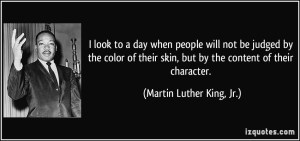
quote-i-look-to-a-day-when-people-will-not-be-judged-by-the-color-of-their-skin-but-by-the-content-of-martin-luther-king-jr-102475

By Mike Cronin

On the occasion of Martin Luther King, Jr. Day, I find myself recalling a class on multiculturalism in my MA program. During the class, one of the topics was “white privilege.”  The essence of white privilege is that being born white, especially as a male, comes with certain privileges that members of other demographic groups don’t get.  The course hinted that white men could and should feel guilty about this privilege, and that they should take unspecified actions to atone for this guilt. 

I had very mixed feelings about this. I acknowledge that, as a white American male, compared to most people in the US and the world, I have a relatively benign position in life. I even accept that due to the accident of my birth, I began life with more advantages than most. If life is a game, then I acknowledge that I started on the easiest setting.  What I could not, (and still cannot) accept, is that I should feel guilty about it.  Guilt implies wrongdoing, and wrongdoing implies a choice between right and wrong. Infants have no understanding of right and wrong, and have not developed the mental faculties to make conscious choices. I cannot be guilty of being a white male, because it is not wrong, and because I had no choice in the matter. 

That means I have nothing to atone for. On the other hand, knowing that just about every other demographic may be “playing life” on a more difficult setting than I am requires that I ask: As an adult with the ability to understand right and wrong and to make conscious choices, what should I do, if anything, about “white privilege?”  I cannot undo history, nor can I change  anyone’s heritage.  I could give money to various causes, but that would have mixed results at best. 

The answer that I arrived at: Context matters.  While, as whole, white males may get the best “starting position” of any group, all groups are made of individuals, and individual circumstances vary. Some white males had it worse than I did, and some had it better. Likewise, while as a group, Asians, blacks, Hispanics, women, or others might not have had as good a starting position as white men, there are individuals in each cohort that started life out in an even better position than I did. In other words, the answer to “white privilege” is not to feel guilty and attempt to atone for something outside of one’s control, but rather to see and interact with every person as an individual, not as a representative of a demographic group (race, ethnicity, gender, etc.). The best thing anyone can do to create a level playing field is not to dole out compensatory advantages to some members of this or that “underprivileged” group, but simply to not hate or act against others because of their differences – to not purposely be bigoted, prejudiced, misogynistic, homophobic, racist, etc. Instead, respect individuals, and be a proponent of individual rights. Since the smallest possible minority is an individual, individual rights ARE minority rights.