Not so Random Matter?

hqdefault

By Mike Cronin

I started out thinking I had several disparate items for this week’s post, but they all seemed to tie together:

It’s science-project season at my son’s school.  He brought home an information/instruction packet.  He had to get a parent to sign the first page – which is a letter to parents explaining that the kid has to do the science work on his own, but parents can help with the non-process portions of the project (e.g. helping the kid get materials) etc., etc. On the reverse of the first page is a progress tracker.  The kid has to get his parents to sign each time he hits a milestone on the project.  My son got dinged on the first milestone because I didn’t sign it.   The first milestone is to have a parent sign the letter to parents.  Yes, that’s right: The purveyors of the science project’s hand-out material failed to notice they are requiring a parent sign the back of a form in order to certify that the parent signed the front of the form…and they make the kid take the hit if the parent doesn’t jump through the hoop.  On a science project. You know, Science?  The subject where they teach kids logic, critical thinking, precision, peer review, attention to detail, right? Little things like that.

Speaking of science, I work in a small office with five other people. All five are scientists and/or engineers. Our office serves as a kind of internal think-tank. We do quantitative and qualitative analysis, among other things. I am the only one in the office who does not have a degree in science, technology, engineering, or math (STEM).  My colleagues can run rings around me on any kind of math-based reasoning or problems.  On the other hand, I usually get the better of them when it comes to verbal expression.  I like to tease them that they are all experts at qualitative reasoning, while I am the quality. At any rate, our work sometimes involves (mathematical) models and simulations. Someone in the field once quipped that “all models are wrong, but some models are useful.”

Given the public’s current fascination with the phenomena of “fake news,” I think an adaptation of the “models” aphorism is apropos as a guidepost for judging the efficacy of anything in the media: “All news is fake, but some news is useful.” Two cases in point:

Some right-wing media sources are reporting that Christiana Figueres, Executive Secretary of U.N.’s Framework Convention on Climate Change, as much as revealed that the UN’s plans to combat climate change are really a set of blinders to hide the real agenda: the destruction of capitalism. While the UN is no friend of capitalism, context matters, as does the thing that is not being said.  Figueres undeniably advocates for the alteration of the global economy when she says:

“This is the first time in the history of mankind that we are setting ourselves the task of intentionally, within a defined period of time, to change the economic development model that has been reigning for at least 150 years, since the Industrial Revolution,”

Note that she stops short of stating that the current global economic development model that must be changed is capitalism (it isn’t, by the way – it’s a mix of capitalism and controls), or describing what model should obtain.  I would not be surprised to learn that Figueres is indeed anti-capitalist, nor would I be surprised to learn that UN efforts to combat global warming are indeed a smokescreen to hide the destruction of capitalism, but Figueres’s statements fall short of being a smoking gun – more like an eyebrow-raiser. The subject bears watching.

Meanwhile, on the left side of the fake news spectrum, we have the New York Times’ headlines for Friday’s attack at the Louvre in Paris by a “lone wolf” Islamic jihadist. Their first headline read: “Louvre Museum Evacuated after French Soldier Opens Fire.” At best, this headline leads you to believe the incident revolved around the actions of a French soldier. At worst, it leads you to believe a French soldier went nuts and started shooting up the Louvre.  A few hours later, the headline had changed to read: “Assailant Near Louvre Is Shot by French Soldier” Again, the French soldier’s actions seem to be the focus.  As mentioned previously, context matters, and what is not being said matters. What the vaunted New York Times neglected, or purposely refused to highlight in their headlines, was that a man shouting “allahu ackbar!” (i.e. “God is great” in Arabic) and wielding knives attacked some French soldiers and was shot by one of them in response.

It would not do to depart from The Narrative by highlighting yet another attack by a Muslim against Western targets, even as the militant arm of the “tolerant” left is convulsing over President Trumps’ recent “anti-Muslim” immigration restrictions, now would it? Instead, the “Newspaper of Record” felt it must mislead readers with deceptive headlines. I’m not suggesting the Times should have gone with “Islamo-Fascist Nut-Job Takes Knives to a Gun Fight in Paris; Wins Darwin Award Nomination,” but something like “Assailant Shouting in Arabic Shot by Soldier At Louvre” might have hit the right balance between not jumping to conclusions about the attacker’s religion, intentions, and connections, and the response of the soldiers.  All news is fake, some news is useful.

The Philosophy of Invincible Ignorance

ignorance3

By Mike Cronin

I once heard an anecdote about a female engineering student who spoke up in the classroom and opined that 50% of engineers should be women.  The professor requested that the student take a look at the class make up. (It was overwhelmingly male.) The professor then observed that before 50% of engineers could be women, 50% of engineering students would have to be women.

A quick web search indicates science, engineering, technology, and math (STEM) are still largely male-dominated fields of work…and college study, with engineering being extremely so – to the tune of roughly 80% male to 20% female. (There was no accounting for any “alternately gendered” engineers/students.)

I don’t know how to get more females into STEM programs, or even if gender parity in STEM is a must-do, but I do know that destroying scientific rigor is not the answer.

Apparently, that is a misogynist attitude on my part.  According to a study by Laura Parson of the University of North Dakota, STEM course syllabi (and by extension all of STEM) alienate women because of the way they are worded. Her study was undertaken through the lens of “poststructuralist feminist thought.” For those of us uninitiated in the arcana of ivory-tower academician-speak,   “Poststructuralism ‘rejects objectivity and the notions of an absolute truth and single reality.’” Ahh, now that explains a few things.

Under such a system of thought, you can do or say anything you want, because in your subjective reality you’ve decided it’s OK.  That kind of junk philosophy may be the foundation (or the excuse) for the pervasiveness of what the late William F. Buckley, Jr. called “invincible ignorance.”  Imagine a world underpinned by such mental guidance: People could do whatever they felt like and get away with it…as long as they were of the anointed class approved by the elite, who could do or say whatever they felt like in their own little realities.

I mean, under such a regime you could have a central bank pump funny money into the big investment banks and the stock market even as the rest of the government taxes the bejesus out of the people’s real earnings and accumulated wealth, and call it “economic stimulus” or “quantitative easing.” Or you could have members of the elite who think the laws don’t apply to them, or that when they are caught breaking the laws, claim they made a “mistake” and not even get charged with a crime, let alone tried or convicted. Or you could wage endless wars against conditions and actions like obesity, poverty, drugs, and terrorism instead of naming your enemies and destroying them.  Or wealth could be distributed and redistributed, instead of earned and taken. Or the Supreme Court could call the Constitution a “living document” and interpret it to mean anything they liked, vice what it actually says.

I wonder how soon it will be before travelers will have to fly in an airplane designed by an engineer who went to the “Laura Parson School of Subjective Sciences and Mathematics,” who “felt” her math was correct under her own alternative understanding of the laws of physics?


Most Illogical

download

By Mike Cronin

We are often presented with the terms “logic,” “reason,” “critical thinking,” and “common sense.” They are often touted as valuable skills or traits in our society.  But are they really so appreciated?

You are likely to find enough differing definitions of those terms to keep you busy reading for a while, but there is a common thread.

I think Ayn Rand described logic quite eloquently as the art of “non-contradictory identification,” and common sense as the “unselfconscious” use of logic. Critical thinking and reasoning have broader connotations, but generally include, or go hand-in-hand with, logic and common sense.

There are formal courses on logic and critical thinking, but it’s hit-or-miss whether you encounter them outside of philosophy electives at a college or university or at law school.  By way of one example: my own formal education has included familiarization with debate (taught as a segment of sixth-grade English), and I went to a high school that prided itself on producing critical thinkers. I’ve earned bachelor’s and master’s degrees. Yet, to my recollection, not one of those sources presented a formal course of instruction on logic or critical thinking. Why?

I suspect that many of you can report a similar gap in your own formal education. Could it be that our educational institutions, and the governments and/or religions that run them, don’t want to produce an abundance of critical thinkers because graduates so equipped might then apply their reasoning skills against some of the irrational curricula or insane policies emitted by learning institutions or their political and financial overlords?

Consider:  In its current guise, the Department of Education, with an annual budget in the tens of billions, was signed into existence by President Carter in 1979. It’s stated mission is to “…promote student achievement and preparation for global competitiveness by fostering educational excellence and ensuring equal access.”

Has it accomplished that mission?  It certainly “promotes” student achievement.  Cranking out a single inspirational poster can “check the box” on that mediocre and vague aspiration. It has also made progress on the “equal access” portion – you would be hard-pressed to find someone in this country who has no access to some form of publicly-funded K-12 education. But it has failed utterly at preparing students for global competitiveness!   US scores in literacy, numeracy, and problem solving skills are now near the bottom for industrialized countries.  Perhaps the mission statement of the Department of Education has little alignment to its true purpose.

Don’t think I’m being paranoid here.  No less a luminary than Woodrow Wilson, then President of Princeton University (and later to become President of the United States) revealed the elite’s view of the purpose of public education when, in 1909, he said: “We want one class of persons to have a liberal education, and we want another class of persons, a very much larger class of necessity in every society, to forgo the privilege of a liberal education and fit themselves to perform specific difficult manual tasks.” Note again that he said those words before he was elected President of the United States, so this idea did not overly detract from his elect-ability.

Nowadays, the elite’s plan seems to be to indoctrinate everyone with as much liberal education as they can absorb! Of course, the meaning of liberal has -ahem- been drifting left somewhat since Wilson illuminated the raison d’etre of public schools.

Might not the alumni of schools and universities that failed to teach courses on critical thinking or reasoning skills logically conclude they have been cheated?

Blanket Guilt or Precision-Guided Accountability?

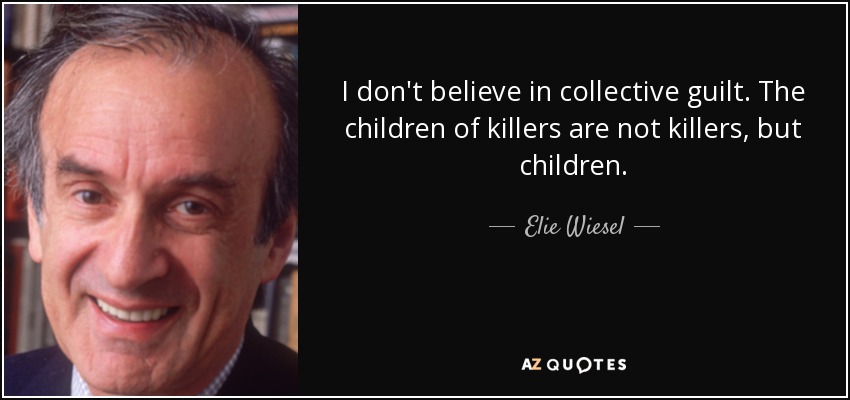
quote-i-don-t-believe-in-collective-guilt-the-children-of-killers-are-not-killers-but-children-elie-wiesel-107-25-38

By Mike Cronin

Q. What do all of the following have in common?

A. You might be tempted to answer racism or bigotry, but that doesn’t cover the last item. The correct answer is that in all of the above examples, an entire group is being held accountable for the supposed sin of an individual or individuals. It is a hallmark of collectivism.

Consider: The sniper who killed the Dallas police officers on Thursday was seeking revenge for the deaths of some black men who had been shot by some white police officers in other states.  In other words, in his mind, since some white police officers in other locations had killed black men, all white officers were racists. The sniper committed the very same crime he believed the white officers had committed:  he held a group responsible for the actions of a few, or of one.  He tried, convicted, sentenced, and shot the Dallas police officers for crimes they didn’t commit, or for the non-crime of being white.

Mr. Trump’s proposal to ban Muslims is less combative, but it still stems from a collectivist mentality: If some Muslims are coming here to do us harm, then we can reduce the potential for such acts by banning ALL Muslims from entering the country. There is certain soundness to the logic here: If no Muslims can enter, it must follow that the jihadist sub-set of Muslims can’t enter.  Nonetheless, setting aside the difficulties in enforcing such a policy, the idea goes against the principles of individual liberty: it applies a sanction to an entire group for potential crimes yet to be committed by some members of that group.

Consider:  If you take the Bible literally, then you believe God created Adam, the first human.  Adam was tempted by Eve (who was herself tempted by the serpent) to eat the forbidden fruit from the tree of knowledge.  Human souls have been tarnished by this “original sin” ever since. Put another way: Humanity is being held to account for a supposed sin we could do nothing about, because it happened thousands of years before any of our births. In essence, we have been born convicted of a crime we didn’t commit and commanded to atone for it or suffer eternal damnation.

The problem is that collectivism belongs to our infancy. Our country was founded on the principles of individual liberty and personal responsibility, but they conflict with the collectivist principles at the root of most religious doctrines, so there has been a constant duality in American culture.  For example: During World War Two, The US Government rounded up US citizens of Japanese ethnicity and “interned” them in concentration camps for the sin of merely having common ancestry with an enemy; yet after the war, our government largely did not hold the Japanese people accountable for the brutality of their vanquished rulers.  Instead, General MacArthur’s occupation forces went after the actual individuals who led the Empire.

It is all too human to project our fear, or anger, or hatred, or resentment over the sins or crimes committed by an individual onto a group, yet there is no justification for doing so. Humans have been doing this since we were stone-age primitives trying to protect our “turf” from rival clans. It takes some enlightenment to dial down our naked aggression and apply accountability with precision.  It is a thing we must learn if we are to advance as a species.

An Open (and Polite) Letter to the Gun Control Faction

8bebecd597872e534de0571c151cfe92

By Mike Cronin

Here’s my take on the bitter firearms dispute vitiating our country. I offer my commentary without vitriol. No contempt. No condescension. No name-calling, baiting, or inflammatory rhetoric; just exposition.

Obviously, we have a fundamental philosophical difference.  I don’t know, but I suspect that your apprehension over firearms is energized by a belief that it is the government’s responsibility to protect the citizenry from harm, and that you see firearms in private hands as a huge threat, especially given horrific mass shootings.  Ergo, the government should further regulate firearms or ban them outright. If I am articulating it wrong, please correct me.

I can’t speak for every pro-gun rights person, but I suspect most of us subscribe to a quite different interpretation of the government’s duty to protect us than you do.  I see it like this:  All of us have the inherent right to defend ourselves from immediate violence.  It would be nice if there were always a police officer around to intercede on our behalf, but that’s just not feasible, so we compromise.  We retain the ultimate individual right to self-defense, but we delegate the right to retaliate after the fact (via impartial criminal prosecution and punishment) to government.

So far, you may not see a large gulf between our positions.  Yet there is a significant one:  It is my position that the right to self-defense is absolute.  By that I mean that I have the right to defend myself from ANY initiation of violence (or the imminent threat of same) from ANY initiator – up to and including government agents, should they act in the absence of due process or turn overtly tyrannical.  A shotgun or revolver is hardly proportional to such a threat. Since our own government, should it turn tyrannical, and the forces of other governments, should they unwisely choose to invade this country, possess weapon systems of devastating destructive power, it is more than reasonable for a free individual to possess mere firearms to stand in opposition, even if such opposition must take the form of a covert insurgency. It is reasonable that a free person possess firearms identically lethal to those his oppressors routinely bear.

Does that mean I think private individuals should be able to go down to “Booms-R-Us” and buy guided missiles and tanks and chemical weapons?  In the absence of a better argument, I’ll accede to this principle: the more indiscriminate a weapon is, the harder it should be for anyone to obtain.  That principle is already largely in effect. Regardless of anybody’s desire, there is no “Booms-R-Us” to go to in this country. Even if I wanted to, I couldn’t legally buy a grenade, landmine, or bomb as a private citizen without an enormous amount of oversight, if at all. Conversely, hand-held firearms currently legal for possession are discriminate enough that law-abiding individuals should not be further barred or banned from buying and possessing them, regardless of militarized appearance, magazine capacity, fire rate, trigger function, or other minutiae, or whether some sociopath or jihadist has used one to commit mass murder.

There has been, and will continue to be, all manner of legal wrangling over the exact meaning of the oddly-phrased Second Amendment within the bounds of “the letter of the law.” However, the Founders made the spirit and intent clear in their other writings.  The Second Amendment does not primarily protect the right to hunt or compete at the skeet range, that protection is a byproduct.  It protects the individual right to self-defense. (Don’t take my word for it; the Supreme Court has said as much in D.C. vs. Heller.) A populace that can assassinate tyrannical leaders and their henchmen and fight a well-equipped guerrilla war against its oppressors is a populace that will not be easy to subjugate. The purpose of the Second Amendment is to guarantee that America has such a populace.

If we look at our positions from a purely logical standpoint, I posit that we are arguing from different premises: The pro-gun rights argument rests on the premise that individuals have an inherent and inviolate right to self-defense, and that our government is obligated by the Second Amendment to protect that right through non-infringement on keeping and bearing arms. If I have not misread the argument for the gun control faction, your premise is that government’s obligation to protect our rights gives it (or should give it) the purview to limit the potential for anyone to cause harm.

I contend that the more power you give to the government to prevent anyone from causing harm, the more pathological personalities you will attract who seek to wield that power…to cause harm!  Eventually, you will get a card-carrying totalitarian who will turn the United States into a Venezuela or an Iraq, or worse. The alternative is to accept some risk with your freedom: occasionally, a nut with a rifle will kill a bunch of innocent people.  The proper mitigation to both threats: A populace that can shoot back!

Storm Warning: Orlando

06132016_Orlando_Shooting_Police_Response

By Mike Cronin

There are many aspects to the tragedy in Orlando that defy reason, but we may yet be able to put many of the chaotic elements into context and derive some small degree of understanding.

Keep in mind the following as you watch the news and listen to the pundits and demagogues:

As we’ve discussed elsewhere, the news networks’ primary job is to sell advertising. They will dwell on every aspect of this story as long as they can in order to keep you coming back to watch commercials find out the latest breaking wrinkle.

The anti-gun fanatics will exploit our fears in order to advance their agenda to ban ___ (take your pick of anything gun or gun-related).  They’ll be sure to shout that this was the worst shooting in US history.  That might be true if you discount several massacres of Native Americans and the Civil War; I don’t know.

Pro-gun zealots will exploit the fear that the left is coming to take our freedom. They will jump up and down to expose every error the anti-gunners make about the specific gun used, how it was obtained, and about how it is already illegal to have a firearm inside a place that serves alcohol in Florida, so gun bans demonstrably don’t work.

Strident religious groups will be in a hurry to tell us that what happened in Orlando was God’s punishment for the sinful behavior of the club’s clientele.  In fact, one such group, ISIS, took credit for the attack!

Let’s try to unscrew ourselves from the ceiling a bit and put some more context to this storm:

Was it the worst mass-shooting in US history?   Ever hear of Bear River (~250 dead), Sand Creek (up to 163 dead), or Wounded Knee (150 dead)? They were but three of dozens of massacres of Native Americans committed in the 1800s.  How about the various battles of the Civil War (~600,000 dead)? (Granted, some might say those events don’t count because they weren’t “crimes” or terrorist attacks; instead, they were (directly or indirectly) government operations. I think that not only do they count, they exemplify the very reason we must not give up the right to keep and bear arms!)

Was it the worst terrorist attack on US soil? No; that was 9/11. (~3000 dead).

Surely it was the worst domestic terrorist attack?  Nope. That dubious title goes to the Oklahoma City bombing. (168 dead)

Nor was Orlando the worst nightclub attack; that distinction belongs to the “Happy Land” club arson fire in the Bronx in 1990 (87 dead).

It does look like Orlando might actually be the worst attack on the LBGT community; though there was an attack nearly as bad in 1973: 32 were killed at the “Upstairs Club” arson attack in New Orleans.

To like-minded folk that believe the second amendment is under attack and should not be infringed upon any further:  Yes, the anti-gunners will shamelessly exploit mass shootings.  We don’t need to follow their example and squawk and honk at each inaccuracy or inane statement made while the tape is still around the crime scene and the blood is still on the floor.  Those rounds are largely wasted.  Save them for the letters to the editor and to your politicians.  Let the anti-gunners make their mistakes in the heat of the moment.

As for the religious condemnation: If you believe Jesus was the son of God, then ask yourself: what would Jesus do?  Would he kill homosexuals?  Would he add salt to their wounds after such a tragedy by saying they were killed because they were sinful? Most especially, would he do that just to get attention? If he wouldn’t do those things, it might be wise to follow his example.

If you are a radical Muslim jihadist, I know that nothing I write here will sway you in any way. Even so, I must say it. If you purport to be a devout member of the so-called religion of “peace,” what is peaceful about slaughtering people whose behavior you don’t approve of, either here or in Syria, or Iraq, or the rest of the world where Islam holds sway?

If ISIS was indeed ultimately behind this attack, what have you gained? All you have accomplished is to show your clients and constituents that one jihadi with a gun and a lot of ammo can kill a lot of unarmed people.  And….what? Is this supposed to terrify us? We are not terrified. Is it supposed to gain you recruits?  You’ve caused just as many, or more, to deplore your cause.

We live in an era with instant news and constant competition for our attention. We are in the middle of one of the most contentious election cycles in recent memory. We are in a shooting conflict with ISIS. The Orlando massacre served as a catalyst to energize a storm of bloviating. We can let it die down a bit so we can hear ourselves think before making hasty conclusions.

Tweets, Taxes, and the Pursuit of Happiness

68808176

By Mike Cronin

Socialists of all stripes decry capitalism, but cannot achieve their vision of a classless, egalitarian society without first stealing the wealth created by capitalists! Case in point:

Mayte Lara, an illegal immigrant, created a brouhaha on Twitter by describing how she bragged during her Valedictory speech about being “undocumented” and yet still achieved a “full ride” scholarship to the University of Texas.  Why?  Federal law does not prohibit states from providing in-state tuition to “undocumented students.”  Why should there be an uproar?  I mean, it’s not as if Texas taxpayers will have their hard-earned money taken from them via the coercive power of government in order to pay for Ms. Lara’s college education at the expense of whatever they might do with it themselves, is it?  It couldn’t be that the price of a UT education is going up in part because there is no such thing as “free” tuition, could it?

This isn’t about race or hatred of illegal immigrants.  We could change our laws to reform the immigration system to make it easier to be in this country legally.  It’s the dysfunction, the absurdity, the gall of having laws on the books that are enforced at virtual gun point (i.e. tax compliance) while facilitating the wholesale abandonment of other laws (immigration) in order to expand the welfare state and the vast pool of voters dependent on government.

As a human being, Mayte Lara has as much right as anyone to seek out the best life she can find for herself.  We might even refer to such a right as “the pursuit of happiness.” Doesn’t that phrase have a familiar ring?  You might have read it before in a modest historical document.  But the right to pursue happiness is not the same thing as being given the privilege to be made happy at other’s expense.  Ms. Lara has no right to the wealth, time, or property others have produced.  Yet (perhaps without realizing it), she flaunted the fact that she was given a license from government to dispose of the wealth, time, and property of others (in the form of her tax-payer funded education).

Taking wealth from the citizens you are supposed to protect, and giving it to illegal immigrants you are supposed to deport.  Absurd!

In a related note, the Democratic National Committee is putting a wall around its convention site.  A Secret Service agent said the wall was for security purposes. Really? You mean it’s not meant to be a canvas for taggers?  It’s for security? From what, Bernie Sanders supporters? Thanks for the enlightenment, Agent Obvious!

Aren’t the Democrats supposed to be the party of inclusion and multiculturalism? They are certainly against the idea of putting a wall along our border with Mexico. If there were such a wall, future Democratic voters like Ms. Lara would have a much harder time getting into the US!

(I am also against a border wall, by the way, but for a different reason.  I think the best way to fix immigration is to make it easier to be here legally under a variety statuses and in a way that doesn’t automatically confer a voter pool to one party and a tax burden to everyone.)

Is it a Conspiracy? Who Gains?

5d-tinfoil-hat-

By Mike Cronin

As we saw last week, Occam’s razor is one tool for helping us avoid falling into the trap of believing in every conspiracy theory that comes along.  Another way to evaluate conspiracy theories for credibility is by asking the simple question: Who stands to gain?  In 1998, when Hillary Clinton was First Lady, she alleged that there was a “vast right-wing conspiracy” to besmirch her husband over the Monica Lewisnky scandal.  The political right certainly made every attempt to tarnish her husband for his indiscretion, but that was not a conspiracy, it was simply opposition politics. The right stood to gain by impeaching the president, but it didn’t take any secret cabal to put together a smear campaign; each individual pundit and politician was able to drum up outrage on his own! On the other hand, Mrs. Clinton stood to gain if she could rally support by painting herself as the embattled victim fighting for truth and dignity, so she let fly with the allegation, and it became one of the most often-cited Hillary quotes.  When the president from one party provides his opposition with the ingredients of a scandal, OF COURSE the opposition will take advantage of the opportunity!  That’s not a conspiracy, it’s an axiom!

Like the “vast conspiracy” against the Clintons, sometimes the activity of a conspiracy theory is credible, but the motives and/or competence ascribed to the perpetrators are dubious: The political right is fond of alleging that the left controls the education system and is intentionally dumbing down our kids through Common Core, campus speech codes, revisionist history curricula, etc.  As with the right’s non-conspiratorial opposition to the Clintons, the state of our education system need not be attributed to a conspiracy of the left. Instead, the state of our education system is the accumulated results of long-term government control.  OF COURSE a government-controlled education system is going to promote and advance a pro-government agenda! That’s not a conspiracy, it’s an axiom!

Let’s look at another example:

Some allege that the wars in Iraq (Desert Storm in 1991, Iraqi Freedom beginning in 2003) were all about oil. It is easy to fan that flame, as Dick Chenney (President Bush Sr’s Secretary of Defense, and Bush Jr’s Vice President) was the CEO of Haliburton (a huge company that provides all manner of services to the oil industry) in between the Bushes presidencies. In the sense that the Bush administrations conspired to go to war in order to gain personal control of Iraqi oil, the answer is doubtful, as Iraqi oil remains under Iraqi control. However, there is a more credible context under which “oil” can be held as the reason for the wars: Saddam Hussein took over Kuwait and threatened to invade Saudi Arabia (his forces actually did cross the border at Najaf). That meant he held a significant portion of the world’s oil reserves (and therefore the lifeblood of international commerce) at risk. OF COURSE the Iraq Wars were about oil! That’s not a conspiracy, it’s an axiom…but not the same one some conspiracy theorists would have us believe.

Often, though, the conspiracy theories are just ludicrous. From the 1990s onward, the term “black helicopters” has picked up the connotation among believers that nefarious forces under the auspices of the United Nations patrol the US and engage in clandestine activities designed to bring about a “New World Order.”  IF such forces exist, and IF they used helicopters for transportation, it is highly unlikely they would adopt a “signature” that would defeat their efforts to remain hidden.

“Chemtrails” is another ridiculous theory. Supposedly, “they” are using jet airliners to spray mysterious chemical agents across the nation for unknown purposes.  The evidence: Contrails. Occam’s razor leaves us no guesswork here: The simplest explanation for contrails is that they are CONTRAILS, not weaponized chemical clouds. Who stands to gain?  The charlatans selling “reports” on chemtrails.

Probably one of the looniest has to be the flat earthers.  Yes, there are still people out there who believe the world is flat.  In order to swallow that pill, you have to ignore or evade absolutely proven scientific facts. For example, you have to believe that every photo and bit of video from orbit showing the curvature of the earth has been faked. That would require that all space programs across the globe have conspired to tell the same lie to billions of people since the USSR launched Sputnik in 1957. The real conspiracy here is the one being perpetrated by the theorists themselves in furthering this drivel.

“What is more likely, a complicated scenario that requires tortured logic to arrive at, or the simple explanation?” “Who stands to benefit, the alleged conspirators, or the person alleging the conspiracy?” When you examine a conspiracy theory and ask a few simple questions, OF COURSE you’ll get a much better sense of the theorists’ credibility!

It’s a Conspiracy!

Paranoid Android

By Mike Cronin

Last week I wrote about critical thinking.  This week I thought we might look at an area that is ripe for its practical application: Conspiracy theories.

Some people believe the 9/11 attacks were perpetrated by our own government in order to provide the Bush administration a pretext to go to war. Others believe the Apollo moon landings were faked.  Conspiracy theories abound: Aliens at Area 51. JFK’s murder. Chemtrails. Black helicopters. The list keeps growing.

How do we get at the truth? Sometimes we can’t. While the truth may be discoverable, the means of discovery are not always available at the time the conspiracy theory is popular, nor is discovery always worth the price to find out even if the means are available.

On the other hand, we have thinking tools to help us decide whether a given conspiracy theory is plausible. These allow us to dismiss the implausible theories.  One of these tools is called Occam’s razor.  In a nutshell, Occam’s razor says that there is seldom any need to consider complicated answers when simple ones will do.

Let’s take the case of UFOs at Area 51.  The theory generally postulates that aliens crashed on earth near Roswell, New Mexico in 1947 and the US government is holding their bodies and recovered spacecraft at Area 51.  In order to believe that, you have to accept:

  1. Out of all the possible places the aliens could visit in our galaxy, the aliens came here.
  2. The aliens have faster-than-light travel (which our science believes to be impossible) or they can hibernate for hundreds or thousands of years. Either way their technology is fantastically beyond ours.
  3. Their fantastic technological advantage both failed them utterly (because they crashed) and succeeded spectacularly (because their bodies and spaceship survived the crash roughly intact.)
  4. Out of all of the possible places they could have crashed, they wound up hitting rural New Mexico.
  5. Our government bureaucrats have been savvy enough to keep the real truth secret all of this time.

It might be possible…but the “evidence” to support the theory to date amounts to not much more than fuzzy pictures and unverifiable “eye-witness” testimony, while the holes in the theory are powerful. For example: Remember the space shuttle Columbia disaster?  If the aliens’ spacecraft made it through reentry intact, there would have been a huge crater at the impact location like the one near Winslow, Arizona:

16772

If it broke up during reentry, there would have been debris scattered for hundreds or thousands of miles along the descent path:

search_map-med

Let’s apply Occam’s razor: It is far more likely that there was never an alien spacecraft crash in 1947 or any other year. Most likely, whatever the government recovered in New Mexico in 1947 was man-made and that whatever goes on at Area 51 now is wholly human activity devoid of alien influence. Why believe that?  Because there is no evidence beyond the circumstantial that intelligent extra-terrestrials have visited earth.

Why does there always seem to be a slate of such conspiracy theories “active” at any given time?   Because conspiracy theories are fun and profitable!  There is no shortage of people who will “investigate” such mysteries and sell their findings in the form of books and special reports. There are others who make and market souvenirs. If the theory gains enough of a following, there will be entire TV shows dedicated to “solving” (i.e. perpetuating) the myth or even movies that popularize various explanations. (For example: there was a movie called Capricorn One that gave credence to the idea that the government could fake a maned Mars landing – which no doubt fueled the Apollo conspiracy). It’s all meant to keep the gravy train on track.

The conspiracy theory-industrial complex is mostly harmless when understood for what it is.  For example: Like most people, I can enjoy a sci-fi mega-flick like Independence Day or its forthcoming sequel Resurgence (which romanticize the idea of aliens at Area 51). However, for me to enjoy such movies, I have to suspend my disbelief (i.e. “ignore” my faculty for critical thinking).

On the other hand, there is a dark side to the conspiracy market. It manifests in at least two ways:

  1. There are an abundance of Americans whose education neglected to cover critical thinking. They cannot “suspend their disbelief” because they don’t have any!
  2. A viable market for conspiracy theories is also fertile ground for politicians to play upon people’s fears: “The whole aim of practical politics is to keep the populace alarmed (and hence clamorous to be led to safety) by an endless series of hobgoblins, most of them imaginary.” (H.L. Mencken)

On Critical Thinking

THINKER_side_columns

By Mike Cronin

A lot of people talk about critical thinking, but I seldom ever see any explanation of what critical thinking is.  Left to our own devices, we might reasonably assume that critical thinking means being critical.  That is partially right.  Certainly people who practice critical thinking are often critical of others, but that is not the essence of the term.

To me, critical thinking means examining my own thoughts on an issue for errors in logic or reasoning before verbalizing them. It means basing my positions on a foundation of rational thought. It means recognizing bias, especially my own.

I’ve written before about bias.  When you read a news article or watch a news piece, the reporters and networks pretend they have no bias, but that is absurd.  Everyone has a bias – it is inevitable, because even the wisest among us cannot see things from every and all perspectives.  The difference between my blog and some others is that I tell you right up front what my bias is.  I am pro-freedom, pro-capitalism, pro-individualism, and pro-reason.  I am against socialism and any other form of collectivism. My biases are not a result of my upbringing.  If anything, my biases are in opposition to the trends and positions espoused to me in school, church, and to some degree, the military.

Logic is another key ingredient of critical thinking.  Ayn Rand described logic as the art of correct identification.  That sounds simple, but it has deep consequences.  It is easy for a child to recognize a lemon as a lemon, but it might be a bit harder for the child to understand that the lemon can never be anything other a lemon.  It can only do or behave as a lemon.  A person might squeeze it to get the juice, or grate it to get the pith, but a lemon cannot become a bird and fly away.

Wishful thinking and other logical errors are the source of much conflict and dysfunction in the world. An example:  The current brouhaha over gender identity.  We are either born with male anatomy or female anatomy (occasions of true androgyny are exceedingly rare). “Identifying” as the opposite gender from what one’s anatomy dictates (no pun intended) is logically erroneous.  One might align their conflicted desires to reality via surgery and drugs, but until those procedures are complete, one is “male” or “female” according to one’s anatomy.

At the heart of many arguments and conflicts over logic are premises.  There is no shortage of pundits, educators, and other influential people that use well-crafted logical arguments that stem from bad premises.  Take “equality” for example.  We might hear that the difference between conservatives and liberals is that conservatives want people to be treated as equal under the law, while liberals want everyone to have equal outcomes.  The first premise rests on the idea that no one is more valuable as a human being than anyone else.  It creates the conditions whereby a poor person can raise themselves up from poverty on their own hard work and merit. It is essentially correct, but hard to enforce, because the rich and well connected can sometimes buy better legal representation than the poor. The second premise rests on the idea that it’s not fair for one person to have more than another, so wealth must be redistributed.  It gives no attention to the concepts that wealth belongs to whomever created it, or that individuals have any responsibility for their own situation.  It is a bad premise, because it ignores the fact that life is not and cannot be fair, and it ignores all of the evidence of human history:  Humans cannot rise above animalism without individual effort to devise technology or apply the technology to raising the standard of living.

Are you a critical thinker?