Ten Observations on Election 2016

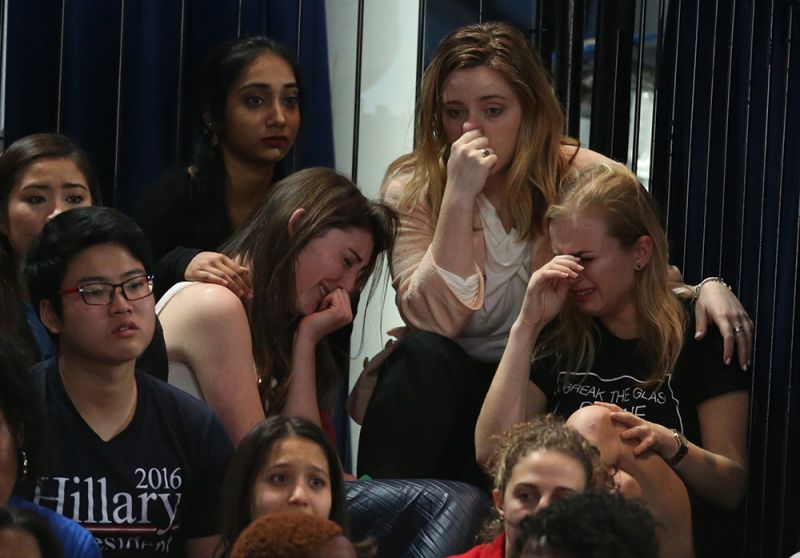
hillary-clinton-supporters-cry-over-election-loss

By Mike Cronin

Donald Trump’s victory certainly stirred up a lot of clamor and noise this week.  Let’s see if we can herd some of the cats:

  1. Democracy has failed. The people chose Hillary Clinton by 200,000 votes, but the electoral victory went to Trump. Our “democracy” cannot fail if we don’t have one, which is in fact the case. We were given a federalist republic under the rule of law. We use democratic processes for some decisions to give the people a voice, but we are not supposed to have a system of straight-up majority rule. As to the electoral vote: It remains to be seen whether any electors will “go rogue” and vote against their “pledge” on Dec 19th, but it has happened before (as recently as 2004).  Of course, it’s never been by enough margin to change the outcome of an election.  In this case, at least 38 would have to be “faithless electors” to get Clinton to 270.
  2. Trump hates immigrants. He hates Mexicans. He hates Muslims. He’s racist.  We’ll, he might. Only he knows for sure.  However, he is married to an immigrant and he has people from all walks of life working for him.  He certainly doesn’t think people should be here illegally, which is not the same thing as hating the people who are or the people who want to be.
  3. Trump is a misogynist sexual predator. His caught-on-camera crudities certainly lend themselves to this narrative. There’s little actual evidence and no credible accusers that demonstrate he hates all women or has assaulted any of them, but Trump’s verbal vulgarity in this area is one of the most troubling things about him. Still, while Trump has been caught speaking like a sexual predator might; Hillary Clinton continues to aid and abet one.
  4. Trump is going to destroy all of the progress progressives have made over the last eight years. Possibly, but presidents seldom accomplish their full agendas.  Yes, Trump will have a Republican-majority Congress, but it won’t be a super-majority, and the Republican establishment doesn’t like him.  Trump bills himself as a deal maker.  He’ll have to be to get his agenda anywhere.
  5. Trump is going to elevate nationalism over globalism. Both are euphemisms for collectivism; only the boundaries are different. Neither is as good for individuals as unfettered free market capitalism.  There might possibly be temporary beneficial effects for Americans in the shift, especially if our troops come home and small businesses can thrive again.
  6. Trump is an idiot/outsider/politically inexperienced. He certainly does not articulate himself with Obama’s grace, but he is no dummy. In fact, he’s likely quite adept at persuasion (see items five and six on this list). He is certainly gifted at getting free publicity (or at least notoriety) from the very mass-media that hates him. Also, his lack of political experience, i.e. his NOT being a career politician or D.C. insider, is one of the fundamentals that led him to get elected.
  7. What happened with the polls? They consistently gave Clinton the edge! Bottom line: garbage in/garbage out.  The pollsters drew their samples from the same body of “likely voters” they always used, and in some cases “oversampled” Democrats.  The former was neglectful and led to the Democrats believing in their own invulnerability; the latter was a nefarious attempt to convince would-be Trump voters to stay home on Election Day. Once exposed, the revelation likely caused the exact opposite effect. Either way, the pollsters failed to obtain accuracy because they could not, or would not, sample validly.  
  8. FBI Director Comey’s shenanigans (i.e. his announcements regarding the on-again/off-again investigation into Clinton’s email debacle vis-à-vis Huma Abedin’s laptop) comprised the quintessential October Surprise, and it hurt Clinton. It certainly didn’t help, but it’s much more likely that Clinton’s shenanigans hurt Clinton.
  9. Why were Clinton and Trump our candidates? What secret weapon did they employ that none of their competitors had? 30-plus years of universal name recognition.
  10. What does it mean that Republicans gained more seats in Congress, strengthening their majority? They didn’t get a super majority, so there are a few (rare) actions they would have to earn Democratic support for in order to act: Impeaching the president and overriding his vetoes are two such cases. 2. Republicans will get to shape the Supreme Court for the next generation. 3. Republicans now have an opportunity to reverse much of the Democrats’ work over the last eight years. Whether they will actually do so, or get complacent and/or get caught up with internal divisions remains to be seen.

Choosing a Beekeeper?

 hillary-clinton-and-donald-trump-face-off-ap-photos-640x480

By Mike Cronin

Today’s item is an update of “Will You Vote for a Beekeeper,” originally posted January 2, 2014.

The most basic (and most commonly employed) model of the political spectrum places Fascism (like Germany under Hitler and Italy under Mussolini) on the extreme right side of the scale, and Socialism or Communism (like the former Soviet Union or modern North Korea) on the extreme left side.  A government, a country, or a person’s political position can be gauged on this spectrum.

The problem with this model is that while the ideologies of Fascism and Communism may differ on the surface, in practice they result in the same conditions for the vast majority of people who live under them: subjugation. There may be distinctions between the two on paper, but in reality both ideologies are collectivist; that is, they espouse that the state, or the party, or the race, or the group, i.e. the collective, is more important than the individual, and that the individual exists to serve the larger group. In other words, both of these forms of politics, Communism and Fascism, treat humans like bees or ants, i.e. as drones (or slaves). The individual’s rights don’t matter (or even exist), only the party, or country (or hive/colony, i.e. collective), matters.

The achievement of the founding fathers was in creating a nation founded on the concept that the individual has rights that are inherent, that is, they are not granted by the state, and that the sole purpose of government is to protect those individual rights. The implementation of this idea was flawed, but still gave rise to a nation that brought more liberty and prosperity to more people than any other in history. One of the hallmarks of the system the founders built is the peaceful transition of power that has attended every presidential election and inauguration (save perhaps Lincoln’s).

One of our most contentious campaign seasons will culminate with the general election on Tuesday.  Consider: Whether a politician identifies as a liberal or a conservative, a Democrat or a Republican, does not matter as much as this: What does his or her character and voting record reveal about their understanding of individual rights?  Mrs. Clinton and Mr. Trump are remarkable as candidates in that each was chosen by their party seemingly on the strength of name recognition over any other factor.  (Both have been in the public eye on a national scale for 30+ years, far longer than any of the other candidates on either side.) They certainly haven’t been selected for their “sterling” personal attributes.  Will we elect one of them based solely on popularity (or notoriety)?  Can either of our candidates be considered defenders of our rights, or are we choosing between beekeepers?

5 Ways to Fight Hobgoblins

panic-button

By Mike Cronin

I often refer to H.L. Mencken’s “hobgoblins” quote: “The whole aim of practical politics is to keep the populace alarmed (and hence clamorous to be led to safety) by menacing it with an endless series of hobgoblins, all of them imaginary.” We see this every day, often with the enthusiastic pot-stirring of the main stream media.

Take today’s headlines, for example.  Rising tensions with Russia over the imbroglio in Syria. Hurricane Matthew. Gold prices. Stock prices. Jobs growth. Giving up control of the internet.  Hillary’s scandals. Trump’s crudities.  Duterte’s bombast. NFL ratings. Crazy clown sightings.

How is all of that really important? How can we ignore the hobgoblins and glean the “ground truth?”

A few rules of thumb can be useful:

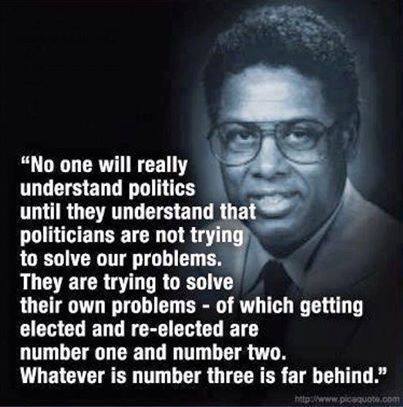
  1. Always keep Mencken’s quote in mind, together with Thomas Sowell’s observation:1931497_10156430011180515_9052930332313088412_n
  2. Get your news from a variety of sources. Journalism has evolved, or more precisely, de-volved, in the face of 24/7 cable news cycles, citizen-chroniclers, and the web.  According to the authors of Blur, the old media’s apex occurred at about the time of the Three Mile Island incident in 1979. CNN came online shortly after in 1980, and the 24/7 news cycle was born. The term spin as euphemism for truth-shaping entered the lexicon at about the same time. Consumers have had to contend with an ever more clamorous, ratings-driven media ever since. Every outlet is biased, but some do a better job of admitting what their bias is (my own, for example, is for individualism, reason, and laissez-faire capitalism) and/or mitigating for it (this reporter, for example, does a commendable job on reporting from Washington D.C. without interjecting his ideology). Alternately, check out the US news from a foreign source, such as BBC, Al Jazeera, or Xinhua.  They are biased as well, but perhaps not about the same things we are. It can be enlightening.
  3. Once the main-stream media have added unique theme music to a particular story, it’s not breaking news anymore. They are trying to turn it into a cash-cow and milk it for ratings.
  4. Most mainstream media operations lean left/liberal/progressive/Democrat, while Drudge, Breitbart, and Fox News (at least until the recent departure of Roger Ailes) tilt right/conservative/Republican – but what if both of those factions are two sides of the same coin? In order to see liberals and conservatives as opposites, you are supposed to accept a left-right political spectrum model with socialism on one end and fascism on the other. To the subjugated souls living under either, there is no practical difference. As the saying goes: All models are wrong, some models are useful.  A left-right / liberal-conservative model keeps you scared of the hobgoblins.  What if we look through a different lens? What if we put individual liberty on one end, and absolute tyranny on the other?  I contend that on such a model, “liberal” and “conservative” establishment politicians are continuously dragging us closer to the tyranny cliff, with only the flavor of tyranny at issue. Using a better model might get us closer to “ground truth.”  Who will lead us to liberty or drag us to tyranny?
  5. One kind of real hobgoblins we must watch for: luminaries with enough wattage to force the public eye to “look away.” Such wattage could come in the form of personal charm or charisma, whereby the figure is judged by their reputation instead of earning a reputation based on considered judgement (e.g. President Obama’s anticipatory Nobel Peace Prize), or via “wagging the dog” (e.g. President Johnson’s incandescent “Gulf of Tonkin” lie).


Trolling by Polling

funny_hillary_clinton_vs_donald_trump_election_postcard-ra42557157e2745d582361c25dfe3b9db_vgbaq_8byvr_630

By Mike Cronin

Now that the presidential campaign season is in full swing, we are being treated to the usual inundation of “demographic” polling results (i.e. how are “soccer moms,” Hispanics, gays, white men, etc. going to vote?)  Taken individually, as they are usually reported, the vast majority of these polls tell us nothing useful.  Piolls that tell us how a state will vote are getting closer to valuable.

Consider: This page at Real Clear Politics lists numerous polls with entries similar to this one:

Race/Topic: State X:         Poll : Qunipiac                Results  Trump 44, Clinton 38                            Spread: Trump +6

Trump is up by six points over Clinton in State X.  Sounds dire for Clinton, right?

You still might be getting “trolled.”

Regardless of how you’d like the race to go, we need to remember how presidents get elected: by winning the Electoral College vote.  The popular vote heavily influences the Electoral College, but the nature of that influence is determined by state laws. As we’ve seen as recently as 2000, it is possible to win the popular vote but lose the electoral vote and the election. In terms of polls: It means that generic surveys of this or that demographic, such as the one cited above, are almost useless by themselves for telling us how an election might go, especially in “solid” red or blue states. It makes no difference if a candidate’s poll numbers go up in a state that was already going to vote for them.  It makes a great deal of difference if a candidate’s numbers change in a battleground state with a lot of electoral votes, such as Florida or Ohio – such a shift could move electoral votes from one column to the other, perhaps enough to get to 270.

Thus, even taken in aggregate, “demographic” polls aren’t much of a barometer.  A much more instructive product would tell us how every state is currently trending, with caveats for the states (Nebraska and Maine) that are not “winner take all.”  Such a tool would give us a much better predictive assessment of the electoral college votes likely to go to each candidate.

Such a beast exists: http://www.270towin.com/. They have broken down the race several ways.  If we look at their map that “kluges” current polling data with expert forecasters’ opinions, Mrs. Clinton already has 272 votes in her camp, two more than are needed to win.  But  if we look at their chart that displays the accumulation of polling data only and omits “expert opinion,” then Clinton has about 200 electoral college votes in her camp (out of 270 needed to win), while Mr. Trump has 163.  Either situation sounds much more troublesome for him than “Trump up by six” sounds for Clinton, doesn’t it?

If “demographic” polls vice “electoral vote” polls do little to predict the outcome of the Electoral College race, why publish them? At least two possibilities come to mind:

  1. There’s nothing like stirring the pot in order to keep you tuned in and watching advertisements.
  2. To shape voters’ behavior in some way favorable to whomever commissioned the poll. Example one: Clinton’s current lead only translates to victory on Election Day if enough voters actually go to polling places and pull levers.  If you want Clinton to win, maybe you paint her as losing ground in the polls in order to generate a hint of doubt. Maybe that will motivate folks to go vote that might have stayed home if they felt comfortable she was going to win. Example two: If you want Trump to win, you might commission such a poll in order to generate enthusiasm by painting him as an underdog coming from behind and pulling ahead – a narrative that always does well in America.

Manifestly, Donald Trump still has an uphill battle.  In his best case scenario, he has to take 107 more votes and keep Clinton from gaining, while in his worst case he needs to take at least three of Clinton’s existing votes away!

Despite being much more instructive than run-of-the-mill poll reporting, even such tools as the “270towin” charts are not infallible, nor is the sentiment recorded today going to be the same on election day.  Clinton’s recent bout with “pneumonia,” clumsy messaging regarding her overall health, and “deplorable” commentary on Trump supporters certainly helped Trump’s polling tick up a bit, but did it affect the electoral vote trend?  Time will tell – and we still have to get through the “October Surprise.”

While such and event or revelation may yet upend the race, there is sure to be a battle over the next few weeks for the remaining available electoral votes. Poll results that don’t tell you how that aspect of the election is going are probably not worth your consideration.

The Land of the Free* (*terms and conditions may apply)

essay

By Mike Cronin

When asked what kind of government our new country has, Benjamin Franklin is widely quoted as stating “a republic, if you can keep it.”  Apparently we could not.  It’s almost universally accepted these days, to the point of being taught as fact in schools, that we have a democracy. Yet our Constitution outlines a republican form of government with three branches (Executive, Legislative, and Judicial) that functions with some democratic processes. (You can check this for yourself – the word democracy does not appear anywhere in the Constitution or Declaration of Independence).

Unfortunately, we’ve accumulated three additional, unofficial branches of government, and devolved so far from our Founder’s vision that we may no longer have either a republic or a democracy, but an oligarchy (i.e. a form of government where power is held by small group).

What are the three “unofficial” branches that the oligarchs use to wield power?  The donor branch, the media branch, and the education branch; all run by the so-called “elites.”

I’ve written before about the “elites” that steer this country, and you’ve probably read or heard others speak of them without really explaining the composition of the group.

Who are the elites in the United States (international elites are another subject)? They are people at the head of the three legitimate branches and the three “shadow” branches of government. In influential order:

The President of the United States: Head of State. Head of Government. Chief Executive Officer of the Executive Branch and Commander in Chief of the military. The incumbent holds possibly the most influential position in the world; certainly whoever occupies the Oval Office wields the most diplomatic influence backed by the most extraordinary military.

The donor class – the folks who provide significant funds to politicians, PACs, and campaigns and are owed favors and quid pro quos. Think George Soros, the Koch brothers, corporate lobbyists, and the like. If we could dig deep enough, we might also find drug lords and other organized crime dons in this class.

The rest of the elected politicians at the Federal level: the 535 members of Congress (the House of Representatives and the Senate), plus the vice president.

Next come political appointees: ambassadors, cabinet secretaries and other cabinet-level executives, federal judges, and military combatant commanders and the Joint Chiefs of Staff – and the emeriti of these positons – e.g. Henry Kissinger.

There is some overlap between the politicians above and the influencers in their networks. These are their fellow Ivy-League and service-academy alumni, corporate and institutional boards, bank chairmen, media moguls, etc.

Perhaps at the bottom rung of the elites are the folks who try to influence us more directly. This group is largely composed of the academic and think-tank intelligentsia and “on-air talent” in the mainstream media.

Perhaps not really elite, but still somewhat culpable for the direction of our country: The entrenched bureaucrats just below the political appointee level. They provide institutional continuity across multiple administrations – and they are largely not accountable. Not because they don’t “report” to anyone, but because it’s so damn hard to fire someone in the Federal government, and because they can just outlast the appointed bosses that can fire them.

Altogether, I estimate that there are perhaps as many as 300,000 to as few as 30,000 people running our country of 300,000,000+ people.  What would you call a form of government where perhaps 1/1000th to 1/10,000th of the population holds almost all of the power?

The Battle Begins. How Will you Fare?

trump-clinton

By Mike Cronin

Barring a “black swan” event, the race for president is down to Trump vs. Clinton.  Who will you vote for, and why?  Will you even vote?  Will your vote matter?

There are so many marginal factors that can shape an election, but there are some basic election fundamentals that seldom get explained.

First: From 1932 to 2012, the average voter turnout has never been higher than 63% or less than 49%.  That means on average only a little over half of the eligible population votes in any given presidential election.  Of the half that votes, roughly 32% are dyed-in-the-wool liberal Democrats and will always vote for the Democrat candidate.  Roughly another 22% of the half that votes is comprised of hard-core conservative Republicans who will always vote for the Republican candidate.  These groups are the “base” for a given candidate/party.  Once you exclude the 54% of voters that are going to automatically vote D or R in any given election, the real battle takes place over the remaining half of the half of Americans who are going to vote. Expressed another way: Presidential elections hinge on the lever pulls of slightly less than 25% of the adult population!

It gets better.  Where those 25% reside is crucial.  If a majority of them reside in states that are overwhelmingly likely to vote a certain way, their votes aren’t going to mean very much.  Conversely, if the bulk of those independent voters reside in states that could go either way (the so-called battleground states), their votes could wield enormous influence!

Are you one of the independents or third party members who vote but don’t blindly punch holes for any party’s candidate (or against the other party’s!)?  Where do you live?  Will your vote count?

If you are, how will you make your decision? Party loyalty isn’t your thing, so what does it for you?  Unfortunately, some will waste their votes on frivolous criteria such as the looks, race, or gender of the candidate, or on candidate’s oratorical prowess.

To do justice to our system and not waste my vote, I’ve developed a small list of criteria that I can rate each candidate against using a survey technique called a Likert scale.  Here it is:

Rate each candidate on how you believe they would:

Honor the Oath of Office and abide by the Constitution & the laws of the land Fail Marginal Mediocre Good Exemplary
Appoint Supreme Court Justices that will uphold the Constitution Fail Marginal Mediocre Good Exemplary
Command the armed forces and employ military force only to counter serious threats to the United States Fail Marginal Mediocre Good Exemplary
Act with integrity & honesty, and demonstrate character Fail Marginal Mediocre Good Exemplary
Govern transparently Fail Marginal Mediocre Good Exemplary
Reduce dysfunction and corruption in the Executive Branch Fail Marginal Mediocre Good Exemplary
Work to reign in government spending, promote capitalism and demonize socialism Fail Marginal Mediocre Good Exemplary
Work to audit, and possibly end, the Federal Reserve Fail Marginal Mediocre Good Exemplary
Work to end, or at least lessen and simplify, the income tax Fail Marginal Mediocre Good Exemplary
Overhaul the immigration system to allow maximum freedom to enter and remain in the country  consistent with preventing criminals, terrorists, and other bad actors in and without yielding an automatic electoral advantage to any party Fail Marginal Mediocre Good Exemplary

Obviously, you might prefer different criteria than what I’ve settled on, but whatever thoughtful criteria you select can still work.  Once you establish your criteria and rate each candidate, score them thus: 1 point for each Fail, 2 points for each Marginal, 3 points for each Mediocre, 4 points for each Good, and 5 points for each Exemplary. Total up the scores and vote for the candidate that earns the highest marks.

Still, there is at least one other major contextual factor that is seldom examined during presidential elections: Congress.  We can elect a president based on the most cogent criteria, but if he or she must deal with a Congress skewed to the opposing party, it is likely they will face high resistance to carrying out their plans or their mandate.  Even if he or she gets to work with a same-party Congress, your candidate could still find it hard to make headway if, like Donald Trump, they come from outside the beltway political establishment.

There is a simple (not easy!) fix to that: Help your presidential candidate get a sympathetic, same-party Congress to work with!


An Open (and Polite) Letter to the Gun Control Faction

8bebecd597872e534de0571c151cfe92

By Mike Cronin

Here’s my take on the bitter firearms dispute vitiating our country. I offer my commentary without vitriol. No contempt. No condescension. No name-calling, baiting, or inflammatory rhetoric; just exposition.

Obviously, we have a fundamental philosophical difference.  I don’t know, but I suspect that your apprehension over firearms is energized by a belief that it is the government’s responsibility to protect the citizenry from harm, and that you see firearms in private hands as a huge threat, especially given horrific mass shootings.  Ergo, the government should further regulate firearms or ban them outright. If I am articulating it wrong, please correct me.

I can’t speak for every pro-gun rights person, but I suspect most of us subscribe to a quite different interpretation of the government’s duty to protect us than you do.  I see it like this:  All of us have the inherent right to defend ourselves from immediate violence.  It would be nice if there were always a police officer around to intercede on our behalf, but that’s just not feasible, so we compromise.  We retain the ultimate individual right to self-defense, but we delegate the right to retaliate after the fact (via impartial criminal prosecution and punishment) to government.

So far, you may not see a large gulf between our positions.  Yet there is a significant one:  It is my position that the right to self-defense is absolute.  By that I mean that I have the right to defend myself from ANY initiation of violence (or the imminent threat of same) from ANY initiator – up to and including government agents, should they act in the absence of due process or turn overtly tyrannical.  A shotgun or revolver is hardly proportional to such a threat. Since our own government, should it turn tyrannical, and the forces of other governments, should they unwisely choose to invade this country, possess weapon systems of devastating destructive power, it is more than reasonable for a free individual to possess mere firearms to stand in opposition, even if such opposition must take the form of a covert insurgency. It is reasonable that a free person possess firearms identically lethal to those his oppressors routinely bear.

Does that mean I think private individuals should be able to go down to “Booms-R-Us” and buy guided missiles and tanks and chemical weapons?  In the absence of a better argument, I’ll accede to this principle: the more indiscriminate a weapon is, the harder it should be for anyone to obtain.  That principle is already largely in effect. Regardless of anybody’s desire, there is no “Booms-R-Us” to go to in this country. Even if I wanted to, I couldn’t legally buy a grenade, landmine, or bomb as a private citizen without an enormous amount of oversight, if at all. Conversely, hand-held firearms currently legal for possession are discriminate enough that law-abiding individuals should not be further barred or banned from buying and possessing them, regardless of militarized appearance, magazine capacity, fire rate, trigger function, or other minutiae, or whether some sociopath or jihadist has used one to commit mass murder.

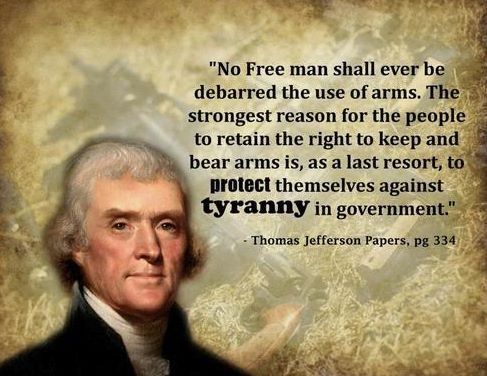
There has been, and will continue to be, all manner of legal wrangling over the exact meaning of the oddly-phrased Second Amendment within the bounds of “the letter of the law.” However, the Founders made the spirit and intent clear in their other writings.  The Second Amendment does not primarily protect the right to hunt or compete at the skeet range, that protection is a byproduct.  It protects the individual right to self-defense. (Don’t take my word for it; the Supreme Court has said as much in D.C. vs. Heller.) A populace that can assassinate tyrannical leaders and their henchmen and fight a well-equipped guerrilla war against its oppressors is a populace that will not be easy to subjugate. The purpose of the Second Amendment is to guarantee that America has such a populace.

If we look at our positions from a purely logical standpoint, I posit that we are arguing from different premises: The pro-gun rights argument rests on the premise that individuals have an inherent and inviolate right to self-defense, and that our government is obligated by the Second Amendment to protect that right through non-infringement on keeping and bearing arms. If I have not misread the argument for the gun control faction, your premise is that government’s obligation to protect our rights gives it (or should give it) the purview to limit the potential for anyone to cause harm.

I contend that the more power you give to the government to prevent anyone from causing harm, the more pathological personalities you will attract who seek to wield that power…to cause harm!  Eventually, you will get a card-carrying totalitarian who will turn the United States into a Venezuela or an Iraq, or worse. The alternative is to accept some risk with your freedom: occasionally, a nut with a rifle will kill a bunch of innocent people.  The proper mitigation to both threats: A populace that can shoot back!

Storm Warning: Orlando

06132016_Orlando_Shooting_Police_Response

By Mike Cronin

There are many aspects to the tragedy in Orlando that defy reason, but we may yet be able to put many of the chaotic elements into context and derive some small degree of understanding.

Keep in mind the following as you watch the news and listen to the pundits and demagogues:

As we’ve discussed elsewhere, the news networks’ primary job is to sell advertising. They will dwell on every aspect of this story as long as they can in order to keep you coming back to watch commercials find out the latest breaking wrinkle.

The anti-gun fanatics will exploit our fears in order to advance their agenda to ban ___ (take your pick of anything gun or gun-related).  They’ll be sure to shout that this was the worst shooting in US history.  That might be true if you discount several massacres of Native Americans and the Civil War; I don’t know.

Pro-gun zealots will exploit the fear that the left is coming to take our freedom. They will jump up and down to expose every error the anti-gunners make about the specific gun used, how it was obtained, and about how it is already illegal to have a firearm inside a place that serves alcohol in Florida, so gun bans demonstrably don’t work.

Strident religious groups will be in a hurry to tell us that what happened in Orlando was God’s punishment for the sinful behavior of the club’s clientele.  In fact, one such group, ISIS, took credit for the attack!

Let’s try to unscrew ourselves from the ceiling a bit and put some more context to this storm:

Was it the worst mass-shooting in US history?   Ever hear of Bear River (~250 dead), Sand Creek (up to 163 dead), or Wounded Knee (150 dead)? They were but three of dozens of massacres of Native Americans committed in the 1800s.  How about the various battles of the Civil War (~600,000 dead)? (Granted, some might say those events don’t count because they weren’t “crimes” or terrorist attacks; instead, they were (directly or indirectly) government operations. I think that not only do they count, they exemplify the very reason we must not give up the right to keep and bear arms!)

Was it the worst terrorist attack on US soil? No; that was 9/11. (~3000 dead).

Surely it was the worst domestic terrorist attack?  Nope. That dubious title goes to the Oklahoma City bombing. (168 dead)

Nor was Orlando the worst nightclub attack; that distinction belongs to the “Happy Land” club arson fire in the Bronx in 1990 (87 dead).

It does look like Orlando might actually be the worst attack on the LBGT community; though there was an attack nearly as bad in 1973: 32 were killed at the “Upstairs Club” arson attack in New Orleans.

To like-minded folk that believe the second amendment is under attack and should not be infringed upon any further:  Yes, the anti-gunners will shamelessly exploit mass shootings.  We don’t need to follow their example and squawk and honk at each inaccuracy or inane statement made while the tape is still around the crime scene and the blood is still on the floor.  Those rounds are largely wasted.  Save them for the letters to the editor and to your politicians.  Let the anti-gunners make their mistakes in the heat of the moment.

As for the religious condemnation: If you believe Jesus was the son of God, then ask yourself: what would Jesus do?  Would he kill homosexuals?  Would he add salt to their wounds after such a tragedy by saying they were killed because they were sinful? Most especially, would he do that just to get attention? If he wouldn’t do those things, it might be wise to follow his example.

If you are a radical Muslim jihadist, I know that nothing I write here will sway you in any way. Even so, I must say it. If you purport to be a devout member of the so-called religion of “peace,” what is peaceful about slaughtering people whose behavior you don’t approve of, either here or in Syria, or Iraq, or the rest of the world where Islam holds sway?

If ISIS was indeed ultimately behind this attack, what have you gained? All you have accomplished is to show your clients and constituents that one jihadi with a gun and a lot of ammo can kill a lot of unarmed people.  And….what? Is this supposed to terrify us? We are not terrified. Is it supposed to gain you recruits?  You’ve caused just as many, or more, to deplore your cause.

We live in an era with instant news and constant competition for our attention. We are in the middle of one of the most contentious election cycles in recent memory. We are in a shooting conflict with ISIS. The Orlando massacre served as a catalyst to energize a storm of bloviating. We can let it die down a bit so we can hear ourselves think before making hasty conclusions.

A Matter of Perspective

XocKd

By Mike Cronin

No doubt you know that the sun rises in the east and sets in the west once every 24 hours.  It has done so for billions of years and will continue to do so for billions more.

Fact: The sun rises and sets about 16 times per day.

Fact: The sun rises and sets once every two weeks.

Fact: The sun doesn’t rise or set at all.

All of these facts are true.  How can that be?

Each is true from a certain perspective – and false from other perspectives.  The first is true from the perspective of people on the earth’s surface.  The second is true from the perspective of an astronaut onboard the International Space Station.  The third is true from the perspective of an astronaut on the surface of the moon.  The last is true from the perspective of the sun itself.

Perhaps you’ve heard it said that in so-and-so’s world, XYZ is quite different than in your world. Maybe you were taught to think of Western Europe, the US, the British Commonwealth, and Japan as the “first” world, and places like Haiti, Somalia, and Afghanistan as examples of the “third” world. Yet we all live on the same planet, so how can we be living in different worlds?

The first, second, and third worlds aren’t really separate worlds; they just appear that way from certain perspectives.  Sometimes using such metaphors can be useful in helping us frame our understanding of the actual world; sometimes the metaphors become euphemisms and are used to evade harsh truths.

For example: Haiti is the poorest, least-developed country in the western hemisphere.  It occupies part of an island called Hispaniola; the remainder of the island is taken up by the Dominican Republic. Compared to Haiti, the Dominican Republic is doing well. Some folks who call Haiti a failed state and a third-world country may be setting a scene or weaving a narrative (i.e. depicting things from a certain perspective) in order to ask you for donations to help the poor souls that live there.

Such people may mean well, but the solution to Haiti’s troubles probably depends on understanding things from a more difficult perspective.

Consider this: The 2010 earthquake that struck Port-au-Prince (Haiti’s capital) was followed less than a month later by an even more powerful earthquake in Chile.  Both earthquakes caused about the same amount of destruction in terms of the value of the property destroyed, yet the death tolls were staggeringly different.  In the Haiti quake, nearly a quarter of a million people lost their lives.  In the Chilean quake, the death toll was three orders of magnitude smaller. (A little over 500 people died).

Why was there such a vast difference between the two? How can a more powerful earthquake cause far less loss of life, but the same amount of property damage?

In Chile, there are building codes, insurance, robust first response capabilities, adequate hospitals, and property rights. In Haiti there are not. The property damage was the same from the perspective of cost, but vastly different from the perspective of number of buildings destroyed.  In Haiti, a good portion of the buildings in Port-au-Prince collapsed outright, including the president’s palace.  In Chile, many buildings suffered damage that will be expensive to fix…but far fewer buildings actually collapsed – because most were built to code to withstand earthquakes.

haiti palace

The Haitian presidential palace after the 2010 earthquake.

Why did Chile have those benefits and not Haiti?  Because for most of its history, Chile has given at least some recognition to the concept of individual and property rights.  Chileans had incentive to achieve and build and protect their investment.  Haiti, though its existence as a nation is essentially the result of a slave rebellion, never really adopted the concepts of individual freedom or property rights.  It has been ruled by a series of thugs, some worse than others, who would simply take what they wanted.

The harsh truth in the more difficult perspective: Sending aid to Haiti may help some Haitians stave off the reaper a little longer, but no amount of aid can help the Haitians adopt a philosophy of recognizing and respecting rights.

Understanding that a difference in perspective can be trivial (as in the case of knowing astronauts see 16 sunrises per “day”) or pivotal (as in the case of sending aid to Haiti), and how differing perspectives might be compared or judged against each other, is a critical skill to develop – one many of our elected leaders have failed to acquire.

Issues, Symptoms, and Oreos

By Mike Cronin

Most of the issues in the presidential debates are not issues at all but symptoms. How so? Let’s take an example: illegal immigration.

The real problem isn’t that the United States is racist and doesn’t want so many people coming into our country. It’s that the flood of people coming into this country illegally is a signal that other things are broken.  The mass of immigrants perceive the United States to be a better place to live and work than wherever they are from. In other words, their incentives to come here are greater than their incentives to stay home. That has always been the case with immigration to the United States. What has changed is the nature of the incentives.

Through much of the 19th and 20th centuries, the incentive to immigrate to United States was the opportunity to be free to work hard, own property, and succeed.  From the latter part of the 20th century to the present, that incentive has been morphing. There is still an incentive to come here to be free and succeed, but another incentive has been steadily taking the place of that original one.

The new incentive is to come to the United States and take part in the bounty of government benefits and handouts that we bestow on a significant portion of our population. Free K-12 education. Subsidized housing.  Free or subsidized medical care. Relatively high paying jobs (even jobs that pay immigrants less than minimum wage under the table may be paying them more than they could get in their own country.) Low risk of being deported.   Even the possibility of voting. Why stay at home and live in absolute poverty, when you can come to America and upgrade to relative poverty and dependence on Uncle Sam?

A related symptom is corporate off-shoring and outsourcing. Even as immigrants are poring in to find a better life here, companies that send jobs or work outside the United States are vilified as unpatriotic. But why do they send these jobs outside the United States? Does it have anything to do with patriotism?

Could it instead be because government interference and manipulation have incentivized them to outsource, just as it has incentivized illegal immigration?

Image result for oreo to Mexico

Consider the Oreo case.  Donald Trump vowed last year not to eat Oreos ever again because of reports that Nabisco’s parent company moved 600 jobs from Chicago to Mexico in order to lower labor costs.  What the reports left out of the equation is that the marginal tax rate and a key product ingredient (sugar) are also cheaper in Mexico than in the US.  Think about that.  A company moved 600 jobs to Mexico because operating conditions are more conducive to profitability there than they are here, the original business-friendly nation!

So what is the disease?  Government interference in the market, namely via ham-handed manipulation of incentives.

Government tells companies who to hire (Affirmative Action), how much to pay them (minimum wage), charges payroll taxes, Social Security taxes, and corporate income taxes. Government requires businesses, and many professionals, to have licenses, and it regulates everything. It makes raw materials, parts, and other materials more expensive by applying the same kinds of interference to suppliers and other business partners.  The costs of all of this are either absorbed out of company profits, or passed on to the consumer, and it drives companies to go elsewhere to do business, which kills jobs here.

In effect, our own politicians  drive unskilled and low-skilled jobs out even as they lure unskilled  and low-skilled laborers in! This drives companies to move entire production lines out, or to hire illegal immigrants and pay them under the table.  It puts drag on the entire economy with excessive regulation, excessive taxes, and excessive interference – then the politicians call the companies unpatriotic for wanting to escape.

Might the politicians be a few cookies short of an Oreo?